Moulin Rouge! Lyrics – All Songs from the Musical
Moulin Rouge! Lyrics: Song List
- Act 1
- Welcome to the Moulin Rouge!
- Bohemian Ideas
- Truth, Beauty, Freedom, Love
- The Sparkling Diamond
- Shut Up and Raise Your Glass
- Firework
- Your Song
- So Exciting!
- Sympathy For The Duke
- Nature Boy
- Elephant Love Medley
- Act 2
- Backstage Romance
- Come What May
- Only Girl In A Material World
- Chandelier
- El Tango De Roxanne
- Crazy Rolling
- Your Song (Reprise)
- Come What May (Reprise)
- More More More!
- Additional Songs
- Lady Marmalade
About the "Moulin Rouge!" Stage Show
Release date: 2019
"Moulin Rouge! The Musical" – The Musical Guide & Song Meanings
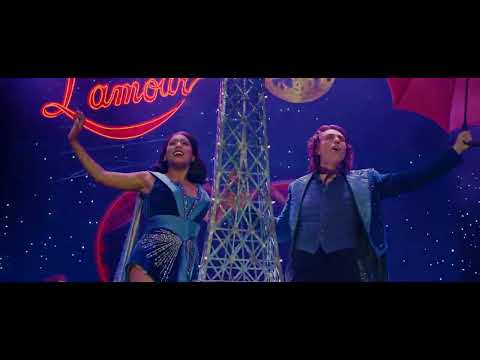
Review: a love story built out of borrowed sentences
Can a jukebox score make you believe in a doomed romance when the words were written for other people, other decades, other radio formats? Moulin Rouge! The Musical answers with pure confidence: yes, if you treat lyrics like weapons, not wallpaper. The show’s defining move is the “argument-as-medley” structure. Characters don’t just sing feelings. They cross-examine each other with famous lines, quoting pop culture the way lovers quote old fights.
The core theme is the bohemian credo, “truth, beauty, freedom, love,” and the text keeps testing whether those words are lived values or marketing copy. Christian’s language is idealistic, sometimes embarrassingly so. Satine’s is transactional, until it isn’t. The Duke’s lyrics land like a purchase order. That tension is why the mashups work when they work: the audience already knows the lines, so the writers can focus on collision and subtext, letting recognition do part of the storytelling labor.
Musically, this score behaves like a club night curated by a dramatist. It shifts from champagne-pop spectacle to stripped-down confession without asking permission. The style means character psychology is often “revealed” by contrast: a glossy hook becomes sad when it’s placed under threat; an anthemic chorus becomes claustrophobic when it’s sung in a dressing room. Listener tip: if you want to follow plot through the soundtrack, track the Act I to Act II hinge. The show tells you exactly when the fantasy starts to curdle.
How it was made
The Broadway version sharpened the film’s concept into a theatre engine: a book by John Logan, direction by Alex Timbers, and a music architecture overseen by Justin Levine, whose supervision and arrangements turn a pile of hits into scene-by-scene argument. The most revealing origin story is about craft, not celebrity. For the Broadway “Elephant Love Medley,” Levine reportedly printed lyrics, cut them up, and recombined them like a physical collage, building a love debate out of love songs and anti-love songs. It is the rare mashup method that sounds exactly like its process.
Baz Luhrmann, the film’s director, also stepped into the cast-album process in a hands-on way, producing the recording and pushing the leads to treat the studio like a scene partner, not a souvenir shop. Even the licensing limitations became dramaturgy: the Beatles can be referenced, but not sung, which turns certain lines into spoken pressure points rather than melodic catharsis.
Key tracks & scenes
"Welcome To The Moulin Rouge!" (Zidler, Satine, Company)
- The Scene:
- The theatre turns into a nightclub. Red light hits first, then the room “opens” like a curtain made of neon and velvet. Zidler conducts the chaos as the cancan detonates around him.
- Lyrical Meaning:
- This is the show’s thesis statement: pleasure as policy. The lyrics sell permission, not just sex, and they teach the audience how to watch the evening, loudly.
"The Sparkling Diamond" (Satine)
- The Scene:
- Satine arrives as an event. Spotlights chase her like paparazzi. The staging treats her entrance as a product reveal, complete with poses that dare the crowd to blink.
- Lyrical Meaning:
- The “diamond” language is self-protection. She is turning herself into an object before anyone else can do it for her. The wordplay is flirtation with armor underneath.
"Firework" (Satine)
- The Scene:
- Backstage ambition, staged as public spectacle. The lighting blooms outward, as if the club itself is pushing her toward the sky.
- Lyrical Meaning:
- In pop form, it’s empowerment. In this plot, it’s a warning label: self-belief arrives right next to a countdown clock.
"Elephant Love Medley" (Christian, Satine)
- The Scene:
- Inside Satine’s elephant-shaped dressing room, Christian tries to talk her into love. The room feels private, but the music keeps bursting the walls, as if the whole century is eavesdropping.
- Lyrical Meaning:
- This is a love debate built from quotations. Christian argues in declarations; Satine counters with distrust. The medley lands because each borrowed line becomes a chess move in a new game.
"Backstage Romance" (Santiago, Nini, Company)
- The Scene:
- Heat and jealousy in a corridor that feels too narrow for the bodies inside it. Strobes and silhouettes turn flirtation into combat.
- Lyrical Meaning:
- The mashup makes desire look dangerous, not cute. It reframes familiar hooks as evidence of obsession, appetite, and power plays.
"Chandelier" (Zidler, Company)
- The Scene:
- An absinthe-party spiral staged like a carnival ride. Bodies swing, the beat lurches, and joy starts to look like self-erasure under bright light.
- Lyrical Meaning:
- The lyric’s bravado reads as escape, then as panic. In context, the song is the club’s coping mechanism, turned up until it hurts.
"El Tango De Roxanne" (Christian, Company)
- The Scene:
- A jealous hallucination. The tango slams into the stage with hard angles and hot shadows, like a blade dance lit from below.
- Lyrical Meaning:
- Christian’s romantic language collapses into possession. The famous “red light” refrain becomes a moral accusation he can’t actually sustain.
"Crazy Rolling" (Christian, Satine)
- The Scene:
- A breakup argument that keeps reloading. The lighting cools, the tempo tightens, and the lovers start sounding like they’re quoting their worst selves.
- Lyrical Meaning:
- The mashup turns heartbreak into escalation. It is the show admitting that pop romance often teaches people the wrong script for conflict.
Live updates 2025/2026
Information current as of January 2026. On Broadway, Moulin Rouge! The Musical continues at the Al Hirschfeld Theatre, with the official show site listing Meg Donnelly as Satine and Christian Douglas as Christian. The production has also booked a high-profile limited engagement for Harold Zidler: Bob the Drag Queen is scheduled to play the role from late January through March 2026, as noted by Broadway ticketing coverage and recent press profiles.
In London, the West End production at the Piccadilly Theatre is on sale well into 2026, with major ticketing outlets listing performances through late July 2026 and public-facing entry prices that start at budget-friendly levels depending on date and inventory. Separately, the touring ecosystem is still active: Playbill reported late-2025 changes to the North American tour cast, and the IBDB tour listing shows continued 2026 stops across multiple cities.
Viewer tip for seats: this is a design-heavy show. If you care about facial acting and micro-comedy, choose closer center sections. If you care about the full cancan geometry and lighting patterns, mid-house gives you the cleanest picture.
Notes & trivia
- The show’s score contains more than 70 songs and is built around medleys, a structural choice that turns recognition into plot momentum.
- The “Elephant Love Medley” is staged in an elephant-shaped dressing room, and the Broadway version expanded the concept into a longer, more combative lyric collage.
- For the Broadway medley, the music team used a literal cut-and-reassemble approach to lyrics during development, treating text like editable material rather than sacred artifact.
- Licensing constraints shaped creative choices: certain Beatles references can be spoken but not sung, which changes how those moments land theatrically.
- London design scale is part of the brand: press coverage of the West End build cited 14 sets, roughly 200 costumes, and tens of thousands of crystals.
- The cast album was released digitally in 2019, with later physical formats following, and the recording credits include Luhrmann and Levine among the producers.
- Song order is unusually “plot-legible” for a jukebox show: Act I ends on “Elephant Love Medley,” while Act II opens with “Backstage Romance,” making the turn from fantasy to consequence hard to miss.
Reception then vs. now
In 2019, a lot of critics wrote some version of the same sentence: the plot is thin, the energy is real. Over time, that divide has become the show’s most honest feature. If you go in wanting tidy psychological realism, you may find the romance schematic. If you go in wanting a pop opera that moves at nightclub speed, the lyric strategy becomes the point: familiarity is the engine, and context is the rewrite.
“A glitzy, silly stage version… glides thanks to its infectious energy.”
“Makes a good case… as the Great American Musical for the TikTok generation.”
“Their lyrics and melodies resonating audibly in ingenious new contexts…”
Quick facts
- Title: Moulin Rouge! The Musical
- Year: 2019 (Broadway opening)
- Type: Jukebox musical; pop mashups and medleys
- Book: John Logan
- Director: Alex Timbers
- Choreography: Sonya Tayeh
- Music supervision / orchestrations / arrangements & additional lyrics: Justin Levine
- Scenic design: Derek McLane
- Costume design: Catherine Zuber
- Lighting design: Justin Townsend
- Sound design: Peter Hylenski
- Selected notable placements (song-to-story): Act I closes on “Elephant Love Medley”; Act II opens on “Backstage Romance”; the jealousy spiral peaks with “El Tango De Roxanne”; the final statement is “Finale (Come What May)” followed by an encore.
- Original Broadway Cast Recording: Released digitally Aug 30, 2019; credited to Original Broadway Cast; label and rights holders include RCA and production entities noted on major streaming metadata.
- Availability: Widely available on streaming platforms; commonly packaged around 19 tracks with extended medleys.
Frequently asked questions
- Is “Come What May” original to the stage musical?
- No. It originates from the 2001 film and functions as the story’s emotional centerpiece in the stage version too, including its placement in Act II and the finale structure.
- How many songs are in the show, and why so many?
- The show includes more than 70 songs, mostly through medleys. The high count is the point: characters argue, flirt, and threaten each other using recognisable lyric fragments.
- What is the clearest “starter pack” of songs if I am new?
- Try these in order: “Welcome To The Moulin Rouge!,” “The Sparkling Diamond,” “Firework,” “Elephant Love Medley,” “Backstage Romance,” “El Tango De Roxanne,” “Crazy Rolling,” “Finale (Come What May).” That arc tracks the plot turn.
- Is the Broadway show still running in 2026?
- Yes, as of January 2026 it remains on Broadway at the Al Hirschfeld Theatre, with ongoing casting updates announced through major theatre outlets and the official show site.
- Is the West End production still on sale?
- Yes. Major London ticketing lists the Piccadilly Theatre run through July 2026, and the production continues to promote the show with current trailers and on-sale calendars.
- What is the big difference between the stage score and the film?
- The stage version expands the soundtrack with many post-2001 hits and restructures songs into theatrical medleys, so lyrics function more like dialogue than standalone numbers.
Key contributors
| Name | Role | Contribution |
|---|---|---|
| John Logan | Book | Shaped the film’s romance into a stage plot that can support rapid-fire medleys and clearer act breaks. |
| Alex Timbers | Director | Built the production’s nightclub pacing and made the audience complicit in the party, then in the hangover. |
| Justin Levine | Music Supervisor; Orchestrations; Arrangements; Additional Lyrics | Turned pop quotations into dramatic argument, including the show’s signature medley architecture. |
| Sonya Tayeh | Choreographer | Defined the movement language that makes the club feel dangerous, athletic, and relentlessly present-tense. |
| Derek McLane | Scenic Designer | Delivered the headline visuals: a theatre transformed into Montmartre fantasy, including the iconic elephant room. |
| Catherine Zuber | Costume Designer | Created the show’s high-glam silhouette vocabulary, balancing period reference with pop-star impact. |
| Baz Luhrmann | Producer (cast recording); original film director | Guided the cast album process and helped translate the film’s mashup logic into a Broadway recording identity. |
Sources: Official Moulin Rouge! The Musical (New York) site; Official UK site and Piccadilly Theatre/ATG ticketing; Ticketmaster; The New Yorker; Playbill; IBDB; Broadway.com; Slant Magazine; The Guardian; Chicago Sun-Times; The Stage; Apple Music/Spotify metadata.