
Million Dollar Quartet Lyrics: Song List
- Blue Suede Shoes
- Real Wild Child
- Matchbox
- Who Do You Love?
- Folsom Prison Blues
- Fever
- Memories Are Made Of This
- That's All Right
- Brown Eyed Handsome Man
- Down By The Riverside
- Sixteen Tons
- My Babe
- Long Tall Sally
- Peace In The Valley
- I Walk the Line
- I Hear You Knockin'
- Party
- Great Balls of Fire
- Hound Dog
- Ghost Riders
- See You Later, Alligator
- Whole Lotta Shakin' Goin' On
About the "Million Dollar Quartet" Stage Show
Musical’s script developed by F. Mutrux & C. Escott. Lyrics & music were created by various authors. Arrangement is by C. Mead. The premiere of the show took place on the stage of Florida Seaside Music Theatre. The show took place from November to December 2006. From September to October 2007, show could be seen at the Village Theatre stage. In January 2008, production took place in the city of Everett, Washington State.
Since the end of September 2008, at Chicago's Goodman Theatre stage was limited musical show. Directed by F. Mutrux & E. Schaeffer. Then the show was transferred to Apollo Theater, where it was held from October 2008 to January 2015 with more than 2,500 performances. This musical was the third for the duration of the shows in the history of Chicago theatres. Production involved: R. Lyons – C. Perkins, L. Guest – J. Cash, E. Clendening – E. Presley, L. Kreis – J. L. Lewis, B. McCaskill – S. Phillips, K. Lamont – Dyanne, C. Zayas – J. Perkins.
Broadway premiere took place at the Nederlander Theatre’s stage in April 2010. The last show was held in June 2011 and survived through 489 performances. Director was E. Schaeffer. In the musical participated: E. Clendening, L. Guest, L. Kreis, R. B. Lyons and others. Off-Broadway production was shown at New World Stages from July 2011 to June 2012. In 2011 the American tour of the musical started.
Canadian production was at the Chemainus Theatre Festival stage from February to March of 2016. In the show participated: A. Baerg, D. Kosub, M. Bjornson, J. Shandel and others. The London production took place in Noël Coward Theatre – from February 2011 to January 2012. The performance included cast of: M. Malarkey, B. Goddard, D. Hagen & R. B. Lyons. Broadway production was nominated for 3 Tonies (and received another 1 win) and for the Drama Desk.
Release date of the musical: 2010
"Million Dollar Quartet" – The Musical Guide & Song Meanings
Review
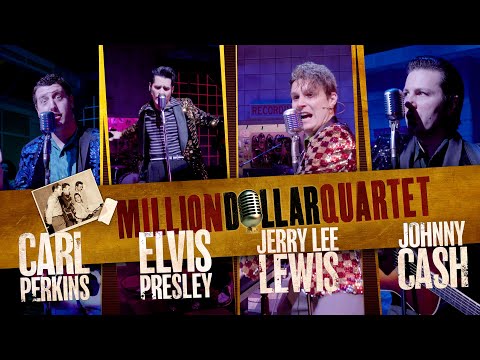
The pitch sounds like a souvenir T-shirt: put Elvis, Cash, Perkins, and Jerry Lee in a room and let the hits do the work. The surprise is that Million Dollar Quartet keeps poking the bruise under the nostalgia. It is a story about ownership. About faith. About a music business that sells “family” while quietly moving the money to the person who signed the paper.
The lyric-writing is borrowed, of course. That is the point. These songs arrive with baggage: bragging rights, guilt, church, lust, and the kind of piety that can double as a career move. What the book does well is treat each “classic” as dialogue. When Carl Perkins leans into a line about shoes, it is not fashion. It is authorship. When Johnny Cash sings about restraint, it reads like a man trying to behave his way into a future.
Musically, the show lives at the crossroads where gospel harmony meets rockabilly bite. That mash-up is not just a playlist. It is character. Jerry Lee’s piano is pure combustion. Elvis is charisma with a tremor of self-awareness. Perkins is the craftsman watching his craft get franchised. Cash is the moralist who knows the sermon will not pay the rent.
Viewer tip (because this show is about fingers as much as voices): if you can, sit close enough to see the fretwork and the pedal action. A mid-orchestra seat often beats the back of the room here. The acting is in the playing, not the facial close-ups.
How it was made
Million Dollar Quartet was created by Floyd Mutrux and Colin Escott, using the famous December 4, 1956 Sun Records gathering as its frame. The show’s central craft choice is to compress a messy cultural moment into a single-room pressure cooker. That makes the evening feel like a live recording session with interruptions: egos, debts, religion, romance, and Sam Phillips steering the ship with a grin that occasionally curdles.
The title itself has a better origin story than most musicals get. It traces back to a Memphis newspaper photo caption and a columnist’s punch line about what that “quartet” could sell. The musical takes that accidental branding and turns it into theme: a night that becomes myth because myth is profitable.
And yes, the show invents, edits, and dramatizes. That is not a flaw; it is the contract. If you came for documentary accuracy, you are in the wrong building. If you came to watch how fame metabolizes other people’s work, pull up a chair.
Key tracks & scenes
"Blue Suede Shoes" (Carl Perkins / Company)
- The Scene:
- Sun Studio is “open for business.” Guitars come out. The room turns into a proving ground. Light is bright, practical, and unromantic, like a workplace that happens to make history.
- Lyrical Meaning:
- It is a brag, sure. It is also a copyright claim in three chords. The song’s swagger becomes Carl’s way of reminding everyone: this is mine before it is yours.
"Matchbox" (Carl Perkins)
- The Scene:
- Perkins is in working-musician mode, trying to cut the track while the day keeps getting hijacked. The energy is controlled, tight, and a little resentful.
- Lyrical Meaning:
- The lyric is small-scale survival talk. In this show, it reads as class friction: the guy who built the sound watching richer, louder personalities take the spotlight.
"Folsom Prison Blues" (Johnny Cash)
- The Scene:
- Cash steps into the mic with the calm of a man who knows the room will listen. The lighting tends to narrow, subtly, because Cash’s world is a corridor: choices, consequences, and the romance of self-control.
- Lyrical Meaning:
- It is not confession, exactly. It is posture. The lyric is Cash trying on adulthood, testing whether discipline can be a persona and a shield.
"That’s All Right" (Elvis Presley)
- The Scene:
- Elvis arrives like weather. The room temperature changes. The staging usually gives him space, then fills that space with everyone else’s reactions.
- Lyrical Meaning:
- The lyric is dismissal on paper. In context, it becomes Elvis’s coping mechanism: keep it light, keep it moving, never stay on the line that hurts.
"Fever" (Dyanne)
- The Scene:
- Suddenly the studio feels like a nightclub. The band drops into a slow burn. Light shifts warmer and lower, as if the room is flirting back.
- Lyrical Meaning:
- “Fever” is desire as performance, which is why it lands here. The show uses it as a reminder that charisma is currency, and everyone in the room is paying attention.
"Walk the Line" (Johnny Cash)
- The Scene:
- Cash tries to anchor the chaos. It plays like a promise made in public, where the audience becomes a witness.
- Lyrical Meaning:
- The lyric is a vow. The subtext is fear. He is singing restraint while standing in a room designed to tempt him.
"Great Balls of Fire" (Jerry Lee Lewis)
- The Scene:
- Jerry Lee detonates. The piano becomes a percussion instrument. The blocking gets bigger because Jerry Lee does not do “contained.”
- Lyrical Meaning:
- The lyric is basically a smile with a pulse. In the show, it is also a warning label: raw talent is thrilling, and it is a liability nobody can manage.
"Peace in the Valley" (Company)
- The Scene:
- The jam turns devotional. The room softens. Lights tend to cool and simplify, as if the studio is briefly a chapel.
- Lyrical Meaning:
- This is the show’s thesis in hymn form: beneath the hustle, these men are still negotiating grace, shame, and the need to belong to something bigger than a hit record.
Live updates (2025–2026)
Information current as of January 2026. Million Dollar Quartet remains a durable regional-booking title, partly because it is built for actor-musicians and can play as a tight, no-intermission night out. Theatrical Rights Worldwide’s listing shows a steady pipeline of licensed productions across late 2025 and 2026.
One concrete snapshot: San Jose Stage programs the show in its 2025–26 season (Nov 19 to Dec 14, 2025), listing a 1 hour 45 minute running time with no intermission, plus a full cast and creative team. That “holiday slot” placement makes sense: audiences want familiarity, theatres want a reliable box office engine.
Also worth tracking for completists: the creative team spun the brand into a seasonal follow-up, Million Dollar Quartet Christmas, with its own cast album and touring/regional life. If you see theatres pairing the two titles across seasons, that is not an accident; it is a repertoire strategy.
Notes & trivia
- The title “Million Dollar Quartet” traces back to a Memphis Press-Scimitar photo caption and a columnist’s line about what the quartet could sell.
- The show’s “Dyanne” is based on Marilyn Evans, later Marilyn Knowles-Riehl; one reported detail is Elvis asking her out on a napkin.
- Theatrical Rights Worldwide positions the piece as ideal for actor-musicians, listing the principal cast as onstage players (guitars, piano, bass, drums).
- Levi Kreis won the 2010 Tony Award for Best Featured Actor in a Musical for playing Jerry Lee Lewis.
- San Jose Stage’s 2025 listing gives the running time as 1 hour and 45 minutes with no intermission.
- A Chicago-to-commercial pipeline helped define the show’s business model; press around later Chicago-area productions notes how the piece “struck gold” in Chicago and sustained a long run there.
- The Original Broadway Cast Recording’s digital storefront metadata varies by platform year labeling, but reporting around its availability dates back to early 2010.
Reception
Critics largely agreed on the main asset: the music-making is the thing, and the book exists to keep the room from becoming a straight concert. The praise tends to spike when the show stops trying to be “plotty” and simply lets tension leak through the banter and the arrangements.
“A show poised delicately at the halfway point between a musical and a revue.”
“A pleasing modesty, taking place… on a single afternoon… in the rattletrap recording studio of Sun Records.”
“Genial, winning, and persuasive… without lapsing into… impersonation.”
Quick facts
- Title: Million Dollar Quartet
- Broadway year: 2010 (Nederlander Theatre)
- Type: Jukebox musical (one-act format in major productions)
- Book / creators: Colin Escott and Floyd Mutrux
- Music & lyrics: Various artists (rock, country, gospel, R&B standards)
- Setting: Sun Records studio, Memphis, Tennessee, Dec. 4, 1956
- Music arrangements / supervision (notable credit): Chuck Mead (frequently credited across Broadway-era materials)
- Selected notable in-show placements: “Blue Suede Shoes,” “Fever,” “I Walk the Line,” “Folsom Prison Blues,” “Great Balls of Fire,” “Whole Lotta Shakin’ Goin’ On”
- Album / recording: Original Broadway Cast Recording; widely available on major streaming services
Frequently asked questions
- Is Million Dollar Quartet a true story?
- It is inspired by a real Sun Records gathering on Dec. 4, 1956, then dramatized into a single-room musical with invented connective tissue and sharpened conflicts.
- Who wrote the lyrics?
- No single lyricist. The score is built from existing songs by multiple writers; the show’s authors are credited for the book and the theatrical framing.
- Who is Dyanne?
- In the musical, Dyanne is Elvis’s girlfriend and a vocalist in the room. The character is based on Marilyn Evans (later Marilyn Knowles-Riehl), whose story has been reported in theatre-history features.
- Do the actors actually play the instruments live?
- Many productions are staged for actor-musicians, with principal performers playing guitars, piano, bass, and drums onstage as part of the storytelling.
- Is there a cast recording?
- Yes: the Original Broadway Cast Recording is available across major music platforms, and the title’s recordings and spin-offs have continued to circulate.
- Is there a follow-up or related show?
- Yes. Million Dollar Quartet Christmas extends the concept into a seasonal companion piece that some theatres program as a separate event.
Key contributors
| Name | Role | Contribution |
|---|---|---|
| Floyd Mutrux | Co-creator / Book | Concept shaping the jam-session premise into a theatrical event. |
| Colin Escott | Co-creator / Book | Music-history backbone and story framing for the 1956 session. |
| Chuck Mead | Arrangements / Music supervision (credited) | Rockabilly-forward arrangements that keep the show playable and dramatic. |
| Eric D. Schaeffer | Director (Broadway-era credit) | Staged the studio as a live-performance engine with narrative interruptions. |
| Levi Kreis | Original cast (Jerry Lee Lewis) | Tony-winning performance that set the “Jerry Lee” bar for productions after. |
| Sam Phillips (character) | Onstage narrator / producer figure | The show’s ringmaster, guiding the audience through business and myth. |
Sources: Theatrical Rights Worldwide, South Coast Repertory, San Jose Stage, Playbill, New York Magazine, The Week, BroadwayWorld, Apple Music, Wikipedia.
Author note: Written in the voice of a Broadway journalist and technical SEO editor. Focus: lyric meaning in context, production-proof details, and current scheduling signals for 2025–2026.