Merrily We Roll Along Lyrics – All Songs from the Musical
Merrily We Roll Along Lyrics: Song List
About the "Merrily We Roll Along" Stage Show
The script for this was written by George Furth, with music and lyrics by Stephen Sondheim. The basis of creation was the 1934 theatrical play, Merrily We Roll Along, by George S. Kaufman and Moss Hart. The creators kept the main idea and plot of the original play but advanced the scenario to cover the time frame between 1957 and 1976. The story follows Franklin Shepard, a gifted songwriter, who abandons Broadway production to produce Hollywood movies.In November 1981, the Alvin Theatre premiered this play. It was directed by Harold Prince and choreographed by Larry Fuller. The cast included Jim Walton, Lonny Price, Ann Morrison, Terry Finn, and Sally Klein. Among the secondary characters was Giancarlo Esposito, known to contemporary audiences for his role as Gustavo Fring in the drama series Breaking Bad. Despite its strong cast, the show had a brief run with only 16 performances and 52 previews, attributed to mixed reviews and weak ratings.
Since its debut, "Merrily We Roll Along" has garnered a cult following and experienced multiple revivals. Paul Kerryson directed a big revival in 1994 at the Leicester Haymarket Theatre, which had a rewritten script and won critical acclaim. In 2012, Maria Friedman's production at the Menier Chocolate Factory in London went to the West End and received the Olivier Award for Best Musical Revival.
In recent news, Richard Linklater's widely awaited film adaptation has been confirmed. This one-of-a-kind effort will be recorded over the course of two decades, reflecting the original play's reverse storytelling format. The cast, which includes Ben Platt, Beanie Feldstein, and Blake Jenner, has piqued the interest of theatrical and film fans both.
Furthermore, the 2023 Off-Broadway revival at New York Theatre Workshop, directed by Noah Brody, has received critical acclaim for its inventive staging and captivating performers. These developments illustrate Sondheim's continuing legacy and growing respect for "Merrily We Roll Along."
Release date: 1981
"Merrily We Roll Along" – The Musical Guide & Song Meanings
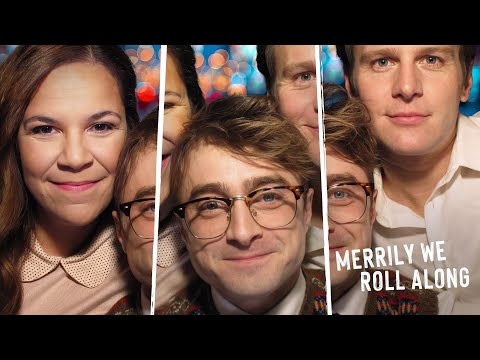
Review
“Merrily We Roll Along” is a musical that starts with the wreckage and walks you backward to the match. That reverse structure can feel like a dare. It also becomes the point: Sondheim’s lyrics keep changing meaning because the characters keep changing, even when the melody stays stubbornly the same.
The headline theme is ambition, but the sharper one is betrayal by inches. The text rarely gives you one clean emotion at a time. A line can be celebratory in one scene, then curdle into self-accusation three “years” later, because the show makes you hear consequences before you hear intentions. Repetition is not a convenience here. It is the dramaturgy.
Listen for how Sondheim treats time as something you sing against. Motifs come back altered, simplified, or emotionally “re-scored” by context. “Not a Day Goes By” is the classic example: its public sweetness can turn into private bitterness with one shift in who is singing and why. The score’s craft is that it does not beg you to feel. It sets up the trap and lets you step into it.
Viewer tip: if you are album-first, start with a full cast recording rather than isolated standards. The show’s biggest lyric punch is the way the same phrases arrive with different moral weight.
How It Was Made
The show began life as a high-wire concept: a Kaufman and Hart play re-centered around a composer, then told in reverse, with Sondheim and George Furth writing a musical about how artists sell parts of themselves without noticing the invoice. It opened on Broadway in 1981, and the idea survived longer than the production did.
Its afterlife is the more revealing story. “Merrily” became a long-term rewrite machine, with major structural and song changes in subsequent versions. Decades later, Maria Friedman’s approach finally made the reverse narrative feel less like a gimmick and more like memory itself. Friedman’s relationship with the material is not casual; she performed it, then directed it, and she has described working directly with Sondheim and Furth in an earlier UK process full of daily rewrites.
One of the most personal lyric admissions in the whole show is “Opening Doors,” where the hustle is comic and the disappointment is specific. Sondheim later framed it as emotionally autobiographical, which explains why that number tends to land even when productions disagree on everything else.
Key Tracks & Scenes
"Merrily We Roll Along" (Company)
- The Scene:
- A tuxedoed Frank at the piano. The company enters as a slide show flickers through the “story about to unfold,” ending with an invitation to a Bel Air party.
- Lyrical Meaning:
- The lyric smiles while the music side-eyes you. It is a cheery surface that keeps asking: when did the dream start slipping, and why did nobody file a complaint?
"That Frank" (Frank, Mary, Company)
- The Scene:
- Bel Air, 1976. A Hollywood party praising Frank’s producer success. Mary is stationed at the bar, visibly drunk, swatting away small talk with sharp little cuts.
- Lyrical Meaning:
- It is applause as peer pressure. The lyric is built from people flattering Frank into becoming smaller, then calling it “growth.” Mary’s sarcasm is the song’s anti-melody.
"Old Friends / Like It Was" (Mary, Charley)
- The Scene:
- New York, 1973. Backstage at an NBC studio during a news broadcast. Mary talks Charley into the interview as a last-ditch attempt to pull Frank back to the work, and to them.
- Lyrical Meaning:
- These lyrics are nostalgia with teeth. Mary is not reminiscing for comfort. She is negotiating, using memory as leverage, and the rhyme carries that desperation.
"Franklin Shepard, Inc." (Charley)
- The Scene:
- The interview goes live. Charley answers a question about collaboration by detonating the truth on national television, humiliating Frank mid-broadcast.
- Lyrical Meaning:
- A comic patter song that is actually a eulogy for the partnership. The lyric’s speed is the point: outrage arrives faster than self-control, then keeps accelerating.
"Not a Day Goes By" (Beth)
- The Scene:
- 1967, courthouse steps. A messy divorce in public. Beth absorbs Frank’s confession and reaches the moment where love and trust stop being synonyms.
- Lyrical Meaning:
- The song refuses to choose between devotion and condemnation. The lyric says love remains, and still insists it is not enough. That tension is why it survives outside the show.
"The Blob" (Gussie, Company)
- The Scene:
- 1962, Sutton Place. A packed party in Joe and Gussie’s brownstone. Gussie tours the room’s wealthy sameness, mocking the group mind while benefiting from it.
- Lyrical Meaning:
- It is satire that exposes social glue as social acid. The lyric is less about a party and more about a culture where taste becomes a loyalty test.
"A Good Thing Going" (Charley, Frank)
- The Scene:
- Same party, same room. Charley and Frank perform for the crowd. The applause arrives, then evaporates as the room drifts back to gossip while the song repeats.
- Lyrical Meaning:
- The lyric praises stability, and the staging undermines it. Repetition becomes the punchline: the song is “good,” but the partnership is already fraying at the edges.
"Opening Doors" (Frank, Charley, Mary, Company)
- The Scene:
- 1959. Frank at the piano, Charley at a typewriter, a light up on Mary on the phone. Separate pools of work become a montage: agents, rehearsal halls, subways, auditions.
- Lyrical Meaning:
- This is the show’s most unglamorous lyric triumph. The jokes are about being ignored, and the deeper point is about how persistence quietly turns into a personality.
"Our Time" (Frank, Charley, Mary, Company)
- The Scene:
- 1957, a rooftop on 110th Street. They scan the sky, spot Sputnik, and talk like the future is a door you can simply push open.
- Lyrical Meaning:
- The lyric is hope with a ticking clock inside it. It is not naive, exactly. It is young enough to believe talent is protection.
Live Updates
Information current as of January 29, 2026. If you came here for “what’s happening now,” the answer is: the 2023 to 2024 Broadway revival ended its run on July 7, 2024, but its filmed live capture has become the main way to see Maria Friedman’s staging.
Proshot film: The filmed Broadway revival had a theatrical release date of December 5, 2025, and as of January 20, 2026 it is available to rent or buy on major VOD services (including Apple TV and Prime Video). Physical media has also been reported for early March 2026, depending on territory and retailer listings.
Cast recording ecosystem: The revival’s cast album dropped digitally in mid-November 2023, with a physical CD release in January 2024. The original 1981 cast album remains the sharper “period piece” listen, while the 2023 to 2024 recording trades some edge for cleaner storytelling and modern vocal intimacy.
Licensing: “Merrily” continues to be licensed for regional and amateur production, and its full synopsis and song list are publicly available through the licensing houses, which is handy when you want to track scenes by year.
Notes & Trivia
- The 1981 Broadway production ran only 16 performances (after 44 previews), yet it still produced an original cast recording.
- The original cast recorded the album immediately after the show closed, essentially preserving a moment that New York barely got to see.
- Maria Friedman has said Sondheim approved small lyric adjustments during her revival process, a rare kind of blessing in Sondheim-land.
- “Opening Doors” has been described by Sondheim as emotionally autobiographical, which explains why it hits even outside the plot.
- The score uses reprise logic that mirrors the reverse timeline. Meaning changes first, then you learn why it changed.
- The title number borrows its name from a much older popular song that later became closely associated with classic animation branding, adding an extra layer of “cheerful surface.”
- The filmed Broadway revival was captured live at the Hudson Theatre in June 2024, ahead of its later cinema rollout.
Reception
“Merrily” has one of theatre’s great critical split-screens: the 1981 reviews largely praised the score while questioning the book and the sourness of the journey, and later critics argued that the piece was always pointing at something true, just not always in a playable way. The Friedman revival shifted the conversation by making the emotional story legible at every stop on the rewind.
“To be a Stephen Sondheim fan is to have one’s heart broken at regular intervals.”
“The first convincing revival of the cult flop.”
“A stunning Broadway revival it deserves.”
Quick Facts
- Title: Merrily We Roll Along
- Year: 1981 (Broadway premiere)
- Type: Book musical told in reverse chronology
- Book: George Furth (adapted from the 1934 play by George S. Kaufman and Moss Hart)
- Music & Lyrics: Stephen Sondheim
- Original Broadway director: Harold Prince
- Selected notable placements: “That Frank” (Bel Air party, 1976); “Franklin Shepard, Inc.” (live TV studio, 1973); “The Blob” (Sutton Place party, 1962); “Opening Doors” (work montage, 1959); “Our Time” (110th Street rooftop, 1957)
- Key recordings: 1981 Original Broadway Cast Recording (RCA era releases); 2023 to 2024 New Broadway Cast Recording (Masterworks Broadway)
- Film capture: Filmed Broadway revival released in cinemas December 2025, available on VOD January 2026
Frequently Asked Questions
- Why do people call it a flop if the songs are famous?
- Because the 1981 Broadway production closed fast, even though the score was widely admired. The cast recording and later revivals kept the music alive.
- Which cast album should I start with?
- If you want “1981,” start with the Original Broadway Cast Recording for period sound and sharper bite. If you want clarity and modern audio, start with the 2023 to 2024 Broadway cast recording.
- Why does “Not a Day Goes By” feel different inside the show?
- Because the show’s structure makes you hear outcomes before origins. Context re-labels the same sentiments as tenderness, regret, or fury.
- Can I watch the Maria Friedman Broadway production now?
- Yes. The filmed live capture had a cinema release in December 2025 and is now available for rental or purchase on major video-on-demand platforms.
- Is “Merrily We Roll Along” appropriate for teens?
- It depends on the production. The themes include divorce, infidelity, addiction, and career cynicism, presented with wit rather than graphic content.
- What is the single best “entry song” if I only sample one?
- “Opening Doors,” because it compresses the artistic hustle into a tight lyrical machine and hints at the friendship engine underneath.
Key Contributors
| Name | Role | Contribution |
|---|---|---|
| Stephen Sondheim | Composer & lyricist | Wrote music and lyrics built on reprise logic and shifting context, central to the show’s reverse timeline. |
| George Furth | Book writer | Adapted the concept into a reverse-chronology friendship story, balancing comedy with disillusionment. |
| Harold Prince | Original Broadway director | Staged the 1981 premiere, whose short run nonetheless cemented the piece’s legend. |
| Maria Friedman | Director of the major modern revival | Reframed the storytelling so the emotional through-line reads clearly, helping reintroduce the show to mainstream audiences. |
| Masterworks Broadway | Recording label | Released the new Broadway cast recording and its supporting booklet and liner materials. |
| Music Theatre International | Licensing publisher | Provides the public full synopsis and production materials that map songs to scenes and years. |
Sources: Music Theatre International; Playbill; Masterworks Broadway; AP News; The New York Times; The Washington Post; The Guardian; Entertainment Weekly; Sonia Friedman Productions; BroadwayDirect; Sony Pictures Classics.