
Make Me A Song Lyrics: Song List
- Disc 1
- Mister, Make Me A Song
-
Heart and Music

-
Hitchhiking Across America
-
Republicans
- Billy's Law-of-Genetics
- Passover
-
Only One
- Republicans (Reprise)
-
I'd Rather Be Sailing/Set Those Sails
- Change
-
I Have Found
- Republicans (Reprise 2)
- You're Even Better Than You Think You Are
- Falsettoland - The Falsettos Suite
- Four Jews In A Room Bitching
- Tight Knit Family/Love is Blind/My Father's A Homo
- Trina's Song
-
March of the Falsettos
- Year of the Child/The Baseball Game
-
Unlikely Lovers
- Disc 2
-
All Fall Down
- Republicans (Reprise 3)
-
Stupid Things I Won't Do
-
That's Enough For Me
-
I Went Fishing With My Dad
-
When the Earth Stopped Turning
-
Anytime (I Am There)
- Song of Innocence and Experience
- Finale
About the "Make Me A Song" Stage Show
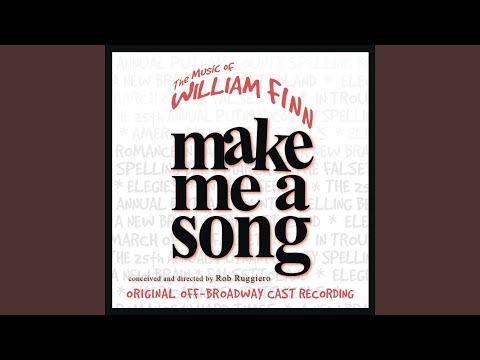
MAKE ME A SONG is a compilation of more than twenty hits from one William Finn's exceptional career in musical theatre. Effortlessly woven together, these treasured tunes by the composer of the acclaimed Falsettos series and the Tony Award®- winning smash hit The 25th Annual Putnam County Spelling Bee tell personal, haunting and often hilarious tales from Finn’s rich and touching human songbook. MAKE ME A SONG brims with spectacular highlights sure to delight longtime fans and newcomers alike.
Release date of the musical: 2008
"Make Me a Song" – The Musical Guide & Song Meanings
Review: what the lyrics are doing
Can a revue feel like a single piece of theatre without a plot, without dialogue, and with thirty songs yanked from different decades of a writer’s life? “Make Me a Song” mostly pulls it off, because William Finn’s lyrics behave like a fingerprint. They twitch. They over-explain. They crack a joke right as the nerve gets exposed. Rob Ruggiero’s concept does not pretend these numbers are “about” one fictional night. It frames Finn’s writing as a mind at work: the comedy of self-interruption, the sudden sincerity, the obsession with family mechanics, and the quiet grief that sneaks in wearing a punchline.
The show’s central lyrical move is Finn’s habit of arguing with himself mid-phrase. Characters and narrators revise their own thoughts in real time, so rhymes feel less like decoration and more like cognition. That is why the score can jump from political satire (“Republicans”) to domestic memory (“I Went Fishing With My Dad”) and still feel emotionally continuous. The musical language is just as restless: Broadway craft, downtown bite, and cabaret direct address, often within the same three minutes. Even when a song is “just” clever, the language is doing character work. It tells you who this person is by showing you how they think.
Listening tip if you are coming in cold: do not treat this album as background. Finn’s jokes are rhythmic, and the meaning often sits in the timing between clauses. Put on headphones, follow the consonants, and you will hear the real dramaturgy: the lyric is the plot.
How it was made
“Make Me a Song” started as a director’s idea, not a composer’s self-curated victory lap. In 2006, Rob Ruggiero went directly to Finn to ask permission to build a revue out of cut numbers, “trunk” songs, and lesser-known pieces, and Finn opened the vault. Ruggiero was explicit that he was not chasing a greatest-hits package, and he even acknowledged that material from “The 25th Annual Putnam County Spelling Bee” was sensitive while the show still had a major commercial life.
That origin story matters because it explains the revue’s personality. The evening is not polite. It likes the weird corners. It keeps faith with Finn’s private songwriting habits, including a title song reportedly written for Mandy Patinkin for an unrealized Finn concert concept. The Off-Broadway run landed at New World Stages in late 2007, built for four singer-actors and a pianist, and later became a live, two-disc cast recording. The album preserves the feeling of being in the room, with audience air around the punchlines and the bruises.
Key tracks & scenes
"Mister, Make Me a Song" (Company / Finn’s voice into ensemble)
- The Scene:
- House lights fall. Before anyone sings live, you hear the composer on a recording, like an offstage conscience. The piano waits. Then the live performer steps in and the room “clicks” into the show’s frequency.
- Lyrical Meaning:
- This is Finn’s mission statement, and it is also a warning. The lyric treats songwriting as compulsion, commerce, prayer, and habit, sometimes in the same breath. The show announces: you are about to watch a brain work.
"Heart and Music" (Performer)
- The Scene:
- A simple cabaret setup. A singer takes the piano like a confidant. Lighting narrows to a clean, honest pool, no tricks.
- Lyrical Meaning:
- Finn’s great theme: feeling versus craft. The lyric refuses to pick a winner. It argues that a song needs both the mess (heart) and the engineering (music), and it makes the conflict sound like flirtation.
"Change" (Performer)
- The Scene:
- Quick tempo, quick mind. The piano darts. The performer rides the internal turns like they are physical choreography, even when standing still.
- Lyrical Meaning:
- Finn weaponizes a single word and squeezes it until it becomes philosophy. The joke is semantic. The sting is existential. It is comedy built from precision, and it lands because the lyric keeps shifting the ground under you.
"Passover" (Performer)
- The Scene:
- The room softens. The singer tells a family story through a child’s lens, with the piano as gentle narrator.
- Lyrical Meaning:
- Finn does intimacy without sentimentality. The lyric’s power is its plainness: ritual as memory, memory as identity, identity as something you inherit before you choose it.
"I Went Fishing With My Dad" (Performer)
- The Scene:
- A singer speaks-sings into nostalgia, then catches on a detail that hurts. Light shifts almost imperceptibly, as if the past got closer.
- Lyrical Meaning:
- This is Finn’s family writing at its most surgical. The lyric turns a small action into a generational map. It is not about fishing. It is about what gets passed down when people do not know how to say the big things.
"Billy’s Law-of-Genetics" (Performer)
- The Scene:
- The performer attacks the lyric like a stand-up set, then lets it tilt into something darker. The piano keeps smiling. The song does not.
- Lyrical Meaning:
- Finn’s signature trick: a comic premise that reveals a cruel little logic underneath. The lyric’s “rules” are coping mechanisms. The laugh is how the character stays upright.
"Unlikely Lovers" (Company)
- The Scene:
- Voices lock into tight harmony. The staging tends to favor stillness here, as if the song is asking the audience to stop fidgeting and listen.
- Lyrical Meaning:
- In Finn-land, love is rarely tidy, and it is rarely a solo. The lyric makes connection sound risky and specific. Harmonies do the storytelling: agreement, friction, and compromise, all audible.
"Anytime (I Am There)" (Performer / Company)
- The Scene:
- Late-evening energy. The number can feel like a benediction after the barrage of wit, with the piano giving the singer room to breathe.
- Lyrical Meaning:
- Finn’s emotional clarity tends to arrive after he has joked you into defenselessness. The lyric is about presence as a promise, and it lands because it is direct, not grand.
Live updates 2025/2026
Information current as of January 29, 2026. “Make Me a Song” remains a practical title for schools and regional companies because it is built for four singer-actors plus a pianist, and it can run without elaborate scenery. It is licensed through Music Theatre International, which keeps it circulating even when it is not on a major commercial stage.
The biggest real-world shift in how the revue is received is also the simplest: William Finn died on April 7, 2025. Since then, tributes and Finn-centric programming have increased, and “Make Me a Song” has become an obvious vehicle because it already functions like a curated biography in music. Documented 2025 productions include a college-affiliated workshop run in Orlando in April 2025 and a regional listing in Salem, Oregon dated April 24-27, 2025.
If you are considering seeing a local production: sit where diction travels cleanly. Finn’s internal rhymes and rapid pivots are the point, and the best seat is the one where you do not miss the consonants. If you are only listening, the live album is the closest thing to the original Off-Broadway pacing, including the opening recording-to-live handoff that explains the revue’s whole aesthetic in under four minutes.
Notes & trivia
- The Off-Broadway engagement began previews on October 30, 2007, opened November 12, and closed December 30, 2007 at New World Stages (Stage V).
- The revue has no dialogue and no connective plot. It is structured as a sequence of songs.
- MTI’s show history describes the revue as built in three parts, including a “Falsetto Suite,” and a later section positioned as the emotional center.
- Playbill reported that Ruggiero originally sought access to Finn’s cut and “trunk” material and was not interested in a standard greatest-hits framing.
- The cast album was recorded live across December 1-2, 2007 performances and released April 29, 2008.
- The two-disc release includes a bonus moment: Finn’s recorded “Mister, Make Me a Song” used to open the show before the live performance takes over.
- The Off-Broadway production received awards attention as a nominated revue (including a Drama Desk nomination for Outstanding Revue in the 2007-2008 season).
Reception
Critically, the piece has always had one unavoidable debate baked into it: is thirty songs too many when the writer’s quirks are so recognizable they can start to blur? Some reviewers admired the writing and performance polish while questioning the sheer quantity. Others treated the evening as an unusually candid self-portrait, with Finn’s language doing the heavy lifting a book would normally do.
“But the two-CD set is a bit too much of a pretty good thing.”
“A swift 90 minutes rather than two acts.”
“Ghostlight Records will release its live recording … on Tuesday, April 29.”
My take is mildly skeptical in a way Finn would probably enjoy: the revue can overwhelm you if you want variety of voice. It is one voice. Strongly. Repeatedly. That is also the point. “Make Me a Song” works best when you stop asking for a plot and start listening for the signature moves: the way Finn makes anxiety rhyme with tenderness, and the way the music lets a joke turn into an admission without changing tempo.
Quick facts
- Title: Make Me a Song: The Music of William Finn
- Year (Off-Broadway version): 2007
- Type: Musical revue
- Music & Lyrics: William Finn
- Conceived/Directed (original concept): Rob Ruggiero
- Off-Broadway venue: New World Stages (Stage V), New York City
- Off-Broadway run: First performance October 30, 2007; opened November 12, 2007; closed December 30, 2007
- Cast album: Live recording; released April 29, 2008
- Label/imprint: Ghostlight Records (associated with Sh-K-Boom)
- Album length: 30 tracks; approximately 1 hour 32 minutes
- Recording locations (album metadata): New World Stages and studio sessions listed by major discography sources
- Notable staging/structure note: Four singer-actors and a pianist; commonly produced without elaborate scenery
Frequently asked questions
- Is “Make Me a Song” a story musical?
- No. It is a revue: a sequence of Finn songs without dialogue or a single connecting plot. The through-line is the writing voice and the curation.
- What’s the best way to listen to the cast album?
- Start at track one and give it twenty minutes before skipping. The revue is paced like an evening in the theatre, including an opening that moves from a recorded voice into live performance.
- Does it include songs from “The 25th Annual Putnam County Spelling Bee”?
- Not in a dominant way. Early development notes flagged that “Spelling Bee” material was sensitive while the show had an active commercial life, so the revue leans harder on other Finn worlds.
- Who is this show for: Finn completists or newcomers?
- Both, with different entry points. Fans will enjoy the rarities and cut material. Newcomers should treat it as a guided tour of Finn’s themes: family, self-argument, political nerves, and sudden tenderness.
- Is it still being performed in 2025/2026?
- Yes in the way revues usually live: through licensing and regional programming rather than a single flagship production. Documented 2025 listings show it continuing in smaller venues and training settings.
Key contributors
| Name | Role | Contribution |
|---|---|---|
| William Finn | Composer-Lyricist | Wrote the songs; the revue draws from multiple Finn scores and unpublished material. |
| Rob Ruggiero | Conceiver / Director | Built the revue concept and original staging; curated the song selection and structure. |
| Darren R. Cohen | Music Director / Pianist | Onstage piano and musical direction for the Off-Broadway production and captured live sound. |
| Michael Morris | Music Supervisor | Supervised musical preparation for the Off-Broadway production. |
| Adam Heller | Performer | Original Off-Broadway cast member; key vocal presence on the live album. |
| Sandy Binion | Performer | Original Off-Broadway cast member; featured vocalist on ensemble and solos. |
| Sally Wilfert | Performer | Original Off-Broadway cast member; featured vocalist on ensemble and solos. |
| D. B. Bonds | Performer | Joined the Off-Broadway cast and appears across the live album. |
| Joel Moss | Album Producer | Produced the live cast recording (as reported in contemporaneous coverage). |
| Kurt Deutsch | Label Executive | Associated with Sh-K-Boom/Ghostlight leadership credited in reporting around the recording. |
Sources: Playbill, TheaterMania, Music Theatre International (MTI), Spectra (Lucille Lortel Off-Broadway Archive), SFGate (San Francisco Chronicle), AllMusic, YouTube (Ghostlight Records upload), BroadwayWorld listings.