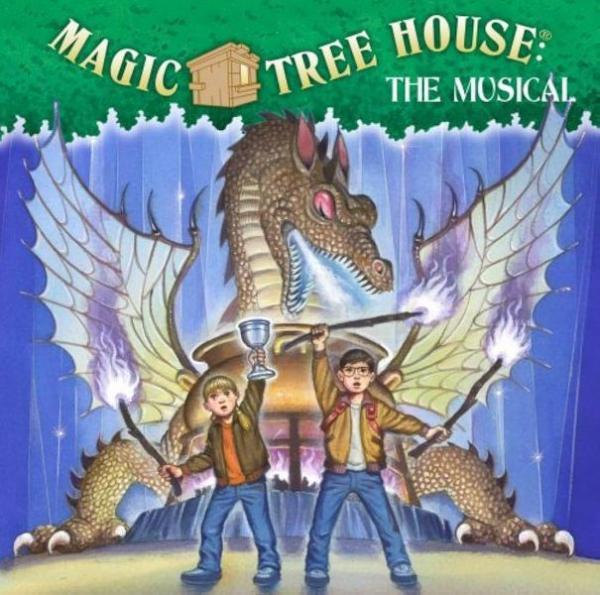
Magic Tree House Lyrics: Song List
- How Far Can You See?
- Banquet In Camelot
- Tick Tock
- Banquet In Camelot
- The Curse
- Not the Man He Was
-
Who Will Go?

- Four Gifts
- Fly!
- What's So Great About Magic?
-
The Dance
-
What Would I Do Without You?
- Remember And Imagine
- I Remember
- Banquet In Camelot
About the "Magic Tree House" Stage Show
Magic Tree House is based on a series of books of the same name of the famous American writer Mary Pope Osborne. They tell about the adventures of a young brother & sister Jack & Annie who without fear or doubt get to the aid of many legendary heroes including the famous King Arthur. Wil Osborne – husband of aforementioned writer has developed the project’s script. Music & lyrics written by R. Courts. It is worth noting that these theatrical figures have had to work in tandem. Fifteen years ago, they have created a very successful musical The Wonderful. This time the audience expect to behold the result of their work to see high-quality and interesting creation.
The first show of Magic Tree House held in Warner Theatre in spring 2007. Closure took place in the autumn of the same year. During this period, many performances in 55 cities across the country have been organized. In the role of the director was Joe Harmston. His team includes set designer A. Dodge, lighting designer M. Richards, costume designer S. Lams, and doll modeler M. Brehmer.
Because of its genre orientation, the project could not seriously claim to any theater award nor nomination. However, this did not prevent the Magic Tree House to get pretty good reviews. The audience noted the ease and goodness of creation, and the critics were not afraid to call it one of the best fairytale performances of the 21st century. The New York Times wrote about the musical the following: on the stage, creators show us a fascinating combination of music, storytelling and stage action that would give pleasure not only to children but also to adults.
Release date of the musical: 2007
"Magic Tree House: The Musical" – The Musical Guide & Song Meanings
Review
Here’s the sneaky challenge “Magic Tree House: The Musical” sets for itself: it has to honor a chapter-book reader’s imagination while also behaving like a grown-up, full-length musical. The 2007 cast album (built around “Christmas in Camelot”) bets on a very Broadway idea: big feelings get bigger when they have a chorus, a motif, and a clock you can hear. That last part matters. The score keeps circling back to time, responsibility, and the moment childhood stops being purely recreational and starts being moral.
The lyrics are built to be understood on first pass, but they’re not lazy. You can hear the writers “teach” without turning the characters into hall monitors. Jack’s language leans observational and cautious; Annie’s text is the kinetic argument for risk. That contrast is the engine. When Camelot falls under a spell, the show’s word choice avoids fantasy mush. “Curse” is a blunt, useful word. It gives the story stakes that even a second-grader can name.
Musically, the show borrows Celtic color and then refuses to stay in the museum. The orchestration language nods to traditional textures, then snaps back into contemporary theatre pacing. That hybridity is the point: Camelot is old; Jack and Annie are now. The score makes them coexist in the same bar line.
Listener tip: If you’re using the album to help a kid follow plot, start with “Tick Tock” and “The Curse” back-to-back. They explain the central problem in musical terms: time pressure, then emotional damage. Everything after is response.
How it was made
The 2007 recording arrived before most audiences saw the show, which is a gutsy way to launch a family property: sell the musical logic first, then the staging. The release was tied to a Barnes & Noble summer reading push, and the live production premiered at the Warner Theatre in Torrington, Connecticut later that year. That sequencing explains a lot about the lyric approach. These songs were designed to travel: to stores, classrooms, car stereos, and finally a proscenium.
Behind the curtain, it’s also a small-world operation in the best sense. Mary Pope Osborne and her husband Will Osborne didn’t outsource the story’s heart. They kept it in the family and built a creative bench around it, including composer Randy Courts and, in later iterations of the stage catalog, playwright Jenny Laird. The team’s working rhythm has been described as neighborly and hands-on, with material developed in a dedicated studio space nicknamed after the series’ fictional hometown. That’s more than cute branding. It’s a method: protect the tone, protect the audience, protect the clarity.
There’s also a telling “company culture” breadcrumb that reads like a lyric thesis statement. In an interview about the stage adaptations, Mary recalled Will making shirts for the touring company with a line from the script: none of this is much fun alone. That is essentially the show’s moral, smuggled in as a joke you can wear.
Key tracks & scenes
"How Far Can You See?" (Jack, Annie, Company)
- The Scene:
- Early on, the kids and the world feel small: bedroom light, flashlight logic, a tree house that reads like a dare. The number typically plays like a curtain-raiser in motion, with the stage picture expanding as curiosity wins.
- Lyrical Meaning:
- The lyric asks a deceptively technical question about perspective. It’s an anthem for attention: learning to look longer, farther, and with less fear of being wrong.
"Banquet in Camelot" (Company)
- The Scene:
- The invitation becomes spectacle. Bright hall lighting, ritual movement, a court that wants to dazzle the kids into compliance. The chorus does the heavy lifting: it sells Camelot as a place where rules are performance.
- Lyrical Meaning:
- It’s pageantry with a trapdoor. The lyric’s politeness and repetition function like etiquette training, which makes the later “loss of joy” land harder.
"Tick Tock" (Ensemble)
- The Scene:
- Time becomes audible. You can stage it with percussion, movement patterns, or literal clocks, but the feeling is the same: the tree house doesn’t wait, and neither does danger.
- Lyrical Meaning:
- The show turns “deadline” into character. This is where the musical tells the audience: adventure has consequences, and procrastination is a villain with good PR.
"The Curse" (Morgan le Fay, Company)
- The Scene:
- Lighting cools. The court’s warmth drains out, replaced by something sharper and more controlled. Morgan’s presence isn’t just narrative; it’s atmospheric.
- Lyrical Meaning:
- The lyric makes darkness legible. It’s not “scary” for its own sake; it’s a diagnosis of what happens when imagination is treated as childish and therefore disposable.
"Not the Man He Was" (Guinevere, Arthur, Company)
- The Scene:
- King Arthur registers as depleted rather than heroic. This usually lands in a tighter pool of light, less pageant, more bruise.
- Lyrical Meaning:
- The lyric gives adults a quiet storyline: leadership without joy becomes administrative. It’s the show’s way of explaining depression without using that word.
"Who Will Go?" (Merlin, Jack, Annie)
- The Scene:
- Merlin puts the mission on the table. The staging often sharpens into a triangle: mentor, skeptic, impulsive believer. The room feels like a choice.
- Lyrical Meaning:
- It’s a consent song. Adventure is not assigned; it’s accepted. The lyric frames bravery as volunteering with full awareness of risk.
"Four Gifts" (Jack, Annie, Company)
- The Scene:
- The quest becomes a scavenger hunt with ethics. Props can be simple; what matters is the ritual of collecting, and the dawning sense that each “gift” changes the collector.
- Lyrical Meaning:
- The lyric treats knowledge as something you carry. It’s a musical translation of what the books do: reading becomes equipment.
"Fly!" (Company)
- The Scene:
- Momentum sequence. Wind, speed, a stage picture that looks like storybook pages turning too fast. Even without literal flight, the choreography can simulate lift.
- Lyrical Meaning:
- “Fly” is the show’s permission slip for awe. It’s also a warning: elevation is thrilling, and therefore distracting, and therefore dangerous.
"I Remember" (Jack & Annie)
- The Scene:
- After the quest, the kids get a quieter landing. Light warms back up, and the staging can finally stop moving.
- Lyrical Meaning:
- The lyric argues that memory is an active choice. The show doesn’t end on victory; it ends on integration: what you do with what you learned.
Live updates (2025/2026)
In 2025 and 2026, “Magic Tree House On Stage” functions less like a single title and more like an operating system for youth theatre: multiple shows, multiple formats, and a licensing ecosystem that reaches professional theatres, schools, and touring programs. That matters for lyrics fans because revisions and credits can shift by title and version. The “Christmas in Camelot” page currently frames the show as a full-length, two-hour production and points audiences to the original cast recording for song samples.
If you’re hunting “current cast” news the way you might for a Broadway revival, adjust expectations. A lot of the 2025/2026 activity is regional and education-facing, with companies touring specific Magic Tree House adaptations. One concrete example: Berkshire Theatre Group lists “Magic Tree House: Showtime with Shakespeare” as its 2025-2026 touring show for schools, positioning it as the season’s family title rather than a one-off event.
Also worth noting: a January 2026 American Theatre feature describes the initiative as thriving, cites the team’s ongoing development process, and references a growing catalogue of stage shows, plus an animated project in the pipeline. Translation: the brand is still being actively built, which makes the 2007 album feel less like nostalgia and more like the foundation stone.
Notes & trivia
- The cast album was released June 5, 2007, with an initial Barnes & Noble exclusivity window before a wider release later that summer.
- The stage production premiered at the Warner Theatre in Torrington, Connecticut in September 2007, and returned in September 2008 to launch the national tour.
- Playbill’s production notes describe the instrumentation as strings, woodwinds, percussion, and piano, with Celtic influence blended into contemporary theatre writing.
- The “On Stage” initiative traces its starting point to 2007 and says the 2008-2009 season tour hit 54 U.S. cities, with later production activity in Germany.
- Mary Pope Osborne has described the team’s writing and composing process as happening in a renovated stable turned studio called “Frog Creek Barn.”
- A lyric from “Christmas in Camelot” became literal tour culture: Will Osborne printed it on shirts for the company (“none of this would be much fun if we were doing it by ourselves”).
- The current “Christmas in Camelot” listing credits book/lyrics to both Will Osborne and Jenny Laird, alongside Randy Courts for music/lyrics, reflecting the broader creative team behind later Magic Tree House stage titles.
Reception
Because the property lives heavily in touring and youth-theatre lanes, the critical record looks different than a Broadway juggernaut’s paper trail. What you do get, repeatedly, is a clear consensus on craft: the creators treat young audiences as real audiences. The smartest praise doesn’t gush about cuteness; it points to structure and intention.
“Using strings, woodwinds, percussion, and piano … [Courts] blends traditional Celtic influences with contemporary theatre music sensibilities.”
“Randy and Will renovated a stable … and made it into a solid music studio … It’s called the Frog Creek Barn.”
“Mary Pope Osborne … and Will Osborne, chose the Warner Theatre as the site to launch the world premiere … in September 2007.”
Quick facts
- Title: Magic Tree House: The Musical (World Premiere Cast Recording)
- Year: 2007
- Type: Family musical; Theatre for Young Audiences ecosystem (album anchors “Christmas in Camelot”)
- Source material: Mary Pope Osborne’s Magic Tree House: Merlin Mission #1, “Christmas in Camelot”
- Book / Lyrics (album-era credits): Will Osborne
- Music / Lyrics: Randy Courts
- Notable original recording cast: Cass Morgan (Morgan le Fay), Donna Bullock (Guinevere), Howard Sherman (Merlin), Paul Wyatt (Jack), Katie Brunetto (Annie)
- Label: P.S. Classics
- Release context: Summer Reading tie-in via Barnes & Noble; stage premiere followed later in 2007
- Selected notable placements: Classroom and family listening; song samples promoted on the Magic Tree House On Stage site
- Availability: Referenced as streamable via Spotify and purchasable via major retailers by official show pages
Frequently asked questions
- Is this musical the same as the MTI “KIDS” and “JR.” Magic Tree House shows?
- No. The 2007 cast album is tied to the full-length “Christmas in Camelot” musical. MTI licenses separate shortened youth-performed adaptations of other titles.
- What book is the album mainly based on?
- “Christmas in Camelot,” the first Merlin Mission, with story elements expanded for a full-length stage arc.
- Who wrote the lyrics?
- For the 2007 album-era credits, Will Osborne is credited for book and lyrics, with Randy Courts credited for music and lyrics. Current official listings for “Christmas in Camelot” also credit Jenny Laird on book/lyrics for the stage catalogue.
- What should I listen for if I’m tracking theme rather than plot?
- Listen for how the score treats time (“Tick Tock”), joy under pressure (“The Curse”), and partnership (the repeated insistence that the mission is better together).
- Is there a current tour of “Christmas in Camelot” in 2025/2026?
- Magic Tree House stage activity in 2025/2026 is often title-specific and regionally produced. Companies are touring other adaptations (for example, “Showtime with Shakespeare” appears as a 2025-2026 school touring title), while “Christmas in Camelot” remains positioned as a licensable full-length show.
Key contributors
| Name | Role | Contribution |
|---|---|---|
| Mary Pope Osborne | Author / Brand creator | Wrote the book series and “Christmas in Camelot,” the primary source text for the musical’s story engine. |
| Will Osborne | Book / Lyricist | Credited for book and lyrics on the 2007 album-era release; ongoing creative lead in the stage initiative. |
| Randy Courts | Composer / Lyricist | Wrote music (and lyrics on key material); described as blending Celtic influence with contemporary theatre writing. |
| Jenny Laird | Playwright / Lyricist | Credited alongside Will Osborne on current official “Christmas in Camelot” listings; core writer across the stage catalogue. |
| Cass Morgan | Original cast | Per Playbill and album notes, performed Morgan le Fay on the studio cast recording. |
| Donna Bullock | Original cast | Performed Queen Guinevere on the studio cast recording. |
| Howard Sherman | Original cast | Performed Merlin on the studio cast recording. |
| P.S. Classics | Label | Released and distributed the 2007 world premiere cast recording. |
| Warner Theatre (Torrington, CT) | Premiere venue | Hosted the September 2007 premiere and later served as a tour launch site. |
| Berkshire Theatre Group | Touring producer (related title) | Lists a Magic Tree House adaptation (“Showtime with Shakespeare”) as a 2025-2026 school touring show, illustrating the initiative’s current footprint. |
Sources: Playbill; Magic Tree House On Stage (official site); American Theatre; Ct Insider (Hearst Connecticut); Berkshire Theatre Group; BroadwayWorld; The Children’s Book Review; YouTube.