Little Shop of Horrors Lyrics – All Songs from the Musical
Little Shop of Horrors Lyrics: Song List
- Act 1
- Prologue (Little Shop of Horrors)
- Skid Row (Downtown)
- Da-Doo
- Grow for Me
- W S K I D / Ya Never Know
- Somewhere That's Green
- Closed for Renovation
- Dentist
- Mushnik & Son
- Feed Me (Git It)
- Now (It's Just the Gas)
- Act 1 Finale
- Act 2
- Call Back in the Morning
- Suddenly, Seymour
- Suppertime
- Meek Shall Inherit
- Sominex/Suppertime II
- Somewhere That's Green (Reprise)
- Bigger Than Hula Hoops
- Finale (Don't Feed the Plants)
About the "Little Shop of Horrors" Stage Show
Musical “Little Shop of Horrors” took place on Broadway in WPA Theatre from May to June 1982. The first staging of the play was directed by Jerry Zaks. It was created based on the eponymous film of 1960, shot by Roger Corman. Howard Ashman wrote the script. Composer Alan Menken made music. It is interesting to know that another movie was made, in 1986 with several fantastic actors like James Belushi and Rick Moranis in the leading part (the one, which starred in “Honey, I Shrunk the Kids” and two its continuations).Off-Broadway production took place in Orpheum Theater. The first show was in June 1982. Director of performance was H. Ashman. The musical production was carried out by Edie Cohen. The roles played by S. L. Vilkof in the main part & E. Greene as Audrey. Voice of the plant was R. Taylor, movements by M. P. Robinson. This musical was exhibited in the Orpheus Theater for 5 years. The last performance took place on November 1987. It has become one of the three longest-running productions in this theater. It became also the highest grossing in the history among off-Broadway’s histrionics.
West End Theater of comedy hosted it in the first day of 1983. The producer of the musical was Cameron McIntosh. E. Greene & B. James were starring. The last show was held in October 1985. In the years of 1982-1983, show has received a number of awards: Drama Critics Circle, Drama Desk & Evening Standard as Best Musical.
In 2003, the play was revived in the United States. 372 regular shows were given in the theater of Virginia. The show stayed on the scene a little less than a year. New London production was carried out later. Musical has been shown from November 2006 to September 2007. Another New York production was founded in 2015. On the basis of this musical, a feature motion picture and animated series were filmed.
Release date: 1982
"Little Shop of Horrors" – The Musical Guide & Song Meanings
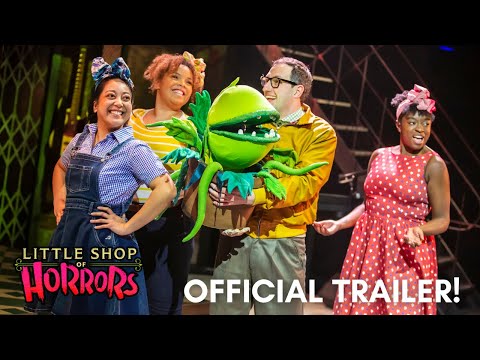
Review: why the lyrics bite
How does a show about a talking plant feel smarter than plenty of “serious” musicals? Because Howard Ashman writes like a dramatist with a switchblade. The jokes are not padding. They are engineering. Every rhyme advances the trap: Seymour wants approval, Audrey wants safety, the shop wants customers, and the plant wants bodies. The score smiles in girl-group harmony while the book quietly locks the exits.
The lyric style is built on cheerful denial. Characters announce their fantasies in bright, familiar pop grammar, then the plot uses that grammar against them. “Somewhere That’s Green” is an “I want” song filtered through cheap magazines and retail catalogues. It is funny, until you realize the fantasy is small because her world has been made smaller. “Feed Me (Git It)” is a seduction scene disguised as a pep talk, and Ashman plants double meanings early so later revelations feel inevitable, not sudden.
Musically, Menken and Ashman borrow early-’60s vocabulary (doo-wop, R&B, rock and roll) to create instant nostalgia, then poison it. The sound is comforting. The choices are not. That tension is why the show keeps playing to audiences who were not alive for the era it imitates.
How it was made: Ashman, Menken, and the B-movie blueprint
The origin story is unusually clean, and unusually nerdy. Ashman fell in love with Roger Corman’s micro-budget 1960 film as a teenager, years before he had any reason to think it could become a musical. When he and Menken came out of a bruising experience transferring “God Bless You, Mr. Rosewater,” Ashman wanted the next project to be “fun.” He remembered a teenage attempt at writing a flower-love musical and realized, with some horror, that he had basically been copying “Little Shop” in his sleep.
According to a Playbill archival feature, it took about a year to secure the rights, and Ashman and Menken wrote the stage version in fits and starts. Once they found the right approach, they finished it fast, with Ashman describing an “eight weeks” sprint to the finish. The creative decisions follow the movie’s logic but sharpen the satire: not just horror spoof, but a Faust story where the devil talks like a hit record.
Technical craft matters here. Ashman was not only the lyricist and book writer; he directed the original production. That triple role explains why the lyrics feel staged on the page. They are written for entrances, reveals, and the precise moment a laugh curdles.
Myth-check: People talk about “Little Shop” as an obvious Broadway transfer. Ashman disagreed at the time and famously resisted moving it uptown, arguing it fit its Off-Broadway scale.
Key tracks & scenes: 8 lyrical pressure points
"Prologue (Little Shop of Horrors)" (Crystal, Ronnette, Chiffon)
- The Scene:
- Streetlight haze. A girl-group trio steps into the role of narrators, half prophets, half neighborhood gossip. The night feels friendly, until the lyric tells you exactly what date you should fear.
- Lyrical Meaning:
- Ashman sets the tone: sweetness as misdirection. The prologue is a warning delivered like a catchy hook, which is the show’s entire moral strategy.
"Skid Row (Downtown)" (Company)
- The Scene:
- A busted block where dreams get priced like scrap metal. Seymour and Audrey sing from inside the daily grind, while the chorus frames the neighborhood as both prison and chorus line.
- Lyrical Meaning:
- It establishes the show’s sympathy for people stuck in systems, then dares you to watch what they do when an “escape” arrives. The lyric is affectionate, not condescending, which makes later choices sting.
"Grow for Me" (Seymour)
- The Scene:
- Back room of the flower shop. A tiny, odd plant refuses to thrive. Seymour’s voice is gentle, pleading, almost prayerful. Then a pinprick of blood changes the rules.
- Lyrical Meaning:
- This is the contract moment. The lyric keeps Seymour innocent on the surface while the staging reveals complicity. He does not “choose evil” in one bold stroke; he slides.
"Dentist!" (Orin)
- The Scene:
- A neon nightmare of chrome tools and grin-first cruelty. Orin performs his own legend, savoring the audience’s discomfort like applause.
- Lyrical Meaning:
- It is villain characterization as genre parody. Ashman makes Orin funny enough to laugh at, then makes you notice what the laughter is covering.
"Somewhere That's Green" (Audrey)
- The Scene:
- Audrey imagines a little home with a little TV and a little safety. The light softens. The fantasy is pastel, retail, carefully measured.
- Lyrical Meaning:
- An “I want” song that refuses grandeur. The lyric’s charm is its specificity, and its tragedy is what those specifics reveal about what she thinks she deserves.
"Feed Me (Git It)" (Audrey II, Seymour)
- The Scene:
- The plant is bigger now, voice slicker, rhythm meaner. It talks like temptation with perfect timing. Seymour tries to laugh it off, then stops laughing.
- Lyrical Meaning:
- This is persuasion writing at a high level: the plant offers fame and belonging, not just money. The lyric turns violence into a sales pitch, which is the show’s sharpest joke.
"Suddenly, Seymour" (Seymour, Audrey)
- The Scene:
- Act II. After Orin disappears, the air clears for a moment. Seymour and Audrey sing like two people surprised they’re still alive, surprised they’re still capable of hope.
- Lyrical Meaning:
- A romantic duet that lands because it arrives at the exact moment the audience wants relief. The lyric promises rescue while the plot quietly keeps the bill running.
"Suppertime" (Audrey II)
- The Scene:
- A showstopper from a monster. The plant takes the stage like a nightclub headliner, and the shop becomes its venue.
- Lyrical Meaning:
- The song is the power shift made audible: the “asset” becomes the boss. The lyric’s confidence is horrifying because it is earned.
Live updates (2025–2026)
Information current as of January 28, 2026.
In New York, the long-running Off-Broadway revival at the Westside Theatre continues to run on a rotating, high-profile casting model. The official production site lists Joy Woods as Audrey and Joshua Bassett as Seymour, with Andrew Durand as Orin. A separate announcement notes Woods and Bassett are scheduled for a limited engagement window ending March 1, 2026, which is typical for this production’s “event casting” strategy.
For UK audiences, an actor-musician revival has been announced with performances at Northern Stage (May 8–23, 2026) and Derby Theatre (May 30–June 20, 2026), with Kristian Cunningham as Seymour and Amena El-Kindy as Audrey. The co-production framing suggests a lean, gig-ready aesthetic: the show as a band-driven fable, not a museum piece.
Practical viewing tip: if you are seeing the Westside production, sit closer than you think. The show lives and dies on puppet detail, and the closer you are to the plant’s mechanics, the funnier the lies feel.
Notes & trivia
- Original stage life: premiered at WPA Theatre May 6, 1982, then opened at the Orpheum Theatre July 27, 1982 and ran 2,209 performances, closing November 1, 1987.
- Ashman used the story frame to satirize B-movies, sci-fi, musical comedy, and the Faust legend, while Menken leaned into early-’60s styles like doo-wop and Motown.
- The prologue pins the story to September 23, a date the show still treats as a running gag and omen.
- “Somewhere That’s Green” is a classic “I want” number with deliberately modest wants, which is why it hits harder than a bigger dream would.
- IBDB documents the 2003 Broadway revival running 372 performances (Oct 2, 2003 – Aug 22, 2004) after the show’s long Off-Broadway life.
- The Original Off-Broadway Cast album is widely listed with a May 6, 1982 release date and Geffen-era rights, with later reissues under different label banners.
Reception: then vs. now
Critically, “Little Shop” has had a strange advantage: its craft is too sturdy to go out of style, and its subject (the seduction of getting what you “deserve”) keeps getting refreshed by the culture. Modern reviews tend to praise the score’s genre agility and the lyric writing’s sneaky structural work, especially in intimate revivals where the show’s scale looks like a choice, not a limitation.
“Ashman’s lyrics blend masterful character comedy with carefully seeded double meanings.”
“Howard Ashman’s lyrics are often also uplifting.”
“The writing is so economical and perfect.”
Quick facts (album + show metadata)
- Title: Little Shop of Horrors
- Year: 1982 (stage premiere)
- Type: Musical comedy / horror pastiche
- Book & Lyrics: Howard Ashman
- Music: Alan Menken
- Based on: Roger Corman’s 1960 film (screenplay by Charles Griffith)
- Original Off-Broadway venue: Orpheum Theatre, East Village
- Original Off-Broadway run: Jul 27, 1982 – Nov 1, 1987 (2,209 performances)
- Musical language: early-’60s doo-wop, R&B, rock and roll, Motown flavors
- Cast recording: Original Off-Broadway Cast album (commonly listed as May 6, 1982; Geffen-era rights with later label presentations)
- Current flagship staging: Off-Broadway revival at Westside Theatre (opened 2019 and continues with rotating casts)
Frequently asked questions
- Can you provide the full lyrics here?
- No. Full lyric text is copyrighted. This guide focuses on song meaning, placement, and how the writing functions dramatically.
- Is the show a parody, or a real love story?
- Both. The show uses pop styles as satire, but Seymour and Audrey are written with genuine tenderness. The trap works because the heart is real.
- What is the most important lyric idea in the score?
- Temptation as customer service. The plant rarely “orders” Seymour; it sells him on an identity he has been denied.
- Is there a movie?
- Yes. A 1986 film adaptation directed by Frank Oz became a cult hit and introduced the score to a wider audience.
- Who is starring Off-Broadway right now?
- As of late January 2026, the production lists Joy Woods (Audrey), Joshua Bassett (Seymour), and Andrew Durand (Orin), with casting scheduled in limited runs.
- Why does the show work so well in small theatres?
- The puppet and the jokes depend on proximity. When Audrey II feels “in the room,” the comedy lands harder and the horror feels less theoretical.
Key contributors
| Name | Role | Contribution |
|---|---|---|
| Howard Ashman | Book & Lyrics; Director (original) | Built the satire and the heart; wrote lyrics engineered for staging and reversals. |
| Alan Menken | Composer | Fused early-’60s idioms with musical-theatre structure and character-driven hooks. |
| Roger Corman | Source film director | Directed the 1960 film that supplied the premise and tone for the musical adaptation. |
| Charles Griffith | Screenwriter (source film) | Wrote the original 1960 screenplay adapted for the stage musical. |
| Martin P. Robinson | Puppet designer (original) | Designed Audrey II’s growth concept and stage mechanics that became iconic. |
| Michael Mayer | Director (2019 Off-Broadway revival) | Current-era staging blueprint for the long-running Westside revival. |
Sources: MTI (Show History), Playbill, IBDB, LittleShopNYC (official site), WhatsOnStage, Northern Stage, Time Out New York, The Guardian, Vanity Fair, Entertainment Weekly, Apple Music.