Lennon Lyrics – All Songs from the Musical
Lennon Lyrics: Song List
- Act 1
- New York City
- Mother
- Look at Me
- Money
- Twist and Shout
- Instant Karma
- India, India
- Real Love
- Oh My Love
- Mind Games
- The Ballad of John and Yoko
- How Do You Sleep
- God
- Give Peace a Chance
- Act 2
- Power to the People
- Woman Is the Nigger of the World
- Attica State
- Gimme Some Truth
- I'm Losing You
- I'm Moving On
- I'm Stepping Out
- I Don't Want to lose You (Now and Then)
- Whatever Gets You Through the Night
- Woman
- Beautiful Boy
- Watching the Wheels
- (Just Like) Starting Over
- Grow Old with Me
- Imagine
About the "Lennon" Stage Show
The first talk of a possible production of the musical about the life & work of John Lennon coincided with the 25th anniversary of his assassination. They refer to 2003 – 2004 years. The original idea of the play as the reflection of all life of a singer from his childhood. Working on the production, the focus shifted on the late period of his work. 2005 was the year of production of this histrionics.A widow of John has agreed to let the performance play songs written by him after their band ceased to exist. Permission to use the composition named Give Peace a Chance gave Paul McCartney, sharing with Lennon rights to it. It was very important for Don Scardino. According to him, the show without this composition would be simply unthinkable.
For the first time a biographical play about the life & work of the legendary John Lennon went to San Francisco in the spring of 2005, then in August & September of the same year it was featured in the Broadhurst Theatre. In this histrionics sounded twenty-eight works of John, including two that have not previously been widely popular. The performance was very highly rated by Yoko Ono. She said that the work of Lennon, telling the world about love, is especially actual today.
With the huge success, performance about Lennon stepped on the homeland of the singer, in Liverpool, in 2010, involving local actors. Then the musical was staged in the UK in 2013 and 2014. Moreover, with the approval of Yoko Ono, in the English version sounded not 28 but 40 songs. The viewer may more fully trace the line of the musician's relationship with his aunt Mimi Smith, with Paul McCartney and with Yoko herself.
Release date: 2005
"Lennon" – The Musical Guide & Song Meanings
Review
How do you stage a man whose most famous lyric is basically a plea for fewer borders, fewer labels, fewer “mine”? “Lennon” answers with a deliberately shared identity: a diverse ensemble swapping in and out of John, backed by an onstage rock band and a flood of projections. That is the show’s best idea, and also the reason it keeps slipping through its own fingers. When everyone can be John, the text has to do the work of specificity. Sometimes it does. Too often, it settles for the postcard version of a complicated life.
At its sharpest, the lyric writing functions like self-incrimination. Lennon’s solo catalog is full of courtroom language: accusations (“How Do You Sleep?”), confessions (“God”), blunt family ledger entries (“Mother”), and public-manifesto slogans (“Give Peace a Chance”). Those words can drive plot because they already carry argument and consequence. The show’s book leans into that by stitching dialogue from Lennon’s own interviews and writings, so lines feel like deposits from a real person rather than a librettist’s imitation. The trouble is the same thing that makes it “authorized”: the messier chapters are easy to sand down, and the evening sometimes plays like a highlight reel with a conscience.
Musically, it’s not trying to sound like Broadway. The orchestrations aim for an authentic rock profile, and the onstage band placement matters: you are constantly reminded this is music first, narrative second. That choice flatters the catalog, but it also exposes the central tension: Lennon wrote songs that argue with themselves. A bio-musical wants a clean arc. Lennon’s best lyrics refuse to give you one.
How it was made
Don Scardino wrote and directed “Lennon” with a theatrical gambit that’s unusually candid: treat the whole evening like an acting troupe walking onstage and announcing “Tonight, we do John Lennon.” It’s a useful frame, because it admits the artifice up front. It also gave Scardino a way to justify casting multiple performers as Lennon across age, gender, and race, aligning the concept with the songwriter’s own “I am he, as you are he” worldview.
Yoko Ono Lennon’s role was not symbolic. This was produced “by arrangement” with her, and the project required her approval of the script and a workshop-style presentation before the catalog could be used. In reporting around the San Francisco run, Ono described the staging of their meeting as emotionally accurate, and Scardino described leaning on her when he was tempted to soften painful episodes. That push-and-pull is baked into the final product: intimacy that feels lived-in, paired with guardrails that keep the ugliest material mostly offstage.
The development was bumpy. The show opened in San Francisco in April 2005, skipped a planned Boston stop to return to the rehearsal room, and arrived on Broadway in July previews. It is a classic “it learned a lot in the tryout” story, except the learning happened under a microscope, with the most litigated rock widow in modern history sitting in the front row.
Key tracks & scenes
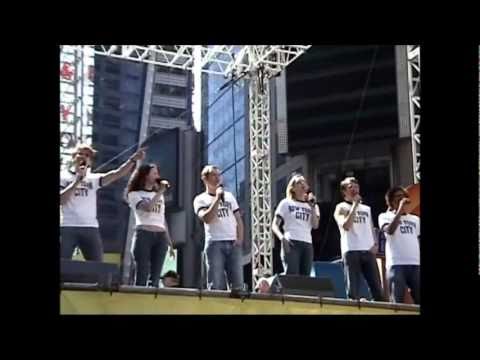
"New York City" (Company)
- The Scene:
- A company surge into the space like a pop-up concert that keeps turning into a history lesson. Projections and quick costume shifts create the sense of headlines landing in real time.
- Lyrical Meaning:
- It announces the show’s thesis: Lennon’s post-Beatles life is inseparable from New York’s noise. The lyric’s punchy street-level detail sells Lennon as citizen first, icon second.
"Mother" (John)
- The Scene:
- The lights narrow. The band recedes. One Lennon, alone enough to be frightening, sits in the emotional basement of the evening while the ensemble becomes a distant echo.
- Lyrical Meaning:
- This is the lyric that refuses charm. It’s grievance without decoration, and it explains why the “peace” songs later on can sound like both conviction and self-treatment.
"Instant Karma!" (Company)
- The Scene:
- The show pivots into rally mode. The band comes forward, the ensemble stacks harmonies, and the staging leans on the push of a live gig.
- Lyrical Meaning:
- The hook is a moral taunt: consequences are coming, now. In narrative terms, it’s Lennon turning outward, weaponizing pop as a public scold.
"How Do You Sleep?" (John)
- The Scene:
- A sharper, colder palette. The performers around Lennon feel less like friends and more like witnesses as the song lands like a cross-examination.
- Lyrical Meaning:
- It’s an anthem of resentment, and the show needs it. Without this track, Lennon becomes too saintly. Here, the lyric insists on ego, rivalry, and the uglier residue of genius.
"God" (John)
- The Scene:
- The staging simplifies. The attention is on declaration after declaration, each line dropping like a placard, with the band holding a restrained pulse.
- Lyrical Meaning:
- “God” is a breakup letter to the myths people want to sell for him. It’s also a confession of how badly he wants to control the story, which makes an authorized bio-musical an inherently risky container.
"Give Peace a Chance" (Company)
- The Scene:
- A communal build. The ensemble becomes crowd, press, and chorus at once, and the song plays like theatre’s oldest trick: making the audience feel recruited.
- Lyrical Meaning:
- As lyric, it’s almost aggressively simple. Its power comes from repetition as strategy, reducing politics to a chant anyone can carry out of the theatre.
"Woman Is the Nigger of the World" (Company)
- The Scene:
- The temperature changes. The staging needs to acknowledge the lyric’s provocation rather than glide past it, often by letting the ensemble frame it as argument, not karaoke.
- Lyrical Meaning:
- This is where Lennon’s activism gets messy: a lyric trying to shock an audience into moral attention. In 2026 ears, it reads as both outrage and overreach, which is precisely the point the show cannot afford to dodge.
"I Don't Want to Lose You (Now and Then)" (John)
- The Scene:
- A late-evening hush. The melody sits in unfinished-business territory, a private note that feels accidentally overheard.
- Lyrical Meaning:
- In a catalog full of manifestos, this is pure human fear. It’s also a fascinating archival hinge: a Lennon fragment with a long afterlife beyond this production.
"Imagine" (John / Company)
- The Scene:
- The show clears the stage of clutter. The lyric is treated as ritual: a final attempt to make a utopia feel personal, not poster-sized.
- Lyrical Meaning:
- “Imagine” is not dramatic because it has plot. It’s dramatic because it asks for consent. The song’s soft imperatives turn the audience into co-authors, which is why it remains the show’s inevitable ending.
Live updates
As of 2025-2026, “Lennon” itself is not a touring staple and has not returned to Broadway in a major revival. Its footprint is closer to a cautionary case study: a short-run bio-musical that aimed for universality through multi-casting and still got tagged as overly “authorized.” The most visible way the show lives on is through clips and memory, including public performance footage from 2005 that continues to circulate online.
What has changed is the surrounding Lennon ecosystem. The Beatles’ completion and release of “Now and Then” in 2023 reignited mainstream interest in Lennon’s late-period writing, and the 2025 documentary “One to One: John & Yoko” pushed renewed attention onto the New York activism era that “Lennon” tries to stage. Meanwhile, the John Lennon estate continues issuing archival and curated releases, including major boxed sets that keep the solo catalog in heavy rotation for new listeners. None of that automatically equals a stage revival, but it does make the underlying songbook feel current rather than museum-bound.
Also worth a clarity note: several 2025 tours branded around Lennon’s name (for example, concert-style “John Lennon Story” evenings) are separate productions, not revivals of the 2005 Broadway musical. If you are looking for “Lennon” specifically, use Don Scardino’s title and the 2005 Broadway credit to avoid buying tickets to a different show.
Notes & trivia
- Scardino described the concept as an acting troupe unpacking and announcing “Tonight, we do John Lennon,” a framing device meant to foreground theatre-making itself.
- The Broadway staging used a diverse ensemble with an onstage 10-piece band, plus extensive projections across multiple screens.
- The production was mounted by arrangement with Yoko Ono Lennon, who required script approval and a workshop presentation before the catalog could be used.
- Ono gave permission for previously unpublished Lennon songs to be used in the show, including “India, India” and “I Don’t Want to Lose You.”
- The tryout path included San Francisco, a canceled Boston engagement, and a return to rehearsal to implement changes before Broadway.
- Playbill reported “No Recording Announced” for “Lennon” in September 2005, and no official original Broadway cast album became a standard release.
- The Broadway run was brief: 42 previews and 49 performances, closing in September 2005.
Reception
In 2005, critics largely judged “Lennon” against two standards at once: the theatrical rigor expected on Broadway and the moral complexity people project onto Lennon himself. Some found the evening flattened the man into a broadly inspirational symbol. Others objected to what was missing: Beatles-era songwriting, darker personal chapters, and the unflattering edges that make Lennon’s lyrics interesting in the first place.
“He is simplified, defanged. He is turned into Everyrebel, a hunky martyr in granny glasses.”
“Somewhere between an I-Spy Book of Lennon … and the New Testament.”
“A paint-by-the-numbers sing-along pastiche that never comes together.”
Viewed now, the show’s experiment with identity reads more modern than its reputation suggests. Multi-casting a rock icon across gender and race is a bold structural decision, especially for 2005 Broadway. The larger issue is still the same: Lennon’s lyrics are confrontational, contradictory, sometimes petty, sometimes radiant. A bio-musical that wants him consistently noble will keep fighting the material.
Quick facts
- Title: Lennon
- Year: 2005 (San Francisco premiere; Broadway run)
- Type: Bio-musical / catalog musical using John Lennon songs
- Book / Direction: Don Scardino
- Music & Lyrics: John Lennon
- Broadway venue: Broadhurst Theatre
- Broadway dates: Previews began July 7, 2005; opened Aug. 14, 2005; closed Sept. 24, 2005
- Music supervision: Lon Hoyt
- Orchestrations: Harold Wheeler
- Design signature: Scenic/projection plus heavy use of video and photo material
- Selected notable placements in-story: “(Just Like) Starting Over” leading into the onstage retelling of Lennon’s death; “Imagine” as final song
- Album status: No official Original Broadway Cast Recording announced in 2005; listening tends to default to Lennon’s original studio albums and live releases
- Availability: Performance clips exist publicly; the show’s score is primarily accessed via Lennon’s recorded catalog rather than a cast album
Frequently asked questions
- Is “Lennon” a Beatles jukebox musical?
- No. The show focuses on Lennon’s solo career and avoids the Lennon-McCartney Beatles catalog by creative choice, which became a major point of debate.
- Who “plays” John Lennon in the show?
- Broadway used a concept where multiple performers embodied Lennon, with a principal narrator Lennon anchoring the evening while the ensemble rotated through ages and facets of the persona.
- Is there an official cast recording?
- Playbill listed “Lennon” under “No Recording Announced” in September 2005, and an official original Broadway cast album did not become a standard commercial release.
- What are the most important songs for plot and theme?
- “Mother,” “God,” “How Do You Sleep?,” “Give Peace a Chance,” and “Imagine” do the heaviest narrative lifting because the lyrics contain conflict, philosophy, and resolution.
- Does the show include Yoko Ono?
- Yes, as a character. The production was also developed with Yoko Ono Lennon’s approval, which shaped both the script and what the show chose to emphasize.
- Where can I start listening if I want the “soundtrack” experience?
- Start with Lennon’s “Plastic Ono Band” material for the raw confessionals (“Mother,” “God”), then move to “Imagine” and later New York-era tracks for the activist and domestic songs the show strings into biography.
Key contributors
| Name | Role | Contribution |
|---|---|---|
| Don Scardino | Book, Director | Constructed the script largely from Lennon’s words and built the multi-identity staging concept. |
| John Lennon | Composer, Lyricist | Song catalog forms the score; lyrics supply the show’s primary conflicts and self-portraiture. |
| Yoko Ono Lennon | Rights holder / Creative stakeholder | Approved the project and enabled catalog use; publicly discussed the show’s depiction of key moments. |
| Lon Hoyt | Music Supervisor | Oversaw musical realization and arrangements for stage performance. |
| Harold Wheeler | Orchestrations | Shaped the rock-band-forward sound world to match Lennon’s recorded style. |
| Natasha Katz | Lighting Design | Supported the show’s constant identity shifts with concert-to-intimate transitions. |
| John Arnone | Scenic / Projection Design | Integrated screens, imagery, and period media to frame biography as public history. |
Sources: Playbill, IBDB, Broadway.com, SFGATE, The Guardian, StageAgent, Pitchfork, JohnLennon.com