Kiss Me, Kate Lyrics – All Songs from the Musical
Kiss Me, Kate Lyrics: Song List
- Act 1
- Another Op'nin', Another Show
- Why Can't You Behave?
- Wunderbar
- So in Love
- We Open in Venice
- Tom, Dick, or Harry
- I've Come to Wive It Wealthily in Padua
- I Hate Men
- Were Thine That Special Face
- Cantiamo d'Amore (We Sing of Love)
- Kiss Me, Kate
- Act 2
- Too Darn Hot
- Where Is the Life That Late I Led?
- Always True to You (In My Fashion)
- From This Moment On
- Bianca
- So in Love (Reprise)
- Brush up Your Shakespeare
- I Am Ashamed That Women Are So Simple
- Kiss Me, Kate (Finale)
About the "Kiss Me, Kate" Stage Show
This musical is written by the Spewacks. C. Porter is an author of the music. Porter's wife Linda acquainted him with journalists Samuel and Bella Spewak. The spouses had fiery temperament. Their matrimonial life constantly teetered on the brink of divorce. That inspired Bella on writing of modern option of Shakespeare's play. Porter had an idea to make the musical according to this scenario.The first version of the performance was shown on Broadway in 1948. The musical had deafening success therefore its display lasted 19 months. J. C. Wilson was the director. Actors were the following: A. Drake, P. Morison, L. Kirk, H. Lang, C. Wood and H. Clark. The UK version of the musical was created on West End in 1951. The cast included P. Morison, B. Johnson, A. Hall and J. Wilson.
The next versions were created in London in 1970, 1987, 2001 and 2012. Broadway revival took place in 1999. The musical has 41 nominations. It won 17 of them, including 11 Tony Awards. The musical has also one film version and 4 embodiments on TV. The first of them was let out in 1953.
Release date: 1948
"Kiss Me, Kate" – The Musical Guide & Song Meanings
Review: Porter’s lyrics as stage management
“Kiss Me, Kate” is about romance, sure, but its lyrics are doing a more practical job: they keep the evening moving. Cole Porter writes like a man who understands traffic patterns. Every internal rhyme, every hard consonant, every elegant punchline nudges a scene from backstage chaos to onstage “performance” and back again, without losing the audience in the corridor.
What makes the lyric writing unusually rich is the show’s double life. The “real” world is a 1948 Baltimore tryout at Ford’s Theatre, all dressing-room nerves and petty revenge. The “play” world is Padua, full of formal courtship and public humiliation. Porter shifts language to match the costume rack. The Shakespeare-side numbers often sit in cleaner, more classical phrasing, while the backstage songs talk like adults who know the rules and keep breaking them. The Library of Congress essay on the original cast recording points out how deliberately Porter tailors musical style and text to those two timeframes, and you can hear that logic even when you’re only reading the lyrics.
The lyric themes are blunt, because the characters are. Desire is embarrassing, ambition is constant, and power is always negotiating with comedy. The show’s biggest issue is also its central engine: it’s built on “The Taming of the Shrew,” and that means the text keeps brushing up against coercion. Modern revivals tend to address this by adjusting the ending, trimming certain lines, and reframing problematic jokes with performance choices that aim for critique rather than endorsement. Sometimes that helps. Sometimes the lyric brilliance just makes the discomfort easier to sing along to.
How it was made: a real couple, a painful composer, an album recorded after midnight
The founding anecdote is theatrical gossip with teeth. Producer Arnold Saint Subber reportedly got the idea after seeing famed married actors Alfred Lunt and Lynn Fontanne bicker offstage during their “Shrew,” then watching that friction spark onstage electricity. He brought in Bella and Sam Spewack for the book, and Porter for music and lyrics. The Library of Congress essay adds a key detail lyric obsessives love: Bella Spewack would suggest titles pulled from Shakespeare lines and from the script, knowing Porter liked to build songs around a strong phrase. That is basically an origin story for why these lyrics feel so “spoken,” even at full melody.
There’s also the physical reality behind the polish. Porter wrote “Kiss Me, Kate” while dealing with intense, lasting pain from his 1937 riding accident, a fact the Library of Congress notes in its discussion of the score’s late-career leap in dramatic integration.
Then the soundtrack album became its own innovation. Columbia recorded the original cast album in midnight sessions early in the Broadway run and released it quickly, making it one of the earliest “modern” cast albums, and a landmark in the new 12-inch LP format. It is a rare case where the recording history is part of the show’s identity: the lyrics weren’t just heard in the theatre, they were packaged fast for living rooms.
Key tracks & scenes
"Another Op'nin', Another Show" (Company)
- The Scene:
- The curtain rises on a rehearsal room running on caffeine and dread. Clipboards, ladders, costumes half-on. Work light energy that gradually “snaps” into show light as the number locks in.
- Lyrical Meaning:
- This is the thesis in rhyme: theatre is a repeatable crisis. The lyric’s pace mimics a calling script, cueing the audience to accept chaos as craft.
"Wunderbar" (Fred & Lilli)
- The Scene:
- Backstage, before the onstage “Shrew” world fully takes over. Two exes stumble into nostalgia like it’s a prop they didn’t mean to touch. Lighting often warms, as if memory has its own gel.
- Lyrical Meaning:
- Porter uses faux-European sweetness as emotional camouflage. The lyric flirts with past romance, then admits how dangerous that flirtation still is.
"So in Love" (Lilli)
- The Scene:
- Lilli alone, after a backstage slight that lands like betrayal. The stage tends to empty out, leaving a single pool of light and a voice that has nowhere to hide.
- Lyrical Meaning:
- The lyric is not coy. It’s an adult confession with an ache in its vowels. Love is framed as certainty, not virtue, which is why the song still lands outside the period comedy.
"Too Darn Hot" (Paul & Ensemble)
- The Scene:
- Intermission, outside in the alley behind the theatre. Shirts loosened, bodies cooling off, desire still loud. Choreography often turns the heat into percussion.
- Lyrical Meaning:
- Porter makes libido comic by making it precise. The lyric name-checks the Kinsey Report, turning sex research into a punchline and a permission slip.
"I Hate Men" (Kate)
- The Scene:
- Onstage as Katherine, in full Padua attitude. Bright “presentation” lighting, a character performing anger for an audience inside the audience.
- Lyrical Meaning:
- This is grievance as aria, but the rhyme scheme keeps it playful. The joke is that Kate’s fury is intelligent, and intelligence is what the men can’t comfortably handle.
"Always True to You (In My Fashion)" (Lois)
- The Scene:
- Backstage seduction as survival. Lois smiles through a situation that is half flirtation, half negotiation. Many recent productions stage it with an edge, letting the room feel slightly unsafe.
- Lyrical Meaning:
- The lyric weaponizes euphemism. “Faithful” becomes a flexible term, and Porter lets the audience enjoy the wit while noticing the economics under it.
"Where Is the Life That Late I Led?" (Petruchio/Fred)
- The Scene:
- Act II swagger, sung by a man pretending to mourn freedom while clearly enjoying the attention. The staging often leans operatic, almost mock-heroic, because the character is posing.
- Lyrical Meaning:
- It’s a brag disguised as regret. Porter’s internal rhymes make the list of conquests sound like patter, which turns male self-mythology into comedy.
"Brush Up Your Shakespeare" (The Gangsters)
- The Scene:
- Two thugs get stuck onstage and decide to teach the audience a lesson in literary seduction. The number usually plays downstage, direct address, with a conspiratorial spotlight and a grin that says, “Yes, we know this is ridiculous.”
- Lyrical Meaning:
- Porter turns cultural capital into pickup advice. The joke structure is simple: name a play, rhyme something scandalous, promise romantic results. The deeper joke is that everyone, gangster or actor, is selling a script.
Live updates: 2025–2026
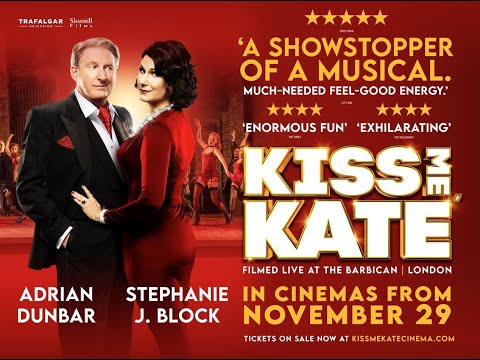
Information current as of January 2026. The most visible “Kiss Me, Kate” footprint right now is screen-based, not a new Broadway run. Bartlett Sher’s Barbican staging was filmed and has circulated as a broadcast and streaming title: it aired in the U.S. via “Great Performances” (May 30, 2025), and the production has also been available on BBC iPlayer in the U.K. following a BBC Two broadcast in December 2025. Some PBS station and Passport windows shift over time, so availability depends on where you watch.
Onstage, the show remains a steady licensing staple, with multiple authorized versions in circulation. Concord Theatricals licenses the original 1948 version and the revised 1999 edition, which reflects later performance history and additions. Practically, that means your local “Kiss Me, Kate” may not be the same lyric experience as the one your friend saw: individual songs have been cut or restored in different revivals, and certain lines have been updated in modern stagings.
Notes & trivia
- The original Broadway run opened Dec 30, 1948 and played 1,077 performances, first at the New Century Theatre and later at the Shubert.
- It won the first Tony Award for Best Musical (1949), plus additional Tonys for Porter and the Spewacks.
- The show-within-a-show is set at Ford’s Theatre in Baltimore, during a June 1948 tryout.
- The Library of Congress notes the original cast album was recorded in midnight sessions early in the run and released Feb 15, 1949, as Columbia’s first original cast LP on the new 12-inch format.
- That same essay highlights Porter’s technique of matching musical and lyrical style to the “Padua” world versus the backstage world.
- The 2019 Broadway revival involved “additional material” by Amanda Green, part of a broader trend of tuning the script for contemporary audiences.
- “Too Darn Hot” nods to the Kinsey Report, giving the lyric a timestamp that still reads as mischievous stage gossip.
Reception: then vs. now
Critically, “Kiss Me, Kate” tends to earn the same compliment in every era: the lyrics are smarter than the mess they’re cleaning up. What changes is the tolerance for the mess. Contemporary reviews praise the score’s wit and momentum, while also debating what to do with a story that inherits “Shrew’s” gender politics. The best revivals don’t pretend the issue isn’t there; they stage around it, sometimes rewriting the final beat so reconciliation reads as choice, not capitulation.
“snappy internal rhymes”
“Porter’s songs … enliven an uneven but still enjoyable revival.”
“the new lyrics are a heavy price to pay.”
Quick facts
- Title: Kiss Me, Kate
- Year: 1948 (Broadway opening)
- Type: Musical comedy; show-within-a-show based on “The Taming of the Shrew”
- Music & Lyrics: Cole Porter
- Book: Bella Spewack & Samuel Spewack
- Original Broadway setting: Ford’s Theatre, Baltimore. June 1948.
- Selected notable placements: Opening rehearsal (“Another Op’nin’, Another Show”); intermission alley (“Too Darn Hot”); onstage “Padua” set pieces (“I Hate Men,” “Where Is the Life…”); gangster interruption (“Brush Up Your Shakespeare”)
- Original cast album context: Recorded early in the run in midnight sessions; released Feb 15, 1949 (Columbia), an early milestone in cast recording history
- Modern recordings: 2019 Broadway cast recording released digitally June 7, 2019 (Ghostlight Records)
- Licensing: Concord Theatricals (Original 1948; Revised 1999)
- Recent screen footprint: Filmed Barbican production released via “Great Performances” (U.S.) and BBC iPlayer (U.K.)
Frequently asked questions
- Who wrote the lyrics to “Kiss Me, Kate”?
- Cole Porter wrote both music and lyrics, with a book by Bella and Samuel Spewack.
- Where does “Another Op’nin’, Another Show” happen?
- It opens the musical in a rehearsal setting, framing the company’s pre-show panic as the first joke and the first truth.
- What is “Too Darn Hot” actually about?
- It’s an intermission blow-off number, staged outside the theatre, turning summer heat into a coded conversation about desire and restraint.
- Why is “Always True to You (In My Fashion)” controversial in 2026?
- The lyric’s humor is built on transactional flirtation and power imbalance. Modern productions often stage it to acknowledge the unease, not erase it.
- Is there a recent professional recording I can watch?
- Yes. Bartlett Sher’s Barbican production was filmed and appeared in the U.S. on “Great Performances” in 2025, and it has also been available on BBC iPlayer in the U.K. after a 2025 broadcast.
- Which cast album is best for following the lyrics?
- The 1949 original Broadway cast album is historically important and unusually helpful for story context. For cleaner modern sound, the 2019 Broadway cast recording is a strong alternative.
Key contributors
| Name | Role | Contribution |
|---|---|---|
| Cole Porter | Composer-Lyricist | Wrote the full score, shifting lyrical voice between backstage realism and the “Padua” play world. |
| Bella Spewack | Book writer | Co-wrote the book; collaborated closely with Porter on song concepts and titles drawn from script and Shakespeare phrasing. |
| Samuel Spewack | Book writer | Co-wrote the book; helped shape the backstage comedy structure and subplot mechanics. |
| Arnold Saint Subber | Producer (origin) | Conceived the concept after observing the Lunt-Fontanne “Shrew” dynamic; launched the project with the Spewacks and Porter. |
| Hanya Holm | Choreographer (original Broadway) | Built the movement language that helped define the show’s split identity: backstage bustle and onstage pageantry. |
| Robert Russell Bennett | Orchestrator (original Broadway) | Orchestrated the original production, shaping the sonic contrast between classical parody and contemporary swing. |
| Amanda Green | Additional material (revival) | Contributed to modern revisions that adjust wording and emphasis for contemporary audiences. |
| Bartlett Sher | Director (Barbican production) | Staged a major recent revival captured for broadcast, including interpretive choices around the ending and character framing. |
Sources: Library of Congress (National Recording Registry essay), IBDB, Tony Awards (American Theatre Wing), LondonTheatre.co.uk, Concord Theatricals, Barbican, Playbill, The Guardian, Variety, Exeunt NYC, PBS Thirteen / Great Performances, KPBS, WestEndTheatre.com, YouTube (official trailers and clips).