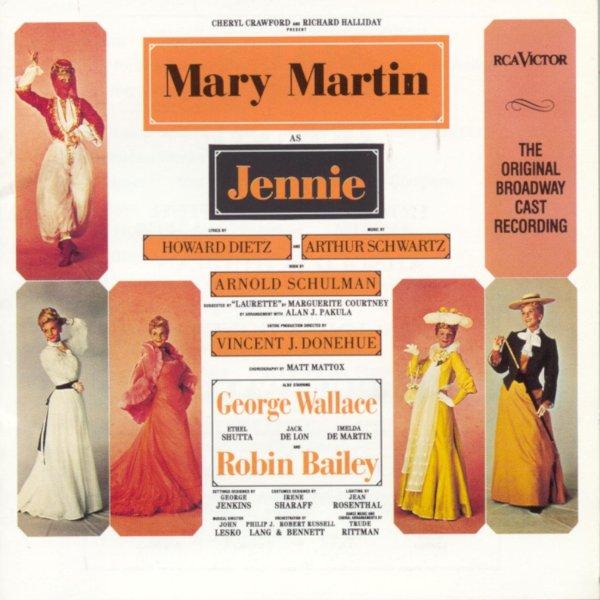
Jennie Lyrics: Song List
- Act 1
- Overture
- Waitin' for the Evening Train
- When You're Far Away from New York Town
- I Still Look at You That Way
- For Better or Worse
- Born Again
- Over Here
- Before I Kiss the World Goodbye
- Sauce Diable
- Where You Are
- The Jig
- See Seattle
- Act 2
- High Is Better Than Low
- The Night May Be Dark
- Dance Rehearsal
- I Believe in Takin' a Chance
- Welcome
- Lonely Nights
- Before I Kiss the World Goodbye (Reprise)
About the "Jennie" Stage Show
The staging has been conceived in 1950, when the family of the actress wanted to glorify her name, creating a stage musical. It was necessary to spend USD 1 million on it, and they have applied for funding from several eminent theatrical producers of that time, who made input of half of the amount, the rest creators of the show have invested themselves. The only condition was to attend the star Cheryl Crawford, but later she was replaced by more eminent Mary Martin.
Production was revised several times in the course of development, as the original script did not suit the producers, or failed during the previews (for example, one version during the pre-reading lasted for only 1 week). As a result, it was decided not to adhere to any chronology or the veracity of the narrative about the life events of prototypes, completely changing the story for the sake of entertainment.
After that began a pre-Broadway shows, as a result of which many critics, though positively speaking about the musical part of the play, generally revealed restrained, moderate reaction on to this theatrical. Many called it boring, solemn, too formal, even disappointing. The composer even sued one of too zealous critics, who allowed himself to say that the composer has stolen some of the sound from other composers.
When production came to the then thriving Detroit, there was a small change of actors (D. O'Keefe left & G. Wallace took his place). Following some personal reasons, the creators did not want to go to NY, but then they had to make up the settlement for the audience that already purchased tickets for substantial USD 1.35 million, which forced them to adhere to previous commitments.
So, on the Broadway musical was opened in 1963 and gave only 86 shows, including the preliminary ones. The critics were right – the story was too dry to stick to hearts of the audience, and a substantial portion of invested funds had not paid off.
Release date of the musical: 1963
"Jennie" – The Musical Guide & Song Meanings
Review: what “Jennie” is really about
How do you build a musical about an actress who performs inside other shows and still make the “real life” feel more urgent than the pastiche? “Jennie” tries by turning stage life into a pressure cooker: props that burn, managers who bluff, husbands who swear it will all work out tomorrow. It largely succeeds on album, where Howard Dietz and Arthur Schwartz can do what they did best: write grown-up lyrics that sound conversational until the rhyme quietly tightens the screw. The show’s core theme is not fame. It’s stamina. Specifically, the kind you need when love and work share the same cramped backstage corridor.
Musically, it’s postwar Broadway craft looking back at prewar theatrical hustle. Schwartz’s melodies rarely posture; they move like experienced performers, stepping around jokes, then catching the heart on the way out. Dietz, meanwhile, writes with a reporter’s eye for human self-justification. Jennie forgives. Jennie compromises. Jennie keeps the company moving. And when she finally chooses ambition over marital triage, the lyrics frame it as self-respect rather than betrayal. Listener tip: follow the plot by treating the album like a travelogue. Each city stop is a moral test, and the choruses often say what the characters refuse to admit in dialogue.
How it was made: the messy biography problem
“Jennie” began in the late 1950s as a project about actress Laurette Taylor, sparked by a biography written by Taylor’s daughter. Early drafts wandered: one non-musical version with Judy Holliday collapsed quickly out of town, and the musical concept itself went through competing “what is this story?” phases, including a version that was later abandoned and a later rewrite that fictionalized the characters. Then came the tryout turmoil: major character surgery in Boston, a choreography switch, a leading-man replacement in Detroit, and a producer-composer relationship that got so sour it flirted with lawsuits. The show did reach Broadway, but you can feel the seam lines in the finished piece: it’s a musical that wants both affectionate satire of barnstorming melodrama and a serious domestic drama about a woman choosing a life. Those are not natural roommates.
The most revealing origin detail is the litigation-adjacent panic: Schwartz sued a newspaper over a review implication of plagiarism. That’s not just gossip. It’s a sign of how high the temperature ran around this score, and how personally its makers took the idea that craft could be mistaken for theft. That anxiety sits behind the writing: Dietz and Schwartz sound like artists insisting, song by song, that theatre people are not frauds, even when their scenery is being repossessed.
Key tracks & scenes: where the lyrics land
"Waitin’ for the Evening Train" (Jennie Malone, James O’Connor)
- The Scene:
- Backstage in a town that’s done with them. The sheriff seizes luggage and scenery; Jennie is left managing damage control while James plays the wounded romantic. The light feels practical, workmanlike, like stage bulbs that never flatter anyone.
- Lyrical Meaning:
- This is the marriage in miniature: waiting, bargaining, postponing consequences. The lyric’s patience is not sweetness. It’s strategy. Jennie keeps telling herself “later” because “now” would mean collapse.
"When You’re Far Away from New York Town" (Abe O’Shaughnessy, Company)
- The Scene:
- A town square with stranded performers, nostalgia and hunger sharing the same bench. The company manager sells a fantasy of home while everyone looks at the road they’re stuck on.
- Lyrical Meaning:
- Dietz flips “New York” into a psychological location, not a map dot. The lyric works because it admits the contradiction: they resent the city’s indifference, and still want its validation.
"I Still Look at You That Way" (Jennie Malone)
- The Scene:
- Jennie rescues James from angry locals after he strays, literally using an umbrella like a weapon and a shield. The staging reads like slapstick with bruises underneath.
- Lyrical Meaning:
- A forgiveness song that refuses to sound saintly. The lyric’s ache is in the word “still”: she knows the evidence, and the feeling persists anyway. It’s not romantic blindness. It’s romantic muscle memory.
"Born Again" (James O’Connor, Abe O’Shaughnessy, Company)
- The Scene:
- New York. Jennie’s luck turns, and a “bit part” becomes an opening. The energy shifts to rehearsal velocity, the kind of bustle that makes a person believe in reinvention.
- Lyrical Meaning:
- The title is ironic. Everyone claims rebirth while carrying the same habits into the next act. The lyric functions as the show’s engine: theatre as a machine for second chances.
"Before I Kiss the World Good-Bye" (Jennie Malone)
- The Scene:
- At home after romance begins to bloom, Jennie sings to the room the way an actress sings to an audience she can’t see yet. It plays intimate on album, but it’s built for a spotlight.
- Lyrical Meaning:
- This is Jennie’s self-authored mission statement. The lyric doesn’t brag about success; it insists on noticing life before it ends. That’s why the reprise later lands as choice, not sentimentality.
"See Seattle" (James O’Connor)
- The Scene:
- Sunday afternoon, family meeting planned. Then James returns from Seattle like a storm cloud with a sales pitch, interrupting Jennie’s careful attempt to blend work, children, and Christopher’s world.
- Lyrical Meaning:
- James sings the way a gambler talks: fast, persuasive, allergic to detail. In lyric terms, it’s the sound of a man trying to rhyme his way out of accountability.
"High Is Better Than Low" (James O’Connor, Jennie Malone, Company)
- The Scene:
- In a dilapidated ex-church in Seattle that James wants to turn into a theatre, Jennie rallies the troupe. The number is communal, almost like a group self-hypnosis session.
- Lyrical Meaning:
- The lyric sells optimism as a survival tool, not a philosophy. It’s what people sing when the building is falling apart and they need their bodies to keep moving anyway.
"Lonely Nights" (Jennie Malone)
- The Scene:
- Onstage inside the onstage show, in harem costume, Jennie performs comedy as a defense mechanism. Later, when a flash fire hits the theatre during “The Sultan’s 50th Bride,” the joke curdles into danger.
- Lyrical Meaning:
- Dietz gives Jennie a lyric that weaponizes wit. The jokes are the point: she’s learned that laughter buys her time. Underneath, it’s still the same request as earlier songs, just in brighter clothing: don’t abandon me.
Live updates (2025/2026): where to find it now
Information current as of January 2026. “Jennie” is not a repertory warhorse, and it isn’t sitting on the usual commercial revival conveyor belt. Its modern footprint is mostly audio and archive. The original cast recording remains officially available through Sony’s Masterworks Broadway channel, and it’s also up on major streaming services. If you want the quickest narrative clarity, start with the Masterworks synopsis, then listen straight through without shuffle. The album’s scene-to-song logic is unusually explicit for a 1963 release.
For a performance echo, there’s a later Broadway-stage appearance by Mary Martin singing “Before I Kiss the World Good-Bye,” which functions as a reminder of what “Jennie” was built to do: put a star in a tight beam and let the lyric do the heavy lifting. If a revival ever happens, the smartest contemporary approach would be to sharpen the biography angle: either embrace the spoof structure as the point, or commit fully to the marriage story. The original tried to be gracious to both, and that politeness is part of why it’s remembered as “interesting” rather than necessary.
Notes & trivia
- The Playbill’s own scene-and-number list pins several songs to specific settings, including “Waitin’ for the Evening Train” backstage and “When You’re Far Away from New York Town” in the town square.
- The Masterworks album synopsis describes an onstage waterfall effect that floods and ruins a theatre before the sheriff starts seizing the company’s belongings.
- During out-of-town tryouts, a major character (Jennie’s second husband) was eliminated, and the choreography credit shifted when Carol Haney replaced Matt Mattox.
- Arthur Schwartz sued The Boston Globe and a critic over an implication of plagiarism in a review.
- The original Broadway production credits include lighting by Jean Rosenthal and costumes by Irene Sharaff, two names that signal real ambition behind a short run.
- A contemporary out-of-town review notes a fire-damaged theatre scene “created by magnificent lighting,” an unusually concrete staging detail to survive in print.
- The original cast recording is associated with RCA Victor, and later catalog life runs through Masterworks Broadway and Sony.
Reception: critics, then and now
The critical story of “Jennie” is a familiar Broadway species: praise the star, side-eye the evening. Even sources that admire Dietz and Schwartz’s craftsmanship often describe the book’s tonal wobble, with the show wanting to spoof melodrama while also asking you to take Jennie’s domestic pain seriously. That push-pull is audible on the album: the comedy material has bite, and the ballads have adult calm. The connective tissue is where the show seems to ask the audience to do extra work.
“Not that Miss Martin has lost her luster... she continues to be a game and resourceful trouper...”
“a woeful tale of some woeful people told in a woeful way.”
“Howard Dietz's lyrics are almost clever but never reach their mark.”
Now, the pendulum has swung toward reassessment of the score and the album as a document. The recording’s staying power is the simplest evidence: even supporters admit the stage piece stumbled, but the songs still play like professionals doing their jobs at a high level. The show may be a footnote; the lyric technique is not.
Quick facts: album & production metadata
- Title: Jennie
- Year: 1963 (Broadway production)
- Type: Broadway musical (book musical with period-show pastiche)
- Book: Arnold Schulman
- Music & Lyrics: Arthur Schwartz, Howard Dietz
- Basis: Inspired by the life of actress Laurette Taylor
- Broadway venue: Majestic Theatre
- Setting: South Dakota, New York City, Seattle (1906)
- Label / album status: Original cast recording associated with RCA Victor; later catalog via Masterworks Broadway / Sony
- Cast recording availability: Official Masterworks page; major streaming services list 16 tracks and ~44 minutes
- Selected notable scene placements (album synopsis): Sheriff seizes the troupe’s gear; Jennie consoles James backstage; “The Sultan’s 50th Bride” sequence culminates in a flash fire
Frequently asked questions
- Who wrote the lyrics in “Jennie”?
- Howard Dietz, co-credited with Arthur Schwartz (who also wrote the music). The book is by Arnold Schulman.
- Is there a movie version of “Jennie”?
- Not as a standard feature-film musical adaptation. What circulates today is primarily the original cast recording and archival clips of Mary Martin performing at later events.
- Where does “Lonely Nights” happen in the story?
- It’s performed as a comic stage number inside the troupe’s show, with Jennie in harem costume. It arrives late, after conflict with Christopher and just before the production’s disastrous fire.
- Why did “Jennie” close so quickly on Broadway?
- It opened at the Majestic in October 1963 and ran 82 performances. Contemporary commentary points to disappointment with the overall show even when reviewers praised Mary Martin and elements of the score.
- How do I listen to the album if I don’t know the plot?
- Start with the Masterworks album synopsis, then play the tracks in order. The synopsis maps songs to locations and story beats more clearly than most cast-album copy does.
- Is the cast recording easy to find today?
- Yes. It’s officially posted under Masterworks Broadway, and major platforms list it as “Jennie (Original Broadway Cast Recording).”
Key contributors
| Name | Role | Contribution |
|---|---|---|
| Arthur Schwartz | Composer / Lyricist | Co-wrote music and lyrics; veteran craftsman score. |
| Howard Dietz | Lyricist / Composer (co-credit) | Lyrics with conversational bite; co-credited on music. |
| Arnold Schulman | Book writer | Fictionalized the story into Jennie Malone’s touring life. |
| Mary Martin | Original star | Created Jennie Malone; anchored the score’s emotional authority. |
| George D. Wallace | Original cast | Created James O’Connor; key to the show’s marriage conflict. |
| Robin Bailey | Original cast | Created Christopher Lawrence Cromwell, the “other life” Jennie is offered. |
| Ethel Shutta | Original cast | Created Nellie Malone; delivers the show’s hard-edged maternal counsel. |
| Vincent J. Donehue | Director | Staged a structure that toggles between spoof and domestic drama. |
| Jean Rosenthal | Lighting designer | Broadway lighting credit; a key part of the show’s stagecraft ambition. |
| Irene Sharaff | Costume designer | Costumes supporting both period realism and inside-the-show spectacle. |
| George Jenkins | Scenic designer | Sets built for touring-theatre chaos and big melodrama effects. |
| John Lesko | Musical director | Led the production’s musical life; credited on the original recording context. |
| Trude Rittmann | Arranger | Dance and vocal arrangements, shaping the score’s theatrical propulsion. |
| Philip J. Lang & Robert Russell Bennett | Orchestrators | Orchestration credits that place the score in top-tier Broadway practice. |
Sources: Masterworks Broadway (Sony), Playbill Vault, IBDB, The Harvard Crimson, Apple Music, Spotify, PBS “Broadway: The American Musical,” Wikipedia (for aggregated background and review excerpts).