In Trousers Lyrics – All Songs from the Musical
In Trousers Lyrics: Song List
- Marvin's Giddy Seizures
- How The Body Falls Apart/Your Lips And Me
- My High School Sweetheart
- Set Those Sails
- My Chance To Survive The Night
-
I Am Wearing A Hat (Marvin Takes A Wife)
- How Marvin Eats His Breakfast
- A Breakfast Over Sugar
- Whizzer Going Down
- High School Ladies At 5 O'clock
- The Rape Of Miss Goldberg
- The Nausea Before The Game
- Love Me For What I Am
- Michael's Final Words From How America Got It's Name
- Your Lips And Me (Reprise)
- Marvin Takes a Victory Shower
-
Another Sleepless Night
- In Trousers (The Dream)
About the "In Trousers" Stage Show
The director of this musical is Finn. The Show was staged twice – the first started in the end of February in 1979 (there were only 24 performances carried out) and the second in December the same year (showing eight more performances). Two productions were displayed with the same actors, among which there were the following: C. Zien, J. Green, M. Testa and A. Fraser.In 1981, the musical was produced at Second Stage Theatre. In that version, Jay O. Sanders played the main hero – Marvin. Judith Swift became the director of the production, while Marta Renzi and Sharon Kinney created wonderful choreography. In 1985, there was another version of “In Trousers” created. The story was very similar, but several more songs were added. Thus, the list of the songs was almost twice longer than for the previous version. Besides, the characters became defined much better. The premier took place at the Promenade Theatre. In general, there were 16 performances of this version. Matt Casella was the director, while the actors were S. Bogardus, C. Cox, S. Hursey, and K. Garrick.
Original cast album is also available on CD. William Finn is considered to be a great songwriter. So, the critics thing that the album is absolutely worth listening. Some other additional musicals were created a bit later. They were focused on the observation of life of the main character. The creators were William Finn and James Lapine. The titles are as follows – “March of the Falsettos” and “Falsettoland”.
Release date: 1979
“In Trousers” – The Musical Guide & Song Meanings
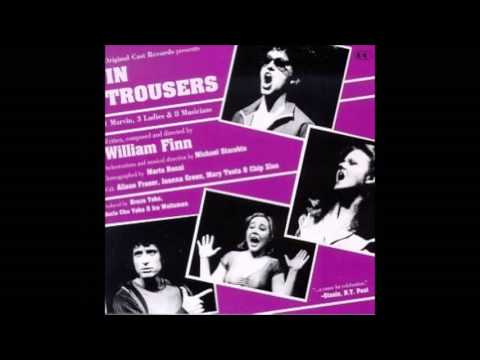
The lyrics in “In Trousers” are funny on purpose, then they refuse to stay funny
In Trousers is William Finn’s early chapter about Marvin, the same Marvin whose later life gets sharpened, expanded, and finally Broadway-ized in Falsettos. Here, the writing is smaller, pricklier, and more openly experimental. The show behaves like a memory file that keeps opening the wrong folder: adolescence, marriage, school, sex, self-invention. If you want a tidy story, you will be irritated. If you want a mind, under pressure, narrating itself in real time, you are in the right place.
Finn’s lyrical trick is compression. He stacks quick turns of phrase, repeats them until they become motifs, then lets repetition curdle into panic. The effect is diagnostic: Marvin tells jokes the way he avoids decisions, while the three women around him keep interrupting his narrative with their own needs. Even the title is a tell, it’s about what’s visible, what’s concealed, and what a person thinks they can pull off in public.
Musically, the writing lives in a contemporary theatre idiom that can pivot from patter to confession without changing shoes. The score is not interested in “big” songs as much as it is interested in what a song can do to time. One minute we are in a kitchen, the next we are back at a school play, the next we are in a dream. That jump-cut logic is the point.
How it was made: Finn used Marvin’s “education” to narrate his own
The show’s origin story is unusually candid because Finn practically wrote the footnote for us. In a note associated with the published edition, he framed the material as an apprenticeship: he was learning how to write the kind of show songs he wanted to write, so the piece is about Marvin’s education and his own. That statement explains the form better than any plot synopsis, it is a workshop that got brave enough to invite an audience.
The first major Off-Broadway run was at Playwrights Horizons in 1979, directed by Finn, with a compact four-person cast and a design team built for intimacy rather than spectacle. Years later, a significantly rewritten version opened Off-Broadway in 1985, and that revised text is the version that has largely become the licensing standard. The show did not so much “arrive” as it kept re-arriving, each time closer to the Marvin we recognize from the later trilogy.
Key tracks & scenes
“In Trousers” (Marvin and the Ladies)
- The Scene:
- Darkness, or close to it. Marvin is awake when he should be asleep. The space reads like a bedroom that can instantly turn into a classroom, a kitchen, a memory. Light comes in slices, like thought.
- Lyrical Meaning:
- This opener works as a nervous overture. The lyric puts Marvin’s self-image on trial immediately: what he wears, what he hides, what he thinks people see.
“Time to Wake Up” (His Wife)
- The Scene:
- Morning routines. The wife is practical, brisk, and tired of negotiating reality with a man who keeps living in subtext. Lighting is domestic, unforgiving.
- Lyrical Meaning:
- Finn writes her as the show’s truth meter. The lyric is less “nagging spouse” than a person insisting that adulthood requires presence.
“How Marvin Eats His Breakfast” (Marvin and the Ladies)
- The Scene:
- A kitchen scene turned into choreography of habits: sugar, silence, small humiliations. It often plays with crisp, almost clinical focus on objects.
- Lyrical Meaning:
- Breakfast becomes character analysis. The lyric treats routine as evidence, and Marvin’s routine reads like avoidance with a spoon.
“Set Those Sails” (Miss Goldberg and the Ladies)
- The Scene:
- School becomes myth. Miss Goldberg stands apart, sunglasses on, teacher as oracle. The staging can lean cabaret, a spotlight that turns authority into performance.
- Lyrical Meaning:
- The lyric is instruction and seduction at once: how to leave, how to pretend leaving is simple, how charisma can feel like permission.
“I Swear I Won’t Ever Again” (Marvin)
- The Scene:
- Marvin makes a promise to himself, which is a dangerous thing when the self is the problem. The room empties, or at least it feels like it does.
- Lyrical Meaning:
- Finn’s humor tightens into self-justification. The lyric circles the familiar loop: regret, vow, relapse, repeat.
“Love Me for What I Am” (Marvin and His Wife)
- The Scene:
- A marriage negotiation played as a duet where both people think they are being reasonable. Lighting typically narrows, as if the outside world is finally shut out.
- Lyrical Meaning:
- This is the show stating its central conflict without romance-movie fog. The lyric asks for acceptance, then reveals how acceptance can be used as leverage.
“I’m Breaking Down” (His Wife)
- The Scene:
- The wife’s comic meltdown, often staged with too many props and not enough emotional oxygen. The bright lights of “funny” start to look harsh.
- Lyrical Meaning:
- The lyric is a breakdown that doubles as a critique of the situation causing it. Finn lets the laughs land, then makes you notice what you laughed at.
“How America Got Its Name” (High School Sweetheart, Miss Goldberg, and Marvin)
- The Scene:
- A school play, history as pageant, Marvin as performer. It can be staged as a ridiculous classroom spectacular, with deliberately tacky theatricality.
- Lyrical Meaning:
- The lyric uses “America” as costume. It is about who gets to narrate a national myth, and how Marvin learns to narrate his own.
“Good Night/No Hard Feelings” (Everyone)
- The Scene:
- After the memory-swirl, a forced calm. Characters try to tidy the emotional room before leaving it, like people smiling at the end of a party they hated.
- Lyrical Meaning:
- Closure is offered, then questioned. Finn’s lyric suggests that “no hard feelings” is sometimes a lie people tell so they can make it to tomorrow.
Live updates (current as of January 27, 2026)
In Trousers is not in a commercial Broadway revival cycle right now. Its present-tense life is licensing and occasional concert or community productions, which fits its scale and its cult reputation. Concord Theatricals controls licensing and positions the show as the Marvin prequel, with a 90-minute running time and a four-person cast. The listing’s musical-number sequence also reflects the revised version now commonly produced.
The most meaningful “2025 to 2026” development around the title is contextual: William Finn’s death in April 2025 renewed attention on his catalog, and tributes have kept his work circulating in cabaret and theatre communities. If you are tracking momentum for a future professional staging, watch for benefit concerts and composer-celebration evenings, that is where this piece tends to reappear first.
Notes & trivia
- The 1979 premiere ran at Playwrights Horizons from February 21 to March 18, 1979, with Finn directing and Michael Starobin credited for music direction and orchestration.
- Concord documents a “significantly rewritten” Off-Broadway version opening in 1985, which has heavily shaped the show’s modern performance text.
- The officially licensed orchestration is a small combo, including two reed books, trumpet, percussion, synth, and piano-conductor, built for precision more than volume.
- Playbill reported in 1996 that the show’s recording was finally set for CD release by Original Cast Records, a sign of how long the piece lived as insider knowledge.
- A Los Angeles Times revival review quotes Finn’s own framing of the show as a learning process, which is unusually explicit authorial commentary for a musical.
- The Concord page preserves blurbs praising Finn’s lyrics as densely packed and witty, which is exactly the experience of hearing this score for the first time.
Reception: admired for the writing, argued over as theatre
Even supporters tend to describe In Trousers like a brilliant draft that insisted on being performed. That “in-process” feel is part of its charm and part of its problem. Critics and producers have often responded by treating the score as the asset, the thing that can survive even when a production struggles to unify the piece’s shifting time and tone.
“An innovative musical which succeeds as completely satisfying theatre.”
“Finn’s lyrics are even more cause for celebration.”
“The most electric performer is Shannon O’Hurley as Marvin’s hapless wife.”
Quick facts
- Title: In Trousers
- Year: 1979 (premiere); 1985 (significantly rewritten Off-Broadway version)
- Type: One-act musical / song-cycle-leaning book musical
- Book, music & lyrics: William Finn
- Premiere venue: Playwrights Horizons (The Judith O. Rubin Theater), New York
- Premiere dates: February 21 to March 18, 1979
- Original featured performers (1979): Chip Zien, Alison Fraser, Joanna Green, Mary Testa
- Key credited collaborators (1979): Michael Starobin (music direction/orchestration), Marta Renzi (choreography)
- Licensed cast size (current listing): 3w, 1m
- Licensed running time (current listing): approximately 90 minutes
- Selected notable placements: domestic morning sequences (“How Marvin Eats His Breakfast”); classroom fantasy (“How America Got Its Name”); marital unraveling (“Love Me for What I Am,” “I’m Breaking Down”)
- Recording: In Trousers: The Marvin Songs (1979 cast, later CD release)
- Label: Original Cast Records (per Playbill’s CD-release report and discography listings)
- Availability: licensed through Concord Theatricals
Frequently asked questions
- Who wrote the lyrics for “In Trousers”?
- William Finn wrote the book, music, and lyrics.
- Is “In Trousers” part of Falsettos?
- It is the prequel chapter in the Marvin trilogy that later feeds into Falsettos.
- Which version should I listen to or produce?
- The best starting point for listeners is the 1979 cast album. Most productions today work from the revised version reflected in current licensing materials.
- Is the show appropriate for teens?
- Licensing guidance targets adult and teen audiences, but content and tone are frank. Producers should review the script perusal and local standards.
- Is there a movie adaptation?
- No feature film adaptation is currently associated with the title in major licensing and production records.
- Why does the show feel “nonlinear”?
- Because it is built like memory, not reportage. Songs function as flashbacks, fantasies, and arguments with the past, often in rapid succession.
Key contributors
| Name | Role | Contribution |
|---|---|---|
| William Finn | Book, music & lyrics; director (1979) | Created the Marvin prequel and its lyrical motifs, then reshaped the piece in later revisions. |
| Michael Starobin | Music direction / orchestration (1979 credit) | Helped translate Finn’s writing into playable, character-driven textures. |
| Marta Renzi | Choreography (1979 credit) | Supported the show’s jump-cut storytelling with movement vocabulary. |
| Chip Zien | Original featured performer (1979) | Originated Marvin in the premiere production at Playwrights Horizons. |
| Alison Fraser | Original featured performer (1979) | Premiered the wife role, carrying much of the score’s emotional counterweight. |
| Mary Testa | Original featured performer (1979) | Premiered Miss Goldberg, one of the show’s sharpest comic instruments. |
| Concord Theatricals | Licensing | Current licensor and source for the modern musical-number listing, casting breakdown, and production specs. |
Sources: Concord Theatricals, Playwrights Horizons, Playbill, Los Angeles Times, Wikipedia, Ovrtur, People, The Washington Post, Discogs, YouTube.