Here Lies Love Lyrics – All Songs from the Musical
Here Lies Love Lyrics: Song List
- American Troglodyte
- Here Lies Love
- Child of the Philippines
- Opposite Attraction
- Rose of Tacloban
- A Perfect Hand
- Eleven Days
- When She Passed By
- Sugartime Baby
- Walk Like a Woman
- Don't You Agree?
- Pretty Face
- Dancing Together
- Fabulous One
- Men Will Do Anything
- Star and Slave
- Poor Me
- Please Don't
- Solano Avenue
- Order 1081
- Seven Years
- Gate 37
- Just Ask Flowers
- Why Don't You Love Me?
- God Draws Straight
- Here Lies Love (Finale)
About the "Here Lies Love" Stage Show
PrologueAs clubbers get inside Club Millennium, the DJ sets up the party with music and with Imelda Marcos motif. The DJ instructs the clubbers to enjoy the party as they watch the club's staff reenacting the life of Imelda Marcos through the club's music. The club ensemble comes in ("American Troglodyte") and performs.
Act 1
Imelda Romualdez is shown as a poor lass in stormy Leyte ("Here Lies Love") with best friend Estrella. Ninoy Aquino comes out of the stage and tells of his background ("Child of the Philippines") and his endearment to Imelda. However, Ninoy ("Opposite Attraction") is apprehensive of having to be in a relationship with Imelda due to their differences. While Ninoy wants to be in politics, Imelda shows only a penchant for love and beauty. Imelda eventually joins a beauty pageant ("Rose of Tacloban") around the same time that Ferdinand Marcos is becoming even more famous ("A Perfect Hand"). Soon, Ferdinand and Imelda meet each other and start dating ("Eleven Days") and kiss each other at the end of the number. Afterwards, Ferdinand and Imelda are married in a ceremony while Estrella ("When She Passed By") watches from afar, reminiscing their past. Ferdinand and Imelda ("Sugartime Baby") go into their honeymoon and Imelda realizes how she should become a perfect wife to the Senator in exchange of Ferdinand pulling her out of poverty ("Walk Like a Woman"). Afterwards, Imelda and Ferdinand ("Don't You Agree? / Pretty Face") start campaigning and ending up winning. Now sitting in Malacañang, ("Dancing Together") Imelda has been spearheading lavish parties and celebrations in the palace while under medication - the price she paid for marrying a busy statesman. In response to the parties and construction projects, the now Senator Ninoy Aquino leads ("Fabulous One") the opposition with great rhetoric. Imelda is surprised by this act from Ninoy ("Men Will Do Anything") and about the same time that Ferdinand gets into a romantic affair with Dovie Beams.
Act 2
Imelda shows a fiercer side of herself after the gaffes ("Star and Slave") and has vented out her anger against a sickly Ferdinand who is asking for forgiveness from her ("Poor Me") - Imelda claims she will be the one running the country, now that Ferdinand is sick. Apparently, the people do not like what was happening to the Philippines ("Please Don't") under Imelda's leadership; but she is doing crisis control by showcasing international leaders. Unfortunately, Estrella does a tell-all interview ("Solano Avenue") which results into a confrontation between her and old friend Imelda, where she offers Estrella money. When Estrella refuses, Imelda has her imprisoned. Due to growing numbers of riots ("Riots and Bombs") in Manila, Ferdinand declares Martial Law ("Order 1081") and the ensemble sings of their experiences and suffering: among them is Ninoy, who grows so vocal he is imprisoned. Imelda visits Ninoy in his cell and tells him he should go to the United States and never come back ("Seven Years"). Ninoy goes to the United States but returns ("Gate 37") only to be assassinated on the tarmac. Ninoy's mother, Aurora ("Just Ask the Flowers") vents about her son's death and encourages the people to revolt. Watching her popularity and support crumble before her, Imelda bemoans her loss as an image of Estrella angrily criticizes her ("Why Don't You Love Me?"). The situation in the Philippines now out of their control, Imelda and Ferdinand are evacuated from the palace by helicopter, bringing their regime to an end.
Epilogue
The actress who played Imelda comes out and introduces the next number. The DJ comes down from his booth and sings about the story of the People Power Revolution while playing his guitar ("God Draws Straight"). The rest of the ensemble returns to do one last song and dance with the clubbers ("Here Lies Love").
Release date: 2023
"Here Lies Love" – The Musical Guide & Song Meanings
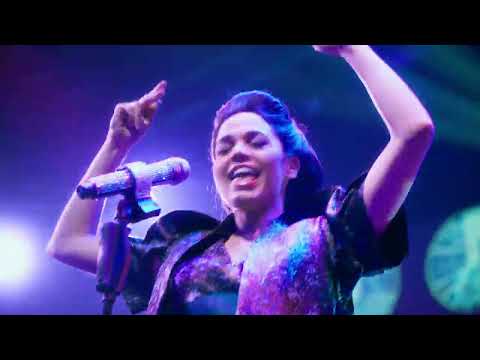
Review: what happens when a dictator’s glamour gets a hook
Can a dance-floor musical treat history like history, while still selling the rush of the party? “Here Lies Love” bets that lyrics can do both jobs at once: seduce you with surface charm, then catch you off-guard with documentary language that refuses to soften what power did. A lot of the text is built from the Marcos era’s own public record: speeches, interviews, slogans, and the blunt rhetoric of a regime that often sounded confident right up until it didn’t.
That method changes how you hear character. Imelda’s early songs lean into self-mythologizing, not because the writers “like” her, but because she liked herself in public. The lyric voice is performative, constantly auditioning for the room. When the political temperature drops, the wording tightens too: shorter clauses, less romance, more decree. You can feel the score’s engine switching from flirtation to mechanism.
Musically it’s disco-pop with a strategic coldness. The beat keeps going even when the story turns, and that tension becomes the show’s clearest motif: rhythm as denial. In Broadway’s club format, the sensation is almost clinical. Bodies move. History advances. The lyrics, often plainspoken, become the place where moral accounting sneaks in.
Listener tip: if you want the narrative to land cleanly, read a synopsis first, then listen for the “document” moments, the lines that sound less like poetry and more like a transcript. Those are often the points where the show stops flattering the room and starts interrogating it.
How it was made
“Here Lies Love” began life as a concept album by David Byrne and Fatboy Slim, sparked by Byrne’s research into Imelda Marcos and the strange specificity of her disco-era iconography. Byrne has described a key image that unlocked the theatrical idea: footage of Imelda dancing under a mirror ball, which clicked with his earlier instinct to stage something in a nightclub-like environment. That connection, between nightlife as fantasy and authoritarian power as pageant, becomes the project’s organizing principle.
The lyric approach is unusually literal for a pop-driven musical. Byrne has said lines were often lifted directly from historical material, including speeches and interviews. That choice is not just trivia. It is the show’s thesis. When a character sounds like they’re quoting themselves, it’s because they often are.
Over time, the stage version expanded the album into a book-driven narrative. The “song cycle” feel never disappears, but the staging and sequencing were shaped for theatrical causality: seduction, consolidation, crackdown, fracture, aftermath. On Broadway, the club concept went even further in production design, with the theatre physically reconfigured around a central floor and multiple audience zones.
Key tracks & scenes
"Here Lies Love" (Imelda)
- The Scene:
- Imelda arrives as a presence before she arrives as a person. In the club layout, the number plays like a coronation in motion, with performers threading through the crowd as if the room already belongs to her.
- Lyrical Meaning:
- The title phrase is framed as a promise and a prophecy. It’s love as branding, love as legacy management. The lyric sells destiny with the confidence of someone who believes the world is an audience.
"The Rose of Tacloban" (Imelda)
- The Scene:
- Origin-story glamour, delivered with a pageant’s sheen. The attention is on presentation: how a local narrative gets packaged for a national gaze.
- Lyrical Meaning:
- The song is a lesson in self-invention. “Rose” is not only a metaphor, it’s a marketing asset. The lyric stakes out innocence while quietly rehearsing ambition.
"Eleven Days" (Imelda / Marcos world)
- The Scene:
- A fast-moving montage energy. Lighting cues have been reported as predominantly pink/red with blue turns, capped by a bright white flash into blackout, a punctuation mark that feels like the room blinking.
- Lyrical Meaning:
- Time compression becomes character revelation. Love and politics share the same breath. The lyric turns speed into seduction: if everything happens quickly enough, it can’t be questioned.
"When She Passed By" (Imelda / observers)
- The Scene:
- A brief shift toward simpler stage lighting, described with blue that warms to yellow, giving the crowd a breath between louder sequences.
- Lyrical Meaning:
- It’s the mythology of proximity. The lyric captures how a public figure becomes a story people tell about themselves: I saw her, therefore I was near power.
"Dancing Together" (Imelda / elite circle)
- The Scene:
- Society-gloss spectacle, the kind of number where the room becomes a curated guest list. Earlier critical writing singled out the way verbatim-style lyric fragments land inside the dance pulse.
- Lyrical Meaning:
- The lyric catalogs names and status markers, turning culture into conquest. It’s not subtle, and that’s the point. Power talks by listing who recognizes it.
"Sugartime Baby" (Imelda / Marcos world)
- The Scene:
- A stylized pop fantasy with reported blue/green washes and a moving green sweep over the audience, plus camera-flash effects and a flower projection ending that can feel dizzying.
- Lyrical Meaning:
- Sweetness is weaponized. The lyric makes indulgence sound harmless, which is exactly how complicity often works in public life.
"Order 1081" (Marcos)
- The Scene:
- The declaration of martial law. Even in a club environment, the number plays like the dance beat has turned into a machine, the room’s pleasure repurposed into compliance.
- Lyrical Meaning:
- Language becomes policy. The lyric’s force is in its bluntness: a title that reads like a file stamp, a reminder that repression can be formatted and signed.
"Gate 37" (Ninoy Aquino / public)
- The Scene:
- The assassination sequence. The show’s club logic tightens here: crowd movement, shock, and the sudden awareness that you’ve been dancing inside someone else’s story.
- Lyrical Meaning:
- “Gate” is a location, but also a threshold. The lyric marks the pivot from rule-by-glamour to rule-by-fear, and the beginning of collapse.
"Just Ask the Flowers" (Aurora Aquino)
- The Scene:
- Ninoy’s funeral, with the mother’s voice cutting through the room. Critical commentary has noted script guidance that the lyrics are derived from real quotes associated with the funeral and its witnesses.
- Lyrical Meaning:
- The show’s most direct act of moral witness. The lyric refuses the dictator’s language games. It doesn’t argue. It remembers.
"God Draws Straight" (Company / DJ figure)
- The Scene:
- After the party and after the fall, the sound world reportedly shifts, including a guitar-led presentation in at least one Broadway account, changing the temperature of the room.
- Lyrical Meaning:
- A final reflection that risks comfort, then complicates it. The lyric frames democracy as action, not inheritance, and the ending asks the audience to take that personally.
Live updates (2025/2026)
Information current as of January 27, 2026. The Broadway run ended on November 26, 2023. Since then, the project’s most concrete next step is a newly announced regional staging: Center Theatre Group is set to mount “Here Lies Love” at Los Angeles’s Mark Taper Forum, with performances scheduled February 11 to March 22, 2026 (opening night listed as February 18), directed by CTG artistic director Snehal Desai.
If you’re tracking ticket behavior historically, Broadway grosses reporting shows wide variance in average paid ticket during the run, a reminder that even formally adventurous shows still live or die by weekly math. The musical also carried a notable production-story conversation around how many live musicians a Broadway house should employ, with reporting describing an eventual agreement involving a smaller ensemble plus actor-musicians.
What has not been announced publicly, at least in widely reported outlets, is a full-scale North American tour. If that changes, it will likely appear first through major theatre trades and presenter season reveals.
Notes & trivia
- David Byrne has said the club staging idea clicked when he connected Imelda’s real disco obsession with a nightclub-style theatre concept.
- Reporting and prior coverage describe lyrics frequently built from historical material such as speeches, interviews, and other contemporaneous documents.
- Nonesuch’s “Original Cast Recording” notes that the stage version added new songs written specifically for the musical, beyond the earlier concept album material.
- The Broadway venue was physically rebuilt around a central floor, with multiple audience zones, a design publicly credited to scenic designer David Korins.
- Industry reporting framed the Broadway production as a landmark for its all-Filipino cast.
- Technical press coverage details a large-scale spatial audio deployment, designed to keep the experience consistent across floor and seated zones.
- Box-office data outlets published week-by-week reporting that captures the show’s attendance swings, especially late in the run.
Reception
The critical split has always been part of the piece’s identity. Some writers see the lyric method as a strength: when the text sounds like propaganda, it exposes how propaganda works. Others worry that the party structure risks flattening the cost of the history, even as it tries to underline it.
“The lyrics are a pastiche of lines from anti-Marcos protesters …”
That Guardian observation is the show in miniature: collage as critique, pop as documentary form, and a constant negotiation between seduction and indictment.
“A participatory pop musical … transforms the Broadway Theatre into a pulsating disco palace …”
The New Yorker’s framing points to the risk and the thrill: participation creates proximity. Proximity, in a story about power, is never neutral.
“A history lesson and disco dance party …”
Entertainment Weekly’s summary lands because it names the contradiction without resolving it. The show wants the beat to feel good, then wants you to ask why it felt good.
Quick facts
- Title: Here Lies Love
- Broadway year: 2023 (opened July 20, 2023; final performance November 26, 2023)
- Type: Biographical disco-pop musical
- Concept, lyrics: David Byrne
- Music: David Byrne, Fatboy Slim (Norman Cook)
- Director: Alex Timbers
- Choreography: Annie-B Parson
- Broadway scenic concept: Reconfigured theatre with central floor (David Korins)
- Sound approach (Broadway): Multi-zone spatial audio system described in technical press coverage (Cody Spencer, M.L. Dogg)
- Album context: Concept album released in 2010, with a 2023 remaster edition listed by digital platforms; stage recording released by Nonesuch as “Original Cast Recording” (2013)
- Current known major staging (as of Jan 27, 2026): Los Angeles, Mark Taper Forum (Feb 11 to Mar 22, 2026)
Frequently asked questions
- Is there a 2023 Broadway cast recording?
- Major music press coverage around the Broadway closing noted that a Broadway cast recording had not been confirmed at the time. The widely available stage recording is the 2013 “Original Cast Recording,” and the separate 2010 concept album also remains available in updated digital editions.
- Who wrote the lyrics for “Here Lies Love”?
- David Byrne is credited with the concept and lyrics, with music credited to Byrne and Fatboy Slim.
- Why do some lyrics sound like real speech instead of classic musical theatre writing?
- That’s intentional. Byrne has described building lyrics from historical documents such as speeches and interviews, which makes the show’s language feel like a record of public performance, not private confession.
- What’s the single most important lyrical turning point?
- “Order 1081,” because the language moves from romance and self-myth to bureaucratic power. The title itself reads like a decree, which is the point.
- Where can I see the show next?
- Center Theatre Group has announced a Los Angeles production at the Mark Taper Forum scheduled for February 11 to March 22, 2026.
- What should I listen to first to understand the story fast?
- Start with “Here Lies Love,” “Eleven Days,” “Order 1081,” and “Just Ask the Flowers.” That sequence captures seduction, acceleration, crackdown, and grief, the show’s core arc.
Key contributors
| Name | Role | Contribution |
|---|---|---|
| David Byrne | Concept, lyrics, music | Built the lyric voice from pop craft and historical source material. |
| Fatboy Slim (Norman Cook) | Music | Co-shaped the disco-pop language and club propulsion. |
| Alex Timbers | Director | Developed the staging into a club-night theatrical format. |
| Annie-B Parson | Choreographer | Turned crowd motion into narrative pressure. |
| David Korins | Scenic designer | Led the Broadway theatre reconfiguration around a central floor. |
| Cody Spencer | Sound designer | Co-designed multi-zone spatial audio for multiple audience areas. |
| M.L. Dogg | Sound co-designer | Co-developed the system that keeps vocals and tracks coherent across zones. |
| Clint Ramos | Producer / designer (credited in Broadway reporting) | Part of the producing team publicly listed for the Broadway run. |
| Tom Gandey | Additional music | Additional musical contributions credited in Broadway reporting. |
| J Pardo | Additional music | Additional musical contributions credited in Broadway reporting. |
Sources: Playbill, Center Theatre Group season coverage (via Playbill/BroadwayWorld reporting), The Guardian, The New Yorker, Entertainment Weekly, Nonesuch Records, L-Acoustics (technical case study), New York Theatre Guide, Pitchfork, Broadway grosses reporting outlets, accessibility lighting notes resource.