Happiest Girl in the World, The Lyrics – All Songs from the Musical
Happiest Girl in the World, The Lyrics: Song List
- Act 1
- Cheers for the Hero
- The Glory That is Greece
- The Happiest Girl in the World
- The Greek Marine
- Shall We Say Farewell
- Never Be-Devil the Devil
- Whatever They May Be
- Eureka
- The Oath
- The Happiest Girl in the World (Reprise)
- Diana's Transformation
- Vive La Virtue!
- Adrift on a Star
- The Happiest Girl in the World (Reprise)
- Act One Finale
- Act 2
- That'll Be the Day
- How Soon, Oh Moon?
- Love-Sick Serenade
- Five Minutes of Spring
- The Greek Marine (Reprise)
- Five Minutes of Spring (Reprise)
- Never Trust a Virgin
- Entrance of the Courtesans
- The Pied Piper's Can-Can
- Vive La Virtue! (Reprise)
- Finale
About the "Happiest Girl in the World, The" Stage Show
The first show of the musical took place on April 1961. It has been staged not long, only four months without one & a half weeks. Closure came in June 1961.This musical on Martin Beck Theatre’s stage gave 96 runs. Eight roles in this theatrical were acted by one person, C. Ritchard, including several major ones. Subsequently, vinyl recording of music was done by Columbia company.
The staging has the basis of the Greek mythology & the story of Aristophanes & his famous "Lysistrata" comedy, describing similar events. Drawing inspiration from Aristophanes’ legacy & out of the variety of myths of Greece of ancient times, F. Saidy & H. Mayers created own libretto. The music was originated by J. Offenbach.
In 1961, production has become nominated on Aw. Theatre World. B. Yarnell was awarded with it, playing a role of General Kinesias. In 1962, this spectacle was included in the short-list of Tonies (D. Krupska), but haven’t win any.
Release date: 1961
"The Happiest Girl in the World" – The Musical Guide & Song Meanings
Review
How do you turn a sex strike into a Broadway musical without turning the whole evening into a wink? “The Happiest Girl in the World” tries something riskier. It plays the premise straight enough to make the women’s vow feel like pressure, not a punchline, then lets the score and the villains smuggle the mischief back in. The book plants us in 400 B.C. Athens at the Olympics, but the lyric voice is mid-century American show-biz: bright, argumentative, and allergic to reverence.
The engine is the lyric contrast between public language and private need. When the men sing of Greece, they inflate themselves into national myth. When Lysistrata sings, the language contracts: time, touch, minutes, waiting. That tension is the show’s real “plot.” The sex strike is the method, not the message. E.Y. Harburg’s craft here is less slogan than leverage. He keeps the words light on their feet, so the moral question arrives almost by accident: what does a society sound like when its appetite for war and its appetite for love share the same vocabulary?
Musically, the show is a collage built from Jacques Offenbach, then reframed for Broadway orchestras and vocal personalities. That matters for meaning. Offenbach’s melodic elegance can make chaos feel civilized, which is exactly what this story needs. Underneath the jokes, there’s a chilly idea: war persists because it can be dressed up as pageantry. The score is expert at pageantry, so the lyrics have to puncture it, again and again, in the same bright tone.
If you’re listening to the cast album to follow the story, begin with “Overture / The Glory That Is Greece.” It tells you how the show will argue. First, the crowd. Then, the hero. Then, the private cost. The narrative is already in the structure.
How It Was Made
This musical’s origin story is baked into its sound. Harburg decided to write a Broadway version of “Lysistrata” using existing Offenbach melodies, then shaped new English lyrics to fit the snap and glide of French operetta. That choice creates a specific kind of lyric problem: you cannot ramble. Offenbach’s phrases demand precision, and that pressure can make a comic lyric feel sharpened, even when it is being naughty.
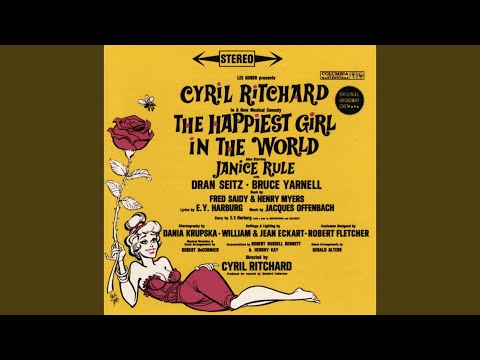
The 1961 Broadway production was produced by Lee Guber, directed by Cyril Ritchard, and choreographed by Dania Krupska. It ran 96 performances at the Martin Beck Theatre (now the Al Hirschfeld). The show also became a showcase for Ritchard’s double duty as both Chief of State and Pluto, giving the evening an unusually clear split-screen: civic authority and underworld sabotage wearing the same face.
On the album side, the recording history is unusually well documented. The original cast album was recorded in April 1961, originally issued by Columbia Masterworks, and later reissued on CD by DRG. For a score built from “borrowed” melodies, the album is where the show’s authorship becomes audible: orchestrations, vocal style, and comic pacing do the heavy lifting that a brand-new through-composed score might have carried by itself.
Key Tracks & Scenes
"The Glory That Is Greece" (Chief of State, Kinesias, Chorus)
- The Scene:
- Olympic celebration. Bright ceremonial light. The crowd becomes a chorus of civic pride as Kinesias returns from war and gets crowned in sound.
- Lyrical Meaning:
- This is propaganda with a grin. The lyric inflates Greece into an idea so big it can swallow human cost. It sets up the show’s central argument: the language of honor can be a mask for appetite.
"The Happiest Girl in the World" (Lysistrata, Kinesias)
- The Scene:
- Home, finally. Intimate space after public spectacle. The warmth is real, but it barely has time to settle before the next summons to war.
- Lyrical Meaning:
- Harburg makes happiness sound conditional. The title phrase is not a victory lap. It is a fragile claim, spoken before it can be taken away.
"Shall We Say Farewell?" (Lysistrata)
- The Scene:
- After the men march out again. A quieter stage picture. Less color. The song sits in the gap between desire and resignation.
- Lyrical Meaning:
- The lyric is bargaining with time. “Farewell” is not romantic here. It’s administrative. The song clarifies that the show’s “war vs love” conflict is also a conflict of language: how you name separation decides how you survive it.
"Never Be-Devil the Devil" (Pluto)
- The Scene:
- Olympus shifts to spectacle. Entrance effects, a burst of theatrical threat. Pluto arrives like the party guest who admits the quiet part out loud.
- Lyrical Meaning:
- This is Harburg’s clever inversion of moral instruction. The lyric warns against “being” the devil while the devil sings it, calmly, as if offering etiquette. It’s comic, but it also frames war as a chosen identity that can be performed.
"The Oath Song and March" (Lysistrata, Women)
- The Scene:
- The Agora. A collective decision becomes a public act. Strong group staging. The women lock into unison, and the scene tightens like a knot.
- Lyrical Meaning:
- The lyric uses ritual language, not flirtation, because the point is discipline. It’s a scene where the text drives the plot directly: the vow is not backstory, it is action.
"Adrift on a Star" (Lysistrata, Kinesias)
- The Scene:
- A reunion colored by dread. The stage often plays this as a hush after noise. The lovers find each other, but the world refuses to stop moving.
- Lyrical Meaning:
- Harburg adapts Offenbach’s famous Barcarolle into an existential love lyric. The metaphor is floating, not landing. Love is present, but stability is not promised, which makes the romance feel adult instead of decorative.
"That’ll Be the Day" (Men)
- The Scene:
- The men, deprived and embarrassed, throw themselves into work and exertion. It plays like a public workout in harsh daylight, energy masking panic.
- Lyrical Meaning:
- The joke is that discipline arrives only when pleasure is blocked. The lyric exposes male pride as performative, and the musical number turns frustration into choreography.
"How Soon, Oh Moon?" (Lysistrata, Women)
- The Scene:
- Inside the Citadel. Night light, cooler palette. The women keep watch, lonely in a fortress of their own making.
- Lyrical Meaning:
- The moon becomes a clock and a witness. The lyric’s tenderness is the price of the vow. This is the show admitting that the strategy hurts the strategists first.
"Never Trust a Virgin" (Pluto, Women)
- The Scene:
- Pluto’s sabotage with a smile. The staging is often sly, half cabaret, half cautionary tale, as the women become both audience and target.
- Lyrical Meaning:
- The title sounds like a joke, but it also attacks the show’s chaste idealism. Pluto argues that purity is a pose. The lyric tests Diana’s influence by mocking it.
Live Updates
As of January 27, 2026, “The Happiest Girl in the World” is best understood as a licensable repertory title rather than an active Broadway property. Concord Theatricals currently lists it for licensing and materials, which is where most modern interest in the piece lives: universities, community theatres, and specialty revivals looking for a smart, off-center score with famous source music.
The most practical “current” way to experience the writing is still the cast album ecosystem. The recording has a long afterlife: the original 1961 issue history is preserved in library catalogs, the DRG CD reissue remains a common reference point in discographies, and the album is also present on major streaming platforms under Sony’s catalog. If you are programming a listening session for story clarity, use the Act I spine: “The Glory That Is Greece” to “The Oath.” It is the cleanest narrative line the show has.
If you are planning to see it live (or mount it), seat choice matters for comprehension. This is a lyrics-forward comedy with quick scene pivots between Olympus and Athens. Center sections help you read group staging in “The Oath,” while closer side seats often reward you during Pluto’s numbers, where facial timing can carry as much meaning as the rhyme.
Notes & Trivia
- The original Broadway run opened April 3, 1961 and closed June 24, 1961, for 96 performances at the Martin Beck Theatre.
- It was produced by Lee Guber and directed by Cyril Ritchard, who also performed multiple roles, including Chief of State and Pluto.
- Dania Krupska’s choreography earned the production a 1962 Tony nomination for Best Choreography.
- Bruce Yarnell received a 1961 Theatre World Award for his performance as Kinesias.
- The score’s music is drawn from Jacques Offenbach, with Harburg supplying new lyrics tailored to operetta phrasing.
- “Adrift on a Star” is an English lyric adaptation of Offenbach’s Barcarolle (“Belle nuit, ô nuit d’amour”) from “The Tales of Hoffmann.”
- The cast album was recorded in April 1961 and originally issued by Columbia Masterworks (later reissued on DRG on CD).
Reception
Critically, the show’s reputation has always split along a familiar Broadway fault line: pleasure versus importance. It arrived in a crowded era and was sometimes treated as lightweight. Yet the lyric craft, especially in the villain songs and the romantic ballad writing, has kept it alive among score collectors and directors hunting for material that plays smarter than its synopsis suggests.
“His baritone is the best voice in the company.”
“The Happiest Girl in the World is a mildly naughty musical that milks the ages for material.”
“Audiences came mostly to see Cyril Ritchard … who delivered with his usual deadpan some of the sauciest lyrics … notably in ‘Never Trust a Virgin.’”
Quick Facts
- Title: The Happiest Girl in the World
- Year: 1961 (Broadway)
- Type: Broadway musical comedy; adaptation of Aristophanes’ “Lysistrata”
- Book: Fred Saidy, Henry Mayers
- Lyrics: E.Y. Harburg
- Music: From the works of Jacques Offenbach
- Producer: Lee Guber
- Director: Cyril Ritchard
- Choreography: Dania Krupska
- Original venue: Martin Beck Theatre (Broadway)
- Original run: Apr 3, 1961 to Jun 24, 1961 (96 performances)
- Orchestrations (album credits): Robert Russell Bennett, Hershy Kay
- Cast album label history: Originally Columbia Masterworks (KOS 2050); later DRG CD (19032)
- Availability: Catalog/streaming release exists on major services; licensing materials listed by Concord Theatricals
- Selected notable musical moments: “The Oath Song and March” (the strike’s turning point); “Never Be-Devil the Devil” (Pluto defines the game); “Adrift on a Star” (the score’s emotional center)
Frequently Asked Questions
- Is “The Happiest Girl in the World” the same thing as Aristophanes’ “Lysistrata”?
- It’s a Broadway adaptation of “Lysistrata,” expanded with Greek mythology elements (notably Diana and Pluto) and set to Offenbach melodies.
- Who wrote the lyrics?
- E.Y. Harburg wrote the lyrics and also provided story elements for the Broadway version.
- What’s the best song to start with if I only want one track?
- Try “Never Be-Devil the Devil” for Harburg’s comic technique, or “Adrift on a Star” for the show’s emotional argument in miniature.
- Is there an original cast recording?
- Yes. The 1961 Original Broadway Cast Recording was originally issued by Columbia Masterworks and has later reissues, including a DRG CD and streaming availability.
- Is the show touring in 2025 or 2026?
- It is not positioned like a standard commercial touring title. In current practice, it appears most often as a licensed production through Concord Theatricals and as a cast album in the catalog.
Key Contributors
| Name | Role | Contribution |
|---|---|---|
| E.Y. Harburg | Lyricist; story | Wrote the English lyrics and shaped the Broadway narrative voice. |
| Jacques Offenbach | Composer (source music) | Provided the melodic foundation via adapted selections from his works. |
| Fred Saidy | Book writer | Co-wrote the book that frames the strike and Olympus plotlines. |
| Henry Mayers | Book writer | Co-wrote the book and comic architecture of the scenes. |
| Cyril Ritchard | Director; performer | Directed the Broadway production and played multiple roles, including Pluto. |
| Dania Krupska | Choreographer | Built the movement language, earning a 1962 Tony nomination. |
| Lee Guber | Producer | Produced the original Broadway run. |
| Robert DeCormier | Musical director; vocal arrangements | Shaped vocal style and musical pacing for the production and recording. |
| Robert Russell Bennett; Hershy Kay | Orchestrators | Orchestrated the Offenbach-derived score for Broadway forces. |
Sources: IBDB; Concord Theatricals; Masterworks Broadway; New York Public Library Research Catalog; AllMusic; SecondHandSongs; Peter Filichia (Masterworks Broadway blog); Donald Sauter archival compilation (Playboy opera coverage); Apple Music.