Grand Hotel Lyrics – All Songs from the Musical
Grand Hotel Lyrics: Song List
- Act 1
- The Grand Parade
- Some Have, Some Have Not
- As It Should Be
-
At the Grand Hotel /Table With a View
- Maybe My Baby Loves Me
-
Fire and Ice
-
Twenty Two Years /Villa On a Hill
- I Want To Go To Hollywood
- Everybody's Doing It
- As It Could Be
- The Crooked Path
-
Who Couldn't Dance With You?
- No Encore
- Act 2
-
Love Can't Happen
-
What You Need
-
Bonjour Amour
- H-A-P-P-Y
- I Waltz Alone
- H-A-P-P-Y (Reprise)
-
Roses at the Station
- How Can I Tell Her?
- At the Grand Hotel
- As It Should Be
- The Grand Parade/Some Have, Some Have Not (Reprise)
-
The Grand Waltz
About the "Grand Hotel" Stage Show
Grand Hotel is based on the literary work by L. Davis. R. Wright, G. Forrest and M. Yeston were the authors of the music. The first performance took place at the Martin Beck Theatre in 1989. Actors were the following: L. Montevecchi, M. Jeter, D. Carroll, T. Jerome, J. Wylie, B. Stillman & J. Krakowski. The musical lasts without interruption, fitting in 1 act.The original version was nominated for 12 Tony awards. It received 5 of them, including for the direction & outstanding choreography. Release of recording was planned. But it was constantly transferred, because of Carrol’s illness (he played Baron). The actor was fatally ill and died while sound recording. In memory of Carrol, there is a bonus-track with his performance, on a charity event against AIDS, where he sings the main song of Baron. B. Barrett took his place in the musical.
The show was also performed in London: in Dominion Theatre and Southwark Playhouse. The musical has a tradition: every year a reunion concert is held. Well-known Broadway actors participate in it.
Release date: 1989
"Grand Hotel" – The Musical Guide & Song Meanings
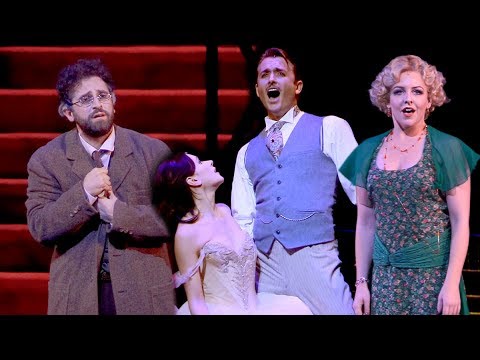
Review: a lobby full of plots, and lyrics that behave like signage
How do you write lyrics for a musical where nobody truly “owns” the story? Grand Hotel answers by turning words into directions. The text points you where to look, when to worry, and who is about to break. The hotel itself is the lead: a glamorous machine that keeps spinning while private catastrophes happen in public. That tension is the show’s main lyric theme, repeated in different costumes: desire with a deadline, romance with a receipt, luxury with an exit sign.
The score is a composite with a single aim: velocity. Wright and Forrest bring the classical Broadway line, clean rhymes, elegant sentiment; Yeston adds urgency, sharper character definition, and a nervous modern pulse that fits 1928 Berlin because it sounds like people trying to outrun the future. The lyrics often do two jobs at once: they sell the surface (champagne, chandeliers, charm) and leak the underside (debt, illness, hunger). Even the simplest hook in this show tends to carry an economic or mortal aftertaste.
One practical viewing tip: sit where you can see the revolving door and the “traffic patterns” across the stage. The show’s emotional plot is frequently staged as footwork. When characters stop moving, the lyric finally lands. That contrast is the secret engine of the evening.
How it was made: the Boston emergency that rewired the lyric book
Grand Hotel has one of those backstage histories that feels like a warning and a fairy tale at the same time. The property began life as At the Grand in the late 1950s, then disappeared for decades before returning in the late 1980s with Tommy Tune’s all-motion concept. Close to opening, the production needed clarity: an opening statement, stronger character songs, and moments where the audience could actually breathe. Maury Yeston was brought in during the Boston tryout crunch, and his additions were designed to do a very specific thing: make the lyric storytelling legible at high speed.
Yeston’s own account of the fix is unusually concrete: he talks about writing an opening that describes physical luxury in detail, then pivoting to a structural promise that multiple stories will overlap in one place. That is craft, not mystery. The famous “applause endings” adjustment is also lyric strategy: a show built to flow without interruption still needs punctuation, and in Grand Hotel that punctuation often arrives as a build in the final bars, not as a new plot beat.
Then there’s the cast album story, which casts a shadow over the score’s afterlife. The original recording was delayed, and when it finally happened, tragedy struck during the sessions. You can hear the result in the album’s tone: performance that feels protective of the material, almost like the company is trying to preserve a moment that already knows it is disappearing.
Key tracks & scenes: the lyrical moments that control the temperature
"The Grand Parade" (Company)
- The Scene:
- The lobby becomes a choreography grid. Guests sweep in; staff snap into place. Light hits the gold and glass like a camera flash. The hotel sells itself in movement before anyone explains the plot.
- Lyrical Meaning:
- This is the mission statement: people arrive, people vanish, and the building keeps smiling. The lyric’s charm is also a threat. It trains you to watch for who gets left behind when the parade turns the corner.
"At the Grand Hotel" (Otto Kringelein)
- The Scene:
- In the lobby and the scullery below, two worlds stack on top of each other. Otto steps into luxury as if it were borrowed time. The lights feel warmer around him than they should, like a last good dream.
- Lyrical Meaning:
- Otto’s lyric is a contract with himself: he will live “now,” even if “now” is brief. The words insist on pleasure, but the line endings keep hinting at a clock. That tension is the show’s cleanest definition of mortality.
"I Want to Go to Hollywood (Girl in the Mirror)" (Flaemmchen)
- The Scene:
- A private corner, a mirror, and a woman turning herself into a product. The lighting sharpens, less ballroom glow, more dressing-room truth. Her dream feels rehearsed because it has to be.
- Lyrical Meaning:
- On the surface, it’s ambition. Underneath, it’s escape velocity. The lyric frames “Hollywood” as distance from poverty and compromise, and that makes her choices later read less like scandal and more like arithmetic.
"The Boston Merger" (Preysing)
- The Scene:
- A conference room, papers, pressure. The sound of deals is percussive, almost danced. Preysing’s body tries to stay upright while his moral posture tilts.
- Lyrical Meaning:
- The language of business becomes the language of desperation. The lyric’s cleverness is how it lets “merger” mean survival, then lets it mean something darker as the plot tightens.
"Love Can’t Happen" (The Baron and Elizaveta)
- The Scene:
- In Elizaveta’s suite, glamour is suddenly still. Night light. A thief caught mid-act, then transformed into a romantic possibility. The room feels like a snow globe: beautiful, sealed, dangerous.
- Lyrical Meaning:
- The title is denial, and the lyric is the crack in that denial. Two people who believe they are “finished” discover the shock of new feeling. The writing makes love sound like an accident, which is exactly why it hurts later.
"We’ll Take a Glass Together" (Otto Kringelein and Company)
- The Scene:
- Act II turns into a multi-location party montage. The bar is bright, the rhythm is reckless, and Otto’s joy is outsized, almost defiant. It plays like a celebration staged against an approaching siren.
- Lyrical Meaning:
- This is pleasure as rebellion. The lyric sells communal happiness, but the subtext is Otto stealing a night from the universe. The refrain is simple because the emotion is not: it’s gratitude, panic, and triumph in the same glass.
"I Waltz Alone" (Doctor Otternschlag)
- The Scene:
- A corridor, then the doctor’s room. The movement vocabulary narrows. The lighting cools, isolating him as the hotel continues elsewhere. His stillness feels like judgment.
- Lyrical Meaning:
- The doctor’s lyric is the show’s cynicism spoken out loud: connection is temporary, survival is messy, and watching can be its own addiction. The waltz rhythm becomes a loop, like a thought he cannot exit.
"Roses at the Station" (The Baron)
- The Scene:
- Late in the story, regret arrives too fast to decorate itself. The image is romantic, but the staging tends to feel stripped, as if the hotel has finally stopped flattering him.
- Lyrical Meaning:
- The lyric is built from a single missed gesture. That small image opens into an entire alternate life. In a musical obsessed with motion, this is the song that freezes on “if only,” and lets the audience do the moving.
Live updates 2025–2026: where the show lives right now
In 2025–2026, Grand Hotel is living less as a touring brand and more as a licensed event: a title directors choose when they want choreography to behave like narrative and an ensemble to behave like a city. MTI continues to license the show, and the “song-forward” materials are positioned for productions that can handle a big, continuous score.
Two concrete datapoints for the current cycle: a 2025 run scheduled in Austin at ZACH Theatre (presented by The Alchemy Theatre) and a 2026 season listing in Fort Wayne (Arena Dinner Theatre). These are not Broadway bellwethers, but they do signal something useful for readers and producers: the piece remains stageable, bookable, and attractive to companies that can sell dance and atmosphere.
For fans tracking public-facing momentum, concert and reunion culture still matters here. The show’s modern life has been boosted by New York concert attention in the past decade, including high-profile spotlight moments tied to Encores! and cast nostalgia. If you are re-listening, pair the album with a video performance clip: the lyrics read differently once you see how often a line is timed to a turn, a cross, a door, or a lift.
Information current as of January 2026.
Notes & trivia
- The original Broadway production opened in 1989 and ran through 1992, moving theatres during its run.
- The show’s setting is Berlin, 1928, and the piece is built to feel like multiple lives colliding over a single weekend.
- Before its 1989 success, the property existed in an earlier musical form (At the Grand) and then lay dormant for decades.
- A common misconception is that this score is “all one voice.” In reality, part of its character comes from the seam: Wright and Forrest’s classic writing welded to Yeston’s late-20th-century urgency.
- Lyrics and staging are unusually entangled here: some programs even print scene synopsis text that embeds song titles in-line, treating numbers like plot circuitry.
- The cast recording was released in 1992 under the Masterworks Broadway banner, and the album’s history is inseparable from the loss connected to its sessions.
- Critics and fans often call the show a “theatrical ballet,” a label that makes sense once you notice how frequently the emotional beats are danced rather than explained.
Reception: what critics argued about, then and now
Criticism of Grand Hotel tends to split along a single fault line: is the show’s constant motion a thrilling portrait of a public space, or a way of dodging intimacy? That argument has been present since early reviews and it still shapes how revivals are received. When the staging leans into design, traffic, and dance, some writers admire the momentum and style; when the staging leans into character, others miss the distance and glamour that the hotel machine creates.
“As the Revolving Door Turns.”
“Perfectly drilled dance, stunning vocals and stylish direction.”
“Well-sung, energetically acted and cleverly designed.”
My take: the lyrics succeed most when a production lets them behave like overheard confessions inside a public dance. If you inflate every number into a standalone “statement,” you flatten the hotel effect. If you treat songs as part of a moving crowd, the writing becomes more brutal and more true.
Quick facts
- Title: Grand Hotel
- Broadway year: 1989 (opened Nov 12, 1989)
- Setting: Grand Hotel, Berlin, 1928
- Type: Musical drama
- Book: Luther Davis
- Music & lyrics: Robert Wright and George Forrest
- Additional music & lyrics: Maury Yeston
- Director & choreographer (original Broadway): Tommy Tune
- Orchestrations: Peter Matz
- Notable lyrical set-pieces: “The Grand Parade,” “At the Grand Hotel,” “We’ll Take a Glass Together,” “Love Can’t Happen,” “I Waltz Alone”
- Original Broadway run: 1,017 performances (closed Apr 25, 1992)
- Cast album: Grand Hotel: The Musical (Original Broadway Cast Recording)
- Album release: June 23, 1992
- Label family: Masterworks Broadway / BMG (commonly distributed today on major streaming platforms)
- Availability: Widely available on major streaming and digital stores
Frequently asked questions
- Is there a movie musical version of Grand Hotel?
- The musical is based on Vicki Baum’s novel and the famous 1932 MGM film, but the stage score is its own entity. If you know the film, expect the musical to amplify dance and compress story into overlapping stage traffic.
- Who wrote the lyrics?
- Robert Wright and George Forrest are credited for the score’s music and lyrics, with additional music and lyrics by Maury Yeston. The split matters: Yeston’s added writing often carries the sharpest character definition.
- What song explains Otto Kringelein best?
- “At the Grand Hotel.” It frames luxury as a last decision, not a lifestyle. Listen for how celebration and time pressure share the same breath.
- Why does “We’ll Take a Glass Together” feel like a victory and a warning?
- Because the lyric is communal while the context is fragile. It’s a party number staged on the edge of consequences, and the show wants you to feel both at once.
- Is the show sung-through?
- Many productions play it as near-continuous, with scenes and numbers interlocking and little downtime. The structure is designed to feel like the hotel never stops operating.
- Where can I see it in 2025–2026?
- It appears most often in regional and licensed productions. Check local company seasons and MTI licensing listings; recent schedules include productions announced in Austin (2025) and Fort Wayne (2026).
Key contributors
| Name | Role | Contribution |
|---|---|---|
| Luther Davis | Book | Built the interlocking hotel narrative and character collisions. |
| Robert Wright | Music & Lyrics | Core score foundations and classic Broadway lyric style. |
| George Forrest | Music & Lyrics | Core score foundations; melodic architecture and lyric craft. |
| Maury Yeston | Additional Music & Lyrics | Added and reshaped key numbers to clarify character stakes and pacing. |
| Tommy Tune | Director & Choreographer | Defined the show’s continuous-motion storytelling grammar. |
| Peter Matz | Orchestrations | Orchestral color that supports both ballroom sheen and backstage dread. |
| Tony Walton | Scenic Design | Iconic luxury frame: the hotel as architecture and metaphor. |
| Santo Loquasto | Costume Design | Period glamour that heightens class contrast and character silhouettes. |
| Jules Fisher | Lighting Design | Shifts between public sparkle and private exposure. |
| Yvonne Marceau & Pierre Dulaine | Ballroom Choreography | Ballroom vocabulary that reads as society performance. |
| Jack Lee | Musical & Vocal Direction (Broadway) | Vocal and musical coherence across a composite score. |
Sources: IBDB (Internet Broadway Database), Playbill, MTI (Music Theatre International), Lyric Stage program PDF (2015), Los Angeles Times, The Guardian, The Washington Post, The Alchemy Theatre (ZACH Theatre listing), Arena Dinner Theatre (Fort Wayne season listing), Apple Music, Presto Music.