Gentlemen Prefer Blondes Lyrics – All Songs from the Musical
Gentlemen Prefer Blondes Lyrics: Song List
- Act 1
- Overture
- It's High Time
- Bye Bye Baby
- A Little Girl From Little Rock
- I Love What I'm Doing
- Just A Kiss Apart
- The Practice Scherzo
- It's Delightful Down In Chile
- Sunshine
- I'm A 'Tingle, I'm A 'Glow
- You Say You Care
- Act 2
- Mamie Is Mimi
- Diamonds Are A Girl's Best Friend
- Gentlemen Prefer Blondes
- Homesick Blues
- Keeping Cool With Coolidge
About the "Gentlemen Prefer Blondes" Stage Show
The musical was staged according to the book of the same name by Anita Loos and Joseph Fields. For the first time it was opened on Broadway in 1949. It was closed in 1951 and included 740 performances. The producers were Herman Levin and Oliver Smith, the director – John C. Wilson. Choreography was staged by Agnes de Mille.Carol Channing starred as Lorelei, and it brought her everyone's recognition and made her a star. Yvonne Adair acted her friend, Dorothy Shaw.
In the West End at the Princess Theatre, the musical was opened in 1962. The main part was acted by Dora Bryan. The subsequent theatricals on Broadway took place in 1974 and 1995. The first musical revival ran at the Palace Theatre and Carol Channing acted the main part again, which brought her a Tony Award nomination, as the Best Actress in a Musical. The second one opened at The Goodspeed Opera House in Connecticut and starred the American singer and actress KT Sullivan as the blonde.
In 1953, the same named musical film was released. The director was Howard Hawks. Inimitable Marilyn Monroe acted as Lorelei, and beautiful Jane Russell – as her friend. Marilyn's fee for the movie was $11 250 while the actress Betty Grable, who originally had to play the charming blonde, demanded $150 000. Two years later, there was a second part of the movie – "Gentlemen marry brunettes", not making such a big success among the audience as the first one.
Release date: 1949
“Gentlemen Prefer Blondes” (1949) – The Musical Guide & Song Meanings
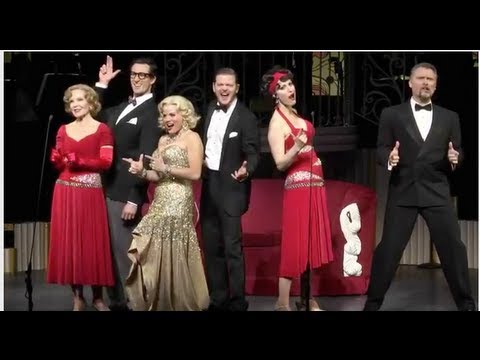
Review: a “dumb blonde” comedy that keeps telling on the audience
What if the joke is not Lorelei Lee, but the people who think she is the joke? That tension is the engine of “Gentlemen Prefer Blondes.” The score gives Lorelei a vocabulary that sounds airy, then turns razor-sharp on the rhyme. She sells a philosophy of security as if it were innocent common sense. That is why the lyrics keep feeling modern. They do not plead for sympathy. They negotiate for it.
Musically, Jule Styne writes with a propulsive, bright commercial swing that never apologizes for being entertainment. It matters because the characters live inside performance. Lorelei and Dorothy are not merely traveling to Paris; they are auditioning for power with every chorus and patter line. And the show’s choral writing, shaped by vocal director and arranger Hugh Martin, tightens the whole thing into an almost radio-ready sheen: close jazz harmonies, thick voicings, and a sound that can resemble a horn section when the ensemble locks in. That sonic polish makes the lyrics feel even more transactional, like flirtation turned into a business plan.
If you are listening at home, try this: play the 1949 original cast recording first, then jump to the 2012 Encores! recording. You will hear the same jokes, but with different amounts of orchestral detail. Reviewers noted how much more of Don Walker’s orchestrations you can actually catch in the later recording, which changes how the punchlines sit against the band.
One practical tip for seeing it live: sit where you can read faces during the bargaining songs. Lorelei’s comedy is often in the micro-timing, the quick glance, the half-smile before the rhyme lands. Seats that favor facial detail can make the lyrics feel louder than the brassy bookends around them.
How it was made: Loos’s flapper satire, sharpened for the Ziegfeld stage
The musical’s origin is a chain of adaptations with a clear through-line: Anita Loos writes a bestselling 1925 novel about show-business ambition and money, then helps adapt it for Broadway with Joseph Fields. Onstage, that satire becomes a two-woman star vehicle, built to ride a charismatic performer straight through a plot that keeps challenging her motives. In 1949, that performer was Carol Channing, and the production infrastructure around her was serious: John C. Wilson staged it, Agnes de Mille choreographed it, and the creative team included dance arranger Trude Rittmann, arranger Don Walker, and musical director Milton Rosenstock.
The lyrics are the quiet key to why it worked. Leo Robin writes jokes that sound conversational, then flips them with internal rhyme and list-making. Lorelei can appear to be “simple,” yet the language is engineered. She speaks in slogans because she is selling. The show lets you laugh, then forces you to notice what you were laughing at.
The cast album history is part of the story too. The Masterworks Broadway release notes a first LP release date in early 1950, and later reissues, including the Encores! recording, reframe the same material with fuller instrumental clarity and contextual liner notes that highlight how the vocal arrangements function in the score.
Key tracks & scenes: the 8 lyrical moments that define the show
“It’s High Time” (Lorelei, Dorothy, Ensemble)
- The Scene:
- On the Ile de France, the ship finally clears the legal line. The stage feels like open air: railings, deck traffic, bodies loosening. The lighting can warm as the ocean “permission slip” kicks in, and the chorus moves as if the horizon is pushing them forward.
- Lyrical Meaning:
- The lyric is a thesis statement for the whole piece: rules exist until money, travel, or status creates a loophole. Dorothy’s excitement reads playful, yet it also sets the show’s moral geography. Freedom is always located somewhere else, often just beyond reach.
“Bye Bye Baby” (Lorelei, Gus)
- The Scene:
- A goodbye staged like a public romance. Lorelei is performing devotion while physically leaving. Keep the light clean and front-facing, as if she wants witnesses, then let the warmth drop out right after he’s gone.
- Lyrical Meaning:
- The words let Lorelei feel sentimental without surrendering control. It is affection with an exit plan. The lyric keeps a smile on the surface while it quietly checks the math underneath.
“I Love What I’m Doing (When I’m Doing It for Love)” (Dorothy, Olympians)
- The Scene:
- Shipboard flirtation turns athletic. The staging can treat the men like moving set pieces: bodies in formation, Dorothy weaving through them, the deck becoming a playground. Bright light, quick angles, no shadows yet.
- Lyrical Meaning:
- Dorothy’s lyric is the show’s counter-argument to Lorelei. She wants pleasure and sincerity, even if it is messy. The line is also a warning: Dorothy’s freedom is emotional, which makes it easier to bruise.
“Just a Kiss Apart” (Dorothy, Henry)
- The Scene:
- A romance that surprises both of them. Pull the world closer: fewer bodies, softer edges, the suggestion of night air and privacy. This is where the show briefly stops selling and starts confessing.
- Lyrical Meaning:
- The lyric is old-fashioned in the best way: longing expressed as distance you can measure. In a musical full of bargains, this is a moment that tries to be priceless.
“It’s Delightful Down in Chile” (Lorelei, Sir Francis “Piggy” Beekman)
- The Scene:
- Lorelei executes a “carefully planned and executed maneuver” to get the $5,000 loan for the tiara. Stage it like a polite ambush: a small, well-lit pocket of the ship where Lorelei can steer the conversation. Her smile should read like choreography.
- Lyrical Meaning:
- This is Lorelei’s method in miniature. The lyric coats persuasion in whimsy. It is travelogue as strategy, comedy as leverage, flirtation as a signed contract you never see.
“I’m A-Tingle, I’m A-Glow” (Lorelei, Josephus Gage)
- The Scene:
- Paris, hotel-room heat, and a new prospect. The lighting can go a touch sultrier, but keep it comic: Lorelei’s “tingle” is both desire and opportunism, and she is not ashamed of either.
- Lyrical Meaning:
- The lyric plays the oldest trick in musical comedy: big feelings described with small words. Lorelei keeps it bouncy so nobody can accuse her of seriousness, even when she is being serious.
“Diamonds Are a Girl’s Best Friend” (Lorelei)
- The Scene:
- After Gus breaks off the engagement, the act has just paraded a nightclub debut and a showgirl spectacle. Then the room changes. Lorelei is left to “muse despondently on life and love.” The light should isolate her, even if the stage is not empty. Let the glamour become a cage.
- Lyrical Meaning:
- This is not only a hit tune. It is Lorelei’s manifesto, delivered as stand-up philosophy. The lyric’s brilliance is its ambiguity: it can be heard as cynical, as self-protective, or as a woman describing the world exactly as it treats her.
“Button Up with Esmond” (Lorelei, Ensemble)
- The Scene:
- Back in New York, the wedding stalls because Lorelei refuses to proceed without the father’s blessing. So she stages a demonstration: Paris-made bridal couture, imported buttons, and business partnership as seduction. Light it like a product launch. Make the “pitch” feel theatrical on purpose.
- Lyrical Meaning:
- The lyric completes Lorelei’s arc. She stops asking to be accepted and starts proving value. It is romance rewritten as commerce, yet the show treats that rewrite as a form of survival intelligence.
Live updates (2025/2026): where the show lives now
As of the most recent listings available, there is no confirmed Broadway run or headline commercial tour announced for 2025 or 2026. “Gentlemen Prefer Blondes” is currently most visible through licensing and regional programming rather than a single dominant production pipeline. Concord Theatricals continues to list the title for licensing, which is a key reason the show keeps reappearing in new contexts: colleges, community theaters, and mid-sized professional houses that want a Golden Age comedy with a built-in set of famous songs.
What you do see in 2025 is the score’s afterlife in concerts and repertory programming. Carnegie Hall’s New York Pops has billed an October 2025 program that includes music from “Gentlemen Prefer Blondes,” positioning the score as part of a broader stage-to-screen lineage. And on the ground, recent years have included clearly documented regional runs, such as a January 2024 staging at Sunset Playhouse (Wisconsin), which is a useful barometer for how the show is being cast and packaged today: a “special event” model, modest ticket pricing, and a large-enough ensemble to sell the cruise-to-Paris spectacle.
If you are tracking the title in 2026, the most reliable approach is not waiting for one “official” production. Follow licensing announcements, regional seasons, and concert calendars. That is where this musical is most likely to surface next.
Notes & trivia
- The original Broadway production opened December 8, 1949, at the Ziegfeld Theatre and ran 740 performances.
- It was produced by Herman Levin and Oliver Smith, staged by John C. Wilson, and choreographed by Agnes de Mille.
- Key music staff on the original production included Trude Rittmann (dance arrangements), Don Walker (arrangements), Milton Rosenstock (musical director), and Hugh Martin (vocal direction and arrangements).
- The Masterworks Broadway album notes the first LP release date as January 9, 1950.
- The Encores! recording spotlights Hugh Martin’s vocal approach in more detail, describing tight jazz harmonies and thick choral voicings that can mimic brass or sax textures.
- “Diamonds Are a Girl’s Best Friend” was introduced on Broadway by Carol Channing, then took on a second iconic life through the 1953 film performance.
- The show’s settings are explicitly a travel circuit: New York, the Ile de France, and Paris, with the plot’s moral arguments shifting as the geography changes.
Reception: the score’s reputation, then and now
Critical response has often separated the show into two overlapping achievements: the star vehicle and the songwriting craft. That split is part of why “Gentlemen Prefer Blondes” keeps returning. Directors can tilt it toward satire, romance, or sheer spectacle without breaking the material. The lyrics are flexible that way, because they are written to be performed, not merely recited.
“It’s grandly entertaining, but you can’t help but wish that Ms. Hilty was … funny.”
“The place came apart.”
“Don Walker’s orchestrations … sound terrific.”
Quick facts
- Title: Gentlemen Prefer Blondes
- Broadway year: 1949 (opened December 8, 1949)
- Type: Musical comedy
- Book: Joseph Fields and Anita Loos (adapted from Loos’s novel)
- Music: Jule Styne
- Lyrics: Leo Robin
- Original Broadway staging: John C. Wilson; choreographer Agnes de Mille
- Music team (original Broadway): Milton Rosenstock (musical director); Don Walker (arrangements); Hugh Martin (vocal direction/arrangements); Trude Rittmann (dance arrangements)
- Selected notable placements (story locations): New York; the Ile de France; Paris
- Album status: Original Broadway cast recording; later Encores! cast recording (2012) offers expanded musical content and clearer orchestral presence
- Availability notes: Major recordings are distributed digitally through modern catalog platforms via Masterworks Broadway listings
Frequently asked questions
- Who wrote the lyrics to “Gentlemen Prefer Blondes”?
- Leo Robin wrote the lyrics, pairing with Jule Styne’s music, for the 1949 Broadway musical.
- Is “Diamonds Are a Girl’s Best Friend” originally from the movie?
- No. The song was written for the 1949 stage musical and introduced on Broadway by Carol Channing, then popularized globally through the 1953 film.
- What is the musical actually about under the comedy?
- It is a comedy about social power: who gets security, who gets judged for pursuing it, and how performance can become a survival skill.
- Are there current tours in 2025/2026?
- There is no single confirmed headline tour or Broadway engagement in the most recent public listings. The title appears most often via licensed productions, regional runs, and concert programming.
- Which recording should I start with?
- Start with the 1949 original cast recording for the source performance style, then try the 2012 Encores! recording to hear more orchestral detail and expanded musical material.
- How does the stage musical differ from the famous 1953 film?
- The film reshapes story emphasis and introduces a different performance vocabulary for the leads. The stage version keeps the satire closer to theatrical show-business mechanics, with Lorelei’s songs operating like live negotiations.
Key contributors
| Name | Role | Contribution |
|---|---|---|
| Anita Loos | Co-book; novelist | Author of the source novel; co-adapted the book for the musical. |
| Joseph Fields | Co-book | Co-wrote the musical’s book, shaping the stage structure and comic pacing. |
| Jule Styne | Composer | Wrote the music, including the show’s signature melodies. |
| Leo Robin | Lyricist | Wrote lyrics that blend salesmanship, satire, and character comedy. |
| John C. Wilson | Staging | Staged the original Broadway production. |
| Agnes de Mille | Choreographer | Created the original choreography that framed the show’s shipboard and nightclub movement language. |
| Hugh Martin | Vocal director/arranger | Shaped vocal sound and ensemble writing; later commentary highlights his jazz-harmony approach. |
| Don Walker | Arranger | Music arrangements credited on the original production; later recordings spotlight orchestral color. |
| Trude Rittmann | Dance arranger | Dance arrangements supporting the show’s movement-driven sequences. |
Sources: IBDB; Playbill Vault; Masterworks Broadway (Original Broadway Cast 1949; Encores! 2012); Playbill (On the Record: Encores! Cast Recording); TIME (2012 Encores review); Variety (2012 review); Concord Theatricals licensing page; Carnegie Hall calendar; Sunset Playhouse production listing.