
Fanny Lyrics: Song List
- Act 1
- Overture
- Octopus Song
-
Restless Heart

- Never Too Late For Love
- Cold Cream Jar Song
- Why Be Afraid To Dance?
- Shika, Shika
- Welcome Home
- I Like You
-
I Have To Tell You
- Fanny 1
- Panisse And Son
- Wedding Dance
- Finale Act I
- Act 2
- Birthday Song
- To My Wife
- The Thought Of You
- Love Is A Very Light Thing
- Other Hands, Other Hearts
- Montage
- Be Kind To Your Parents
About the "Fanny" Stage Show
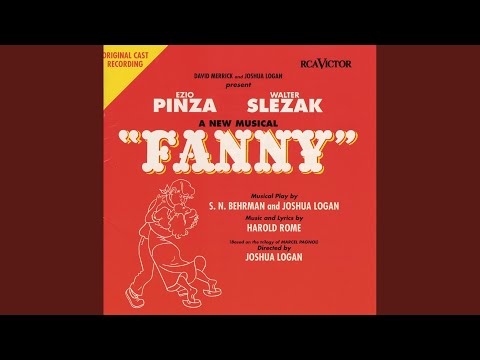
The musical was staged in 1954 on Broadway in 1956 at West End, on the libretto, created in cooperation of S. N. Behrman with J. Logan. H. Rome wrote the music and lyrics. Opening on Broadway was held at Majestic Theatre and went aggregative at quantity of beautiful number 888 hits. It later moved in to another theater, Belasco. Closing took place at the end of 1956. Helen Tamiris was responsible for the choreography, well-known Jo Mielziner performed a stage design and lighting, and the actors were: W. Slezak, F. Henderson, W. Tabbert & E. Pinza. W. Slezak received Tony.
In 1956, the show has arrived in the West End with such actors: J. Pavek, K. K. Scott, R. Morley. Its resurrection took place in 1990 in New Jersey and it was played by such actors: T. Bibb, J. Ferrer, G. S. Irving. The director was R. Johanson.
Sunny California took the show in late 1997, for the winter season of 1997 – 1998, with the actors: P. P. Brandt, C. Hitchcock–Cone, L. Hitchcock–Cone (brother and sister), C. Altman, D. Criss & K. Houston. In London, but not in the West End, the show was in 2005. Its next production was in 2010, where such people worked on it: M. Bruni (director), L. Latarro (choreography), actors: T. Sutherland, E. Shaddow, J. Snyder, F. Applegate, M. McCormick, G. Hearn, P. Lopez & D. P. Kelly. The last production was really the last chronologically because it received mixed reviews and it was decided not to continue the production of a musical.
Release date of the musical: 1954
"Fanny" – The Musical Guide & Song Meanings
Review
“Fanny” sells you a romance, then makes you watch what romance costs. In Marseille, love is not an abstract. It is a room you can’t afford, a reputation you can’t repair, a child you can’t undo. Harold Rome’s lyrics keep insisting on plain speech, the kind people use when they are trying not to cry in public. The score avoids “big poetry” on purpose. It prefers repeated phrases, half-finished confessions, and the nervous logic of people bargaining with their own hearts.
The central lyric conflict is a tug-of-war between two verbs: stay and go. Marius dreams in motion. Fanny dreams in continuity. César tries to control both with volume. Panisse, the older man everyone underestimates, speaks in choices that sound modest but land as moral. Rome writes each voice with a different rhythmic stance. Marius’s lines itch and pull forward. Panisse’s words settle into gentle, twinkling shapes. César’s songs can waltz, but they waltz like a man arguing with the air.
Musically, it is classic Broadway filtered through a French port atmosphere. The orchestral palette leans on color that suggests place, and the writing is unusually careful about motif, letting emotional ideas recur rather than resetting every number. “Fanny” can feel unfashionable if you want your musicals to punch. It aims for emotional realism instead. It lets the story bruise slowly.
How It Was Made
“Fanny” began as a translation problem with high stakes: how to turn Marcel Pagnol’s Marseille trilogy into a Broadway musical without flattening its local flavor. Producer David Merrick asked Joshua Logan to adapt it, and Logan turned to Harold Rome, a composer known for sharp, topical songs in revues. The pivot was radical. Rome had to stop writing “about the world” and write “about the inside of a person,” in characters who were not American, in a story that refuses easy heroes.
Rob Berman, writing for the 2010 Encores! presentation, describes how Rome and Logan pushed for grounded language, and how the creative team used orchestral detail to evoke Marseille, including instruments like mandolin and concertina. He also points to a key irony that still stings: when the story became a 1961 film, Rome’s songs were cut, leaving his work largely as background music. For a lyricist who wrote to serve drama, it is a cruel kind of compliment.
The show’s internal timeline also shaped its lyric choices. “Be Kind to Your Parents” arrives years after the opening events, and Berman argues that its different musical language may be intentional, because the characters themselves have changed. It is a small craft decision that becomes a big emotional one: time does not just pass, it rewrites your voice.
Key Tracks & Scenes
"Never Too Late for Love" (Panisse)
- The Scene:
- Early Marseille bustle. Warm afternoon light on the waterfront. Panisse steps forward with the calm confidence of a man who has stopped pretending he’s young.
- Lyrical Meaning:
- Panisse’s lyric sells optimism, but the subtext is urgency. He is bargaining with time. The charm is genuine, and that is what makes the later pain feel earned.
"Restless Heart" (Marius)
- The Scene:
- The port at dusk. Rigging silhouettes, restless shadows. Marius stands near the water like it’s a doorway that keeps calling his name.
- Lyrical Meaning:
- Rome writes desire as agitation. The lyric isn’t romantic about travel, it’s compulsive. Marius does not want adventure, he needs escape, even from love.
"I Have to Tell You" (Fanny)
- The Scene:
- A private corner carved out of a public world. Fanny tries to speak before courage evaporates. The lighting tightens, like the room is listening.
- Lyrical Meaning:
- This is confession as struggle. Repetition becomes realism: she keeps starting because the truth is too large for one clean sentence. The lyric makes vulnerability audible.
"Fanny" (Marius)
- The Scene:
- Night air, salt on the wind. Marius sings as if naming her is safer than promising her anything. The melody rises, then swerves when the sea enters his mind.
- Lyrical Meaning:
- The title song is love with a second rival inside it. Even in the most romantic phrases, the lyric keeps admitting divided loyalty. It is devotion, interrupted.
"Why Be Afraid to Dance?" (César)
- The Scene:
- Inside César’s café. Lamps glow, glasses clink, arguments hover. He turns the room into a waltz that feels like a dare.
- Lyrical Meaning:
- César uses cheer as control. The lyric pushes movement as a cure for fear, but it also reveals fear’s source: he cannot stand still long enough to feel loss.
"To My Wife" (Panisse)
- The Scene:
- Domestic quiet. A softer palette, fewer bodies on stage. Panisse offers tenderness without performance, as if he’s speaking into a life he didn’t expect to get.
- Lyrical Meaning:
- It is devotion without ownership. Panisse’s lyric dignity is the show’s surprise, because it forces the audience to treat the “convenient marriage” as real.
"Love Is a Very Light Thing" (César)
- The Scene:
- Years later. A child in the room changes the air. César, older and more careful, measures love like weight he can’t quite hold.
- Lyrical Meaning:
- The lyric treats love as fragile and cumulative, built from small acts. César, who once equated love with power, now describes it as something that can vanish if mishandled.
"Be Kind to Your Parents" (Fanny & Cesario)
- The Scene:
- A family lesson framed as a song, often staged with bright, public cheer that cannot fully hide what the adults know. The moment plays like sunshine with a shadow attached.
- Lyrical Meaning:
- It’s the show’s most famous “outside the plot” lyric, yet it is not random. It lands as a coping mechanism. The child sings moral clarity while the adults carry moral compromise.
Live Updates
As of 2025 and into early 2026, “Fanny” is more visible as a recording and a licensing title than as a marquee revival. Concord Theatricals continues to license the show and publishes a detailed song list and orchestration info, which is often the practical reason theatres consider it again. The most recent large-scale New York reintroduction remains City Center Encores! (February 2010), which helped reframe the piece as a “rediscovery” rather than a museum artifact.
On the listening side, the original cast recording is easy to find on major platforms, and an official YouTube “album” playlist for the original Broadway cast recording shows a 2025 update date, making discovery friction low for new listeners. In late 2024, BroadwayWorld also noted a 70th anniversary radio feature that spotlighted the original cast album, another small signal that the title still circulates among theatre archivists and enthusiasts.
A naming note matters for anyone searching tickets: London listings for “Fanny” in late 2025 refer to a different piece, a contemporary comedy about Fanny Mendelssohn, not the 1954 Harold Rome musical set in Marseille. The overlap can mislead buyers and researchers, so check composer and setting before you commit.
Notes & Trivia
- The original Broadway run opened November 4, 1954 and closed December 16, 1956, totaling 888 performances, first at the Majestic and briefly at the Belasco.
- The original cast included Florence Henderson as Fanny, Ezio Pinza as César, Walter Slezak as Panisse, and William Tabbert as Marius.
- Walter Slezak won the Tony Award for his performance as Panisse.
- Rob Berman notes that the orchestrations used mandolin and concertina to evoke Marseille, and that the lyrics aim for emotional realism rather than ornate poetry.
- When the story became a 1961 film, Rome’s songs were cut, leaving the score largely as underscoring, a decision Rome reportedly found disappointing.
- “Be Kind to Your Parents” is identified by Berman as the one song that sustained broader life outside the show.
- City Center Encores! revived “Fanny” in February 2010, with George Hearn, Priscilla Lopez, and Elena Shaddow among the featured cast.
Reception
In 1954, critical praise focused on how seriously the musical treated everyday feeling. The work was seen as romantic but not sugary, and the best writing was credited with serving character more than clout. Later reappraisals have been split. Some writers admire the humane triangle at the center, especially Panisse’s choice to raise a child that is not biologically his. Others argue that compressing a trilogy into one musical can thin out the younger lovers, leaving the older generation to carry the drama.
“Genuine and rueful… melodic… engaging… a thoroughly absorbing theatre experience.”
“A surprisingly romantic, if overly bounteous, score.”
“Something genuinely moving about Panisse’s determination to raise Fanny’s child as his own.”
Quick Facts
- Title: Fanny
- Year: 1954 (Broadway premiere)
- Type: Full-length musical play
- Book: S. N. Behrman; Joshua Logan
- Music & Lyrics: Harold Rome
- Based on: Marcel Pagnol’s trilogy Marius, Fanny, and César
- Original Broadway run: Majestic Theatre (Nov 4, 1954 to Dec 2, 1956); Belasco Theatre (Dec 4 to Dec 16, 1956)
- Performances: 888
- Key musical craft notes: Repeated-phrase lyric writing for realism; motif-driven continuity; orchestration color including mandolin and concertina to suggest place
- Selected notable placements: “Restless Heart” as Marius’s sea-compulsion; “I Have to Tell You” as Fanny’s confession; “To My Wife” as Panisse’s moral center; “Be Kind to Your Parents” as the time-jump signature
- Soundtrack / album status: Original Broadway cast recording first issued as an LP January 12, 1955; widely available via reissues and streaming
- Availability notes: Original Broadway cast recording appears on major streaming services; an official YouTube playlist for the album shows a 2025 update date
Frequently Asked Questions
- Is “Fanny” the same as the 1961 film “Fanny”?
- They share the source story, but the 1954 Broadway musical has a full song score by Harold Rome. The 1961 film adaptation removed the songs.
- Who are the four emotional pillars of the story?
- Fanny and Marius are the young lovers. César is Marius’s father, a café owner whose pride becomes grief. Panisse is the older suitor whose generosity reshapes the family.
- Why do the lyrics feel so conversational?
- The writing aims for emotional realism. The text often repeats phrases as characters search for the nerve to say what they mean.
- What is the show really “about” beneath the romance?
- It is about chosen responsibility. It keeps asking whether love is blood, promise, or daily behavior, and it refuses to give only one answer.
- What should I listen to first if I only try two tracks?
- Start with “Restless Heart” for the story’s central itch, then “To My Wife” for the show’s quiet moral argument.
- Where can I legally license the show?
- Concord Theatricals licenses the stage musical and lists song order, materials, and orchestration details.
Key Contributors
| Name | Role | Contribution |
|---|---|---|
| Harold Rome | Composer-Lyricist | Wrote a motif-aware score with conversational lyric technique aimed at emotional realism. |
| S. N. Behrman | Book | Co-shaped the Broadway adaptation’s dramatic structure from Pagnol’s trilogy. |
| Joshua Logan | Co-Book; Director (original) | Adapted the story for Broadway scale and guided the tone away from operetta and toward musical play. |
| Marcel Pagnol | Source Author | Created the Marseille characters and the trilogy narrative the musical condenses. |
| David Merrick | Producer | Commissioned the Broadway adaptation and helped position it as a major mid-century property. |
| Trude Rittmann | Arranger | Provided continuity and dance arrangements, supporting the show’s cinematic flow. |
| Lehman Engel | Conductor; Vocal Arrangements | Helped shape the vocal sound of the original production and its recording identity. |
| Philip Lang | Orchestrations | Orchestration approach included instrumental color that suggests Marseille (mandolin, concertina). |
| Ezio Pinza | Original Cast | Originated César with a big-hearted, short-tempered vocal presence. |
| Florence Henderson | Original Cast | Originated Fanny, anchoring the show’s youth-to-adulthood arc. |
| Walter Slezak | Original Cast | Originated Panisse and won the Tony Award for the role. |
Sources: Concord Theatricals; Playbill; IBDB; Masterworks Broadway; Variety; The Guardian; BroadwayWorld; Wikipedia; Apple Music; YouTube (album playlist).