Falsettoland Lyrics – All Songs from the Musical
Falsettoland Lyrics: Song List
- Falsettoland / About Time
- Year of the Child
- Miracle of Judaism
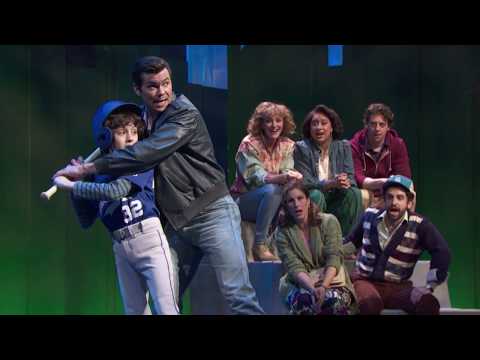
- The Baseball Game
- A Day in Falsettoland
- Round Tables, Square Tables
- Everyone Hates His Parents
- What More Can I Say?
- Something Bad Is Happening / More Racquetball
- Holding to the Ground
- Days Like This
-
Canceling the Bar Mitzvah
- Unlikely Lovers
- Another Miracle of Judaism
- Something Bad Is Happening (reprise)
-
You Got to Die Some Time
-
Jason's Bar Mitzvah
- What Would I Do?
About the "Falsettoland" Stage Show
J. Lapine wrote the libretto for this musical, and was its director. Words and the music were prepared by W. Finn. It is not really a separate show, but one of the three parts that talk about this family and their friends. There, the boy is soon to experience Bar Mitzvah, while his friend with AIDS dies. The premiere of the show was in 1990 in the form of off-Broadway exhibitions and lasted for 6 weeks, followed by its opening on Broadway in Lucille Lortel Theatre, where it lasted only for 176 hits.Actors were: C. Zien, H. MacRae, F. Prince, L. Price, S. Bogardus & M. Rupert. Release of music was made by DRG Records, and in 1992 Broadway opened the second and third parts of the play, which greatly supplemented the picture of the story.
With Lucille Lortel Award, which was named after the theater (or backwards), where it was depicted, this musical was awarded in the following year after its start, and in the same 1991 year, musical won Outer Critics Circle Award & Drama Desk Award.
Release date: 1990
"Falsettoland" – The Musical Guide & Song Meanings
Review
Falsettoland begins with a grin and ends with a throat-tightening hush. That swing is the point. William Finn’s lyrics keep insisting that adulthood is a decision, not a birthday. The characters talk like they think: half-finished, contradictory, funny at the exact moment that feels least polite. It reads like chatter until you notice the engineering. A repeated word becomes a moral. A tossed-off joke becomes the warning siren later.
Musically, the writing sits in that Finn lane where speech and song share the same nervous system. The score feels piano-driven and conversational, but it snaps into ensemble geometry when the “family” needs to behave like a unit. That tension makes the lyric work land harder. Nobody delivers a neat thesis statement. They circle the truth, then collide with it. In Falsettoland, the plot is simple on paper: a bar mitzvah, a reunion, an illness. The text makes it brutal because it refuses to let anyone speak from a safe distance.
How It Was Made
Falsettoland arrived almost a decade after March of the Falsettos, and that gap matters. Finn and director-book writer James Lapine built these pieces in rehearsal, then later fused them into the two-act Falsettos, tightening the time between comedy and catastrophe until it felt like one continuous bruise. Finn has described his songwriting as line-first: he needs the opening phrase before the rest can exist. That method shows. Falsettoland’s best songs feel like a first line that keeps arguing with itself until it becomes a scene.
The writing also carries an era shift. Falsettoland is set at the start of the AIDS epidemic, with characters who do not yet have the vocabulary the audience brings into the room. That dramatic irony is lyric fuel. The words stay casual while the stakes turn lethal. Even the baseball jokes have an aftertaste, because play is what these people use to avoid naming fear.
Key Tracks & Scenes
"Falsettoland" (Mendel & Company)
- The Scene:
- Darkness, then a flashlight sweep. The space feels like a stage and a memory at once. Mendel welcomes us into a “land” that sounds cute until you realize it is a coping mechanism.
- Lyrical Meaning:
- The opening turns the show into its own metaphor: a place built out of denial, humor, and ritual. The lyric frames everything as a guided tour, which makes the later grief feel like the lights going out on purpose.
"About Time" (Marvin & Company)
- The Scene:
- Morning energy. Marvin tries on a calmer version of himself like a shirt that still itches. The ensemble snaps around him with the impatience of people who have heard promises before.
- Lyrical Meaning:
- The phrase “about time” is an apology and a self-congratulation in the same breath. Finn writes Marvin’s growth as anxious and incomplete. The lyric does not let him graduate into wisdom. It makes him practice.
"The Baseball Game" (Ensemble)
- The Scene:
- A community of adults pretending to be normal in the bleachers. Daylight, chatter, public smiles. Jason plays while everyone else keeps score of the adults’ messy alliances.
- Lyrical Meaning:
- It is comedy with choreography. The lyric’s running commentary makes “watching” the real action. Finn turns spectatorship into a character flaw: everyone is watching everyone, avoiding the private truths that do not fit in a public park.
"Something Bad Is Happening" (Charlotte & Cordelia)
- The Scene:
- Clinical light. A doctor’s certainty collides with a partner’s tenderness. The room feels suddenly smaller, like the walls are closing in on language that cannot keep up.
- Lyrical Meaning:
- The song weaponizes understatement. The title phrase is blunt, almost childish, because the characters lack a stable name for what they are seeing. The lyric becomes a historical document of dread without turning into a lecture.
"Holding to the Ground" (Trina)
- The Scene:
- Trina alone, body in motion. Workout rhythm, forced breath, a domestic space that feels like it is tilting. The humor is physical, but the loneliness is the real staging.
- Lyrical Meaning:
- Finn gives Trina a survival tactic: control the body when the world will not behave. The lyric sounds like self-help until it slips into confession. She is not building strength. She is trying not to float away.
"Unlikely Lovers" (Marvin, Whizzer, Charlotte, Cordelia)
- The Scene:
- A hospital room that turns into a fragile commune. Night light, quiet voices, the sense that everyone is bargaining with time. The staging often reads as stillness with tiny shifts: a hand, a chair, a glance.
- Lyrical Meaning:
- The lyric argues for chosen family without sentimental polish. “Unlikely” is the key word. Finn makes love feel practical and hard-earned, something assembled out of necessity, shame, and loyalty.
"You Gotta Die Sometime" (Whizzer)
- The Scene:
- Isolation inside a crowded crisis. The room is bare in feeling even if bodies are nearby. Whizzer faces the fact of death with bravado that keeps cracking into honesty.
- Lyrical Meaning:
- Finn refuses purity. The lyric does not turn Whizzer into a saint. It lets him be scared, funny, angry, and brave in the same minute. The blunt title is not acceptance. It is a dare aimed at the universe.
"What Would I Do?" (Marvin & Whizzer)
- The Scene:
- After. Marvin in the quiet, replaying choices with a mind that cannot rewind far enough. Whizzer’s presence can read as memory, fantasy, or the last generous gift of the theatre.
- Lyrical Meaning:
- The lyric is grief with no disguise. Marvin finally speaks plainly, which is why it lands like a body blow. Finn structures the questions so they circle back into love, then collapse into loss.
Live Updates
In 2025 and into 2026, Falsettoland is most often encountered as Act Two of Falsettos, with companies leaning on the 2016 revival’s staging language: toys, blocks, and play that curdles into reality. In May to June 2025, Washington, D.C.’s Keegan Theatre mounted Falsettos in a production framed as a tribute soon after William Finn’s death in April 2025. Regional momentum continued through 2025, including Arden Theatre Company’s Philadelphia run from late September through late October 2025, and at least one Canadian presentation announced for March 2026 in Montreal at the Segal Centre.
Ticket trends vary by market, but the programming pattern is consistent: theatres schedule Falsettos as an “event” musical, often pairing it with community partnerships around LGBTQ+ history and public health memory. For audiences who only know the filmed revival, the most surprising live detail is how compact Falsettoland can feel in the room. Ninety minutes. No filler. Once “Something Bad Is Happening” arrives, the clock feels audible.
Notes & Trivia
- Falsettoland premiered Off-Broadway at Playwrights Horizons in 1990, directed by James Lapine.
- It later became the second act of the full-length Falsettos on Broadway in 1992.
- The original cast included Michael Rupert (Marvin), Faith Prince (Trina), Stephen Bogardus (Whizzer), Chip Zien (Mendel), Heather MacRae (Charlotte), and Janet Metz (Cordelia).
- Finn’s process, by his own account, starts with the opening line; without it, he cannot write the song.
- The dramatic engine of Falsettoland includes audience knowledge the characters do not yet have, which sharpens the lyric irony.
- Falsettoland received major Off-Broadway accolades, including a Drama Desk recognition for Finn’s lyrics.
- The cast recording circulates widely on streaming, keeping the Off-Broadway vocal imprint alive even when productions are scarce.
Reception
When Falsettoland first landed, some critics praised its craft while others struggled with its refusal to treat queer life as “exotic.” Later commentary and scholarship has been blunt about that critical discomfort, noting how reviewers sometimes reduced characters to labels rather than reading the lyric strategy. Over time, the pendulum has swung. The revival era reframed the piece as a canon work about family structure and historical memory, with reviewers repeatedly calling out Finn’s jagged humor and emotional precision.
“It’s about time, don’t you think?” sings Marvin at the outset of the second act.
A repeated lyric asks, “Why don’t you feel all right for the rest of your life?”
Frank Rich said the fused evening “gains exponentially in power” when the acts are seen minutes apart.
Quick Facts
- Title: Falsettoland
- Year: 1990 (Off-Broadway premiere)
- Type: One-act musical; later used as Act Two of Falsettos
- Book: William Finn and James Lapine
- Music & Lyrics: William Finn
- Original Director: James Lapine
- Original Venue: Playwrights Horizons (New York City)
- Setting: New York City, early 1980s (AIDS era)
- Soundtrack album: Original Off-Broadway Cast Recording (released by DRG Records; 18 tracks)
- Availability: Streaming on major platforms (album pages list DRG Records and 1991 release metadata)
- Selected notable placements: “The Baseball Game” as public-comedy hinge; “Something Bad Is Happening” as tonal pivot; “What Would I Do?” as final elegy
Frequently Asked Questions
- Is Falsettoland its own musical, or just part of Falsettos?
- It is its own one-act musical from 1990. Most audiences now meet it as Act Two of the full-length Falsettos, where it follows March of the Falsettos.
- Who wrote the lyrics for Falsettoland?
- William Finn wrote the music and lyrics. The book is credited to Finn and James Lapine.
- What is the “Something Bad Is Happening” song actually doing in the story?
- It functions as diagnosis and prophecy. The characters can sense disaster but cannot yet name it cleanly, so Finn gives them blunt language that lands like a warning label.
- Why does the baseball sequence matter so much?
- Because it makes the community visible. The lyric turns the audience into fellow spectators, then quietly reminds you that watching is not the same as helping.
- Is there a film version that includes Falsettoland?
- Yes. The filmed performance of the 2016 revival (released via the Live from Lincoln Center presentation) includes Falsettoland as the second half.
- Where can I listen to the cast recording?
- The Original Off-Broadway Cast Recording has official album pages on major streaming services and official audio tracks released by DRG Records on YouTube.
Key Contributors
| Name | Role | Contribution |
|---|---|---|
| William Finn | Composer-Lyricist; Co-Book | Wrote the score’s conversational lyric style and built the show’s tonal turn from comedy into grief. |
| James Lapine | Co-Book; Director (original) | Helped shape the material in rehearsal and staged the original Off-Broadway production. |
| Michael Rupert | Original Cast | Originated Marvin in the 1990 production, anchoring the lyric contradictions with warmth and bite. |
| Faith Prince | Original Cast | Originated Trina, giving Finn’s comic panic a grounded emotional motor. |
| Stephen Bogardus | Original Cast | Originated Whizzer, threading charm through the show’s hardest late songs. |
| Chip Zien | Original Cast | Originated Mendel, the narrator-therapist whose language keeps trying to organize chaos. |
| Heather MacRae | Original Cast | Originated Dr. Charlotte, the medical voice that forces the lyric world to face reality. |
| Janet Metz | Original Cast | Originated Cordelia, bringing tenderness and bite to the show’s communal scenes. |
Sources: Concord Theatricals; Playbill; The Washington Post; Time Out New York; Playwrights Horizons; Lincoln Center Theater / Live from Lincoln Center (YouTube); Arden Theatre Company; Segal Centre for Performing Arts; Apple Music; Spotify; Journal of Dramatic Theory and Criticism (Jeffrey Smart).