
Face the Music Lyrics: Song List
- Overture
- Lunching at the Automat
- Let's Have Another Cup O' Coffee
- Two Cheers Instead of Three
- The Police of New York
- Reisman's Doing a Show
- Torch Song
- You Must Be Born With It
- Castles In Spain (On A Roof in Manhattan)
- Crinoline Days
- My Beautiful Rhinestone Girl
- Soft Lights and Sweet Music
- If You Believe
- Well, of All the Rotten Shows
- I Say Spinach (And the Hell With It)
- How Can I Change My Luck?
- A Toast to Prohibition
- I Don't Wanna Be Married (I Just Wanna Be Friends)
- Manhattan Madness
- The Investigation
About the "Face the Music" Stage Show
Ingenious Irving Berlin wrote this music and lyrics & the libretto was performed by Moss Hart. In the production of musical, a title have had several options, including Nickels & Dimes, but then it was called with neutral name, Face The Music, so not to say aloud of Great Depression.
Its pre-Broadway run was held in Philadelphia in 1932, and then at the beginning of the same year, a musical without any significant changes was moved to New Amsterdam Theatre. Having only 165 hits, it was closed in the summer of the same year. In contains a story of its own time and shall not be judged severely, that during the Great Depression it lasted for six months only – in fact, many modern histrionics run less than this figure, so it means that it was good.
After re-opening, the musical has held for 31 shows, in the 44th Street Theatre, which was demolished in 1945. Actors: M. Boland, The Albertina Rasch Dancers, M. Adams, T. Arace, C. Lawrence, K. Carrington, R. E. Keane.
Its subsequent production was in 1997, for 2 weeks in San Francisco & in 2002 in New York. In the Big Apple musical returned again in 2007 to do only a few shows with such actors: M. Patterson, J. Kaye, J. Denman, L. Wilkof, E. Korbich & W. Bobbie.
In 2015, its resurrection took place again in the summer, at 1 month, in Rose & Crown Theatre in the Great Britain, where the director was Brendan Matthew.
Release date of the musical: 1932
"Face the Music" – The Musical Guide & Song Meanings
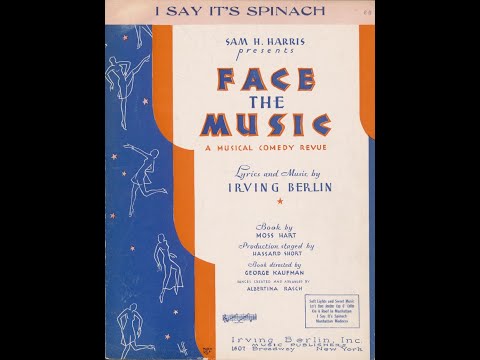
Review: a satire that keeps smiling while it bites
What kind of musical opens by watching rich people learn how to eat like everyone else? “Face the Music” (1932) is Irving Berlin writing with a raised eyebrow, and Moss Hart aiming that eyebrow at New York itself. The lyric engine is the show’s real plot: it constantly converts public scandal into punchline, then converts punchline into a chorus you can whistle on the way home. That’s the trick. The songs rarely pause the story to admire themselves. They keep the machinery moving, especially when the book leans into backstage chaos and political farce.
Berlin’s style here is classic Broadway with a newsprint edge: crowd-pleasing forms, quick setups, and rhymes that land like a wink. The show’s central obsession is money, specifically dirty money. That theme shapes the language. Characters sing as if they are bargaining in public. Even romance is framed like a purchase. When the score turns lush, it feels like a deliberate escape hatch that the characters know is temporary. Then the satire snaps back, brighter and faster, as if the bandleader just changed the subject before the room got too honest.
How it was made: headlines, hard times, and a later restoration
“Face the Music” was written in the middle of Depression anxiety and New York’s corruption talk. Hart and Berlin built a story that spoofs police graft and civic hypocrisy, echoing the era’s investigations into corruption while still promising a night of laughs. The title itself went through options; “Nickels and Dimes” was in the mix before Berlin landed on “Face the Music,” a phrase that sounds like morality and show business at once. The original Broadway production opened at the New Amsterdam Theatre with a major commercial team behind it, including George S. Kaufman and choreographer Albertina Rasch.
The deeper behind-the-scenes tale came decades later. For City Center’s Encores! in 2007, the show was reconstructed from surviving materials: old parts, revisions, and the kind of paper trail musicals rarely protected in the 1930s. David Ives shaped a concert adaptation, while music staff and archivists rebuilt the score so it could play again with clarity and heft. That restoration matters for lyric analysis because it re-centers Berlin’s intent: not just “two standards and filler,” but a full satirical arc that keeps returning to the same targets, in new masks.
Key tracks & scenes: where the songs hit, and what the words mean
"Lunching at the Automat" (Ensemble)
- The Scene:
- Outside, then inside an automat. Bright, fluorescent practicality. The crowd moves like a line that never ends. The formerly comfortable try to look casual while counting coins.
- Lyrical Meaning:
- This number establishes the show’s emotional weather: hunger dressed up as etiquette. Berlin’s language treats “being broke” as a social costume. It’s funny, and the joke hurts because it’s specific.
"Let’s Have Another Cup of Coffee" (Pat Mason Jr. & Kit Baker)
- The Scene:
- Still near the automat world. The couple stands close, staging optimism as if it were a dance step. The lighting warms just enough to suggest hope, then cools again when reality interrupts.
- Lyrical Meaning:
- The lyric is pep talk with teeth. It sells cheer the way ads sell soap, which is exactly the point. The song becomes the show’s thesis: when you can’t buy a future, you rent one with a refrain.
"Torch Song" (Streetwalker)
- The Scene:
- A nightclub or street-corner fantasy, staged with a tight spotlight and exaggerated shadow. She performs heartbreak like a career move, milking every sigh because the room rewards it.
- Lyrical Meaning:
- Berlin skewers the commercial packaging of suffering. The lyric turns “misery” into an audition piece, and the joke becomes commentary on how entertainment industries profit from pain.
"My Beautiful Rhinestone Girl" (Rodney St. Clair)
- The Scene:
- Onstage within the onstage show “Rhinestones of ’32.” Glittery light, hard smiles, a deliberate imitation of luxury. The performance is gorgeous in the way a shop window is gorgeous.
- Lyrical Meaning:
- The word “rhinestone” is the whole metaphor: shine without value. Berlin lets the lyric seduce you, then leaves you sitting with the falseness it celebrates.
"Soft Lights and Sweet Music" (Pat Mason Jr. & Kit Baker)
- The Scene:
- A calmer pocket inside the frenzy. The stage dims. The couple finds a private corner of Manhattan, as if the city finally stopped talking long enough for them to breathe.
- Lyrical Meaning:
- This is Berlin offering romance as anesthesia. The lyric doesn’t deny the Depression; it makes a small room inside it. The song’s beauty reads as strategic, not naïve.
"I Say It’s Spinach (And the Hell with It)" (Pat Mason Jr. & Kit Baker)
- The Scene:
- In a social setting where taste is policed: a party, a foyer, a world of opinions. The lighting is crisp, even clinical, as if the room itself is judging them.
- Lyrical Meaning:
- The lyric is refusal. It’s Berlin writing an anthem for people who are tired of being told what’s “good.” In the show, that defiance doubles as a survival skill: if you can’t control the system, you can at least control your appetite for its rules.
"Manhattan Madness" (Pat Mason Jr.)
- The Scene:
- Times Square energy, movement pushing against the edges of the stage. The band feels louder. The lights flash like a street that won’t sleep, even when the city is broke.
- Lyrical Meaning:
- The lyric treats New York as a tempo problem: too fast to think, too loud to confess. It’s less “I love this town” than “this town won’t let me go.”
"Investigation" (Company)
- The Scene:
- A courtroom sequence that grows into a running musical argument. Themes return, testimony overlaps, and the ending swerves into theatrical absurdity, like a scandal papered over with spectacle.
- Lyrical Meaning:
- This finale shows Berlin using reprise as political structure. The words circle back on earlier promises and earlier jokes, implying that the system never truly resolves, it just changes costumes.
Live updates for 2025/2026 listeners
“Face the Music” is not a repertory staple with constant major revivals. Its modern public life comes from two places: licensing and recordings. Concord Theatricals currently represents the show for secondary-stage licensing, including the Encores! concert adaptation credited to David Ives, with perusal and rental options listed through their platform. That matters for 2025/2026 because it is the most practical route for new audiences to encounter the full piece, not only the familiar standards.
On the audio side, the 2007 City Center Encores! cast recording remains the most accessible “complete show” document, and it has become the default reference for how the restored material flows. If you are searching streaming platforms, you’ll often find the Encores! album entry rather than a 1932 original-cast artifact. For collectors, listings and re-sales still circulate, but the cleanest way to understand the lyric architecture is to start with the restored recording, then compare how individual songs traveled into the broader Berlin songbook.
Notes & trivia
- It was the first collaboration between Moss Hart (book) and Irving Berlin (music and lyrics).
- The original Broadway run opened at the New Amsterdam Theatre in February 1932 and ran 165 performances.
- The story is anchored in a producer trying to finance a show during the Depression, with crooked cops laundering money through Broadway.
- Multiple working titles circulated; “Nickels and Dimes” is a documented example before Berlin settled on “Face the Music.”
- The 2007 Encores! version was rebuilt from surviving materials, with a concert adaptation credited to David Ives and a restoration effort led by music archivists.
- Playbill’s surviving 1932 material even lists scene locations alongside songs, reinforcing how directly the numbers were tied to specific places like the automat and Times Square.
- “Torch Song” is frequently singled out by reviewers as a comic standout because it spoofs the era’s suffering-as-entertainment pose.
Reception then vs. now
In 1932, critics recognized the show’s ambition: satire aimed at real civic rot, packaged as musical comedy. Later commentary often framed it as a “minor” Berlin score with a couple of big hits, a judgement that softened once the Encores! restoration revealed how many of the lyrics were built to interlock with the book’s cynicism. Modern reviews tend to praise the piece less for plot coherence and more for how quickly it turns topical anger into stage rhythm.
“The result … is a minor gem - a lost 1932 hit unearthed and brilliantly polished by New York's Encores series.”
“The best musical in town is the City Center Encores! revival of Irving Berlin and Moss Hart’s Face the Music.”
“Berlin's score is quite an interesting one, with lyrics that contain a sharper satirical bite than you might expect from him.”
Quick facts
- Title: Face the Music
- Year: 1932
- Form: Musical comedy revue / backstage satire
- Book: Moss Hart
- Music & lyrics: Irving Berlin
- Original Broadway producer: Sam H. Harris
- Original Broadway theatre: New Amsterdam Theatre (Broadway)
- Original production stage direction: Hassard Short; directed by George S. Kaufman
- Choreography: Albertina Rasch
- Musical director: Frank Tours
- Orchestrators (original credits): Frank Tours, Robert Russell Bennett, Maurice De Packh
- Selected notable placements inside the show: automat opening (“Lunching at the Automat”), Times Square sequence (“Manhattan Madness”), extended courtroom finale (“Investigation”)
- Modern performance edition: Encores! concert adaptation credited to David Ives (as listed for licensing)
- Album status: 2007 Encores! cast recording (DRG Records) remains the primary full-score listening entry
Frequently asked questions
- Is “Face the Music” the same thing as “Let’s Face the Music and Dance”?
- No. “Let’s Face the Music and Dance” is a separate Irving Berlin song written for a film. “Face the Music” is a 1932 stage musical with its own story and score.
- Who wrote the lyrics?
- Irving Berlin wrote both music and lyrics, with Moss Hart writing the book.
- Is there a cast recording?
- Yes. The most widely available full-show audio document is the 2007 City Center Encores! cast recording, released by DRG Records.
- What is the show actually about?
- A broke Broadway producer tries to fund a new revue during the Depression and ends up taking investment from corrupt police figures trying to get rid of illegal money.
- Why does the automat matter so much in the opening?
- It’s a social equalizer. The lyric uses the setting to show class panic in plain daylight, then spins that discomfort into comedy.
- What song best captures the show’s attitude?
- “I Say It’s Spinach (And the Hell with It).” It’s the score’s clearest expression of refusal: refusing taste-policing, refusing false refinement, refusing to apologize for directness.
Key contributors
| Name | Role | Contribution |
|---|---|---|
| Irving Berlin | Composer & Lyricist | Wrote the score’s melodies and lyrics, balancing pop immediacy with political bite. |
| Moss Hart | Book writer | Built the backstage satire structure and the corruption storyline. |
| Sam H. Harris | Producer (original Broadway) | Mounted the 1932 Broadway production at the New Amsterdam Theatre. |
| George S. Kaufman | Director (original Broadway credit) | Helped shape the original staging and comedic timing. |
| Albertina Rasch | Choreographer | Created dance material for the original production’s revue-driven format. |
| Frank Tours | Musical Director (original Broadway credit) | Led music direction and received orchestration credit alongside Bennett and De Packh. |
| David Ives | Concert adaptation (Encores!) | Shaped the restored concert version used for modern performance contexts. |
Sources: IBDB; Concord Theatricals; Playbill; PBS (Broadway: The American Musical); TheaterMania; SF Gate; BroadwayWorld; Wikipedia.