Evil Dead Lyrics – All Songs from the Musical
Evil Dead Lyrics: Song List
- Book of the Dead
- Cabin in the Woods
- Stupid Bitch
- Housewares Employee
- Evil Trees
- It Won't Let Us Leave
- Look Who's Evil Now
- What the F**k Was That?
- Join Us
- Good Old Reliable Jake (Intro)
- Good Old Reliable Jake
- Housewares Employee (Reprise)
- Death is a B****
- I'm Not A Killer
- Evil Puns
- Bit Part Demon
- Good..Bad..I'm the Guy with the Gun
- All the Men in My Life Keep Getting Killed by Candaian 19. Demons
- Ode to an Accidental Stabbing
- Boomstick
- Do the Necronomicon
- It's Time
- We Will Never Die
- S-Mart
- Blew That Bitch Away
- Groovy
About the "Evil Dead" Stage Show
After seeing this musical, we can say that it is based more on the second part of the movie, The book of Dead, where there is about the Necronomicon, which protagonist finds. But it turns out that all of parts of Evil Dead were the origin of it (well, mostly, three, as the fourth came out after it). The latter, incidentally, has 4 official parts, shoot from 1981 to 2013, united by a common hero Ash and has spin-offs that are not associated with the original part. The creation of 1 – 2 extensions/restarts is discussed, but so far, their quantity is as stated. In a word, the film of 2013 as its restarting.In Canada, its show lasted until 2004, in particular, in the Tranzac Theatre, Toronto, and then it was renewed in 2007, after the Off-Broadway exhibition. The revival went for one and a half year, and in 2008, it was shown for more than 300 times only in Canada, not counting others, so in Toronto it became the longest in the history among all shows.
Off-Broadway was launched in 2006, and then, within the next six months, a musical went with 8 shows per week. Recording of music with it reached number 4 in the popular charts of Billboard.
In addition to professional shows, about 200 others have passed, including amateur ones, in different parts of the world, inclusive the United States, Tokyo & Seoul. It began in 2011 in Las Vegas, where, as of 2012, were continuing. It received there a status of the longest show in this city. It was made even 4D show, with elements of involving the audience in staging, with noise and light that highlights the musical among its kind. It was decided to do production in 4D five times a week, as long as it will not be visited by people. That is, with an open-ended termination date. Tour of the United States in 2014 – 2015 was quite successful and has been in 18 cities in more than 9 states. The main actors were: C. Sclavi, J. Kingsdale, D. Sajewich, R. Czerwonko, D. Zaino, R. McBride, C. Johnson, J. Baird & A. D. Rosa.
Release date: 2003
"Evil Dead: The Musical" – The Musical Guide & Song Meanings
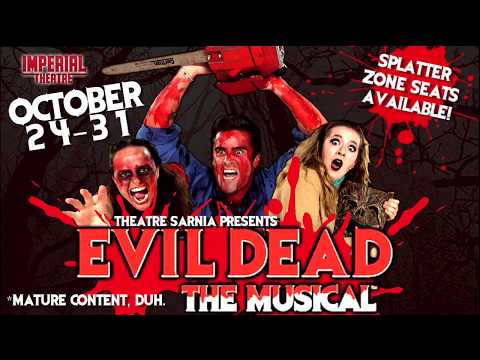
Review
Why does a horror comedy about dismemberment need lyrics at all. Because the lyrics are the alibi. “Evil Dead: The Musical” takes a story built on panic and turns panic into punchline cadence. Songs arrive right where a normal horror film would cut away. The musical does the opposite. It holds the moment and forces you to grin inside it.
The best writing trick here is tonal misbehavior. George Reinblatt has said the aim was to make the songs feel like “regular musical theater” and then twist the expectation with blunt language and wrong-footed subject matter. That is the core engine. Love songs happen when love is the least useful emotion in the room. Dance numbers happen when survival should be the only agenda.
Musically, it sits in pop-rock comfort with genre pastiche as seasoning. A ballad can be sincerely pretty. A villain feature can swing into camp choreography. The score keeps winking, but it still builds stakes through rhythm and repetition. Ash’s material is written like a reluctant hero trying to stay ordinary. That is why his big declarations land. He keeps insisting he is not built for this, and the show keeps proving he is.
How It Was Made
The show’s origin is not a tidy theatre myth. It is a bar. In August 2003, “Evil Dead: The Musical” debuted in the back room of Toronto’s Tranzac Club with a DIY vibe and a crowd that heard about it fast. The official history leans into how scrappy it was, including a period when the production was too cheap for a formal ticketing system. That early atmosphere matters because the lyrics still behave like they are being sung at you from three feet away.
Fangoria’s reporting on the early “Evil Dead 1 & 2” era captures the creative logic in plain terms: Bond and Reinblatt were chasing the cult-musical electricity they felt watching “The Rocky Horror Show,” then picked Raimi’s films because the characters and the horror-comedy blend could carry that kind of audience participation. Reinblatt also frames the fan base as the real pressure test. He describes “Deadites” as a brutal audience to satisfy, which explains why the adaptation is full of reverent details and also jokes about the franchise’s own absurdities.
Even the show’s legend has literal darkness baked in. During the Northeast blackout in 2003, the company performed outdoors with acoustic instruments and improvised lighting from flashlights and car headlights. That anecdote fits the show’s personality: if you can still sing while the power is out, you can probably sing while someone gets sprayed in the face.
Key Tracks & Scenes
"Cabin in the Woods" (Company)
- The Scene:
- A road-trip arrival that starts like a party and ends like a warning label. Bright, friendly cabin light. The woods around it feel like a closed fist. The number is often staged with fast movement and a sense of “we’re safe now,” which is the joke.
- Lyrical Meaning:
- The lyric is pure setup. It sells normalcy so the show can smash it. It also frames Ash as the least mythic guy in the group, which becomes the point later.
"Housewares Employee" (Ash, Linda)
- The Scene:
- A romantic pocket inside the cabin. Softer lighting, slower tempo, bodies closer. It is the calm before the first real rupture.
- Lyrical Meaning:
- The lyric insists that Ash’s identity is small and practical. That “smallness” becomes his survival skill. He does not start as a hero, he starts as a guy who wants a quiet life.
"It Won’t Let Us Leave" (Cheryl)
- The Scene:
- Cheryl senses the woods turning hostile. The staging often shifts into shadow and slanted angles, with the doors and windows suddenly feeling like props that refuse to cooperate.
- Lyrical Meaning:
- This is the show’s first lyrical admission that the environment is a character. The lyric makes fear specific. Not “I’m scared.” More like “the rules changed while we weren’t looking.”
"Look Who’s Evil Now" (Cheryl, Shelly)
- The Scene:
- Possession as a performance. A spotlight-on-the-monster moment where the tone flips into swagger. This is where the show starts telling you the demons are having fun.
- Lyrical Meaning:
- The lyric turns transformation into a punchline and a power grab. It is also a signal: the musical is not aiming for dread. It is aiming for gleeful violation of taste.
"What The F*@k Was That?" (Ash, Scott)
- The Scene:
- A shouted duet after the first “you have got to be kidding me” horror beat. Harder lighting. Faster pacing. Physical comedy layered over real shock.
- Lyrical Meaning:
- The lyric is the audience’s inner monologue made singable. It also defines the show’s contract: the score will not protect you with polite language.
"Join Us" (Deadites and Company)
- The Scene:
- The invitation number. Deadites gather like a twisted chorus line, often staged to flirt with audience participation. In some versions, this is where the “cult musical” DNA is most explicit.
- Lyrical Meaning:
- The lyric sells belonging as danger. Scholarship on the show notes how the creators anticipated “Rocky Horror” comparisons, even slipping in a “Time Warp” nod to signal the lineage.
"I’m Not a Killer" (Ash)
- The Scene:
- A reluctant hero arguing with the situation. Ash is usually isolated in a tighter pool of light, because he is trying to decide who he is before the show decides for him.
- Lyrical Meaning:
- This is moral hesitation set to propulsion. The lyric does not make Ash noble. It makes him human, which is the only credibility the show needs.
"All the Men in My Life Keep Getting Killed by Candarian Demons" (Annie with Ash and Jake)
- The Scene:
- Annie arrives with the professor’s context and a growing body count. The number often plays as bright delivery of bleak information, a grin that shows teeth.
- Lyrical Meaning:
- The lyric is comic escalation as character backstory. It also proves the score’s skill: it can carry exposition without stopping the show.
"Do the Necronomicon" (Demons)
- The Scene:
- A full dance number in praise of the book. Choreography pushes toward parody-of-ritual, with staging that often turns the cabin into a nightclub from hell.
- Lyrical Meaning:
- The lyric makes evil sound organized. That is the joke and the threat. The demons do not only kill, they celebrate the system that lets them keep killing.
Live Updates
As of January 23, 2026, the show is alive in the way cult titles often are: not one official tour you chase, but many licensed productions popping up everywhere. The official “Productions” list includes dates in the U.S., Canada, Europe, and Australia, plus a 2026 German-language run billed as “Evil Dead Das Musical.” If you want a practical snapshot of where the show is actually playing, that page is more useful than any rumor mill.
Licensing is also fully mainstream now. MTI lists multiple versions, including a High School Version that cleans up profanity in titles and lyrics. That matters for the lyric legacy, because it shows how the text can be reshaped without losing the central joke: classic musical forms, applied to unacceptable events.
On the album side, the original cast recording’s chart story is well documented. Playbill reported the cast album debuting in the top five of Billboard’s Cast Albums chart, and the show’s official site keeps pointing new fans to that milestone. In 2024, the cast recording also saw fresh physical-life energy through vinyl retail listings, proof that the score still reads as collectible culture, not only a stream.
Notes & Trivia
- The official show history places the first debut in August 2003 at Toronto’s Tranzac Club, with a scrappy early ticketing situation.
- During the 2003 blackout, the company performed outside with acoustic instruments and improvised lighting, turning crisis into legend.
- Fangoria quotes Reinblatt describing hardcore fans as “the toughest” audience to please, which explains the show’s mix of homage and mockery.
- StageAgent notes that later revisions changed the ending structure, and that the original “Hail to the King” ending was replaced in some versions.
- StageAgent also notes the High School Version renames explicit titles, including “What the Heck Was That” and “Blew That Witch Away.”
- MTI’s synopsis makes the “Splatter Zone” part of the show’s identity, framing it as a feature, not a gimmick.
- The official site’s 2025 to 2026 listings show the musical continuing as an international licensed brand rather than a single commercial run.
Reception
Critics generally respond to the same paradox. It should be unbearable, and it keeps working. When it fails, it is usually production-side: sound, pacing, or gore that reads as mess rather than punchline. When it succeeds, it is because the lyrics know exactly how to behave. They do not chase poetry. They chase timing.
“Welcome to the wild and woolly universe of ‘Evil Dead: The Musical.’”
“The show’s wit, gore and stage magic make it a ridiculous amount of fun.”
“Evil Dead: The Musical wants to be the next Rocky Horror Show, and it may just succeed.”
Quick Facts
- Title: Evil Dead: The Musical
- Year: 2003 (first staged in Toronto)
- Type: Rock musical comedy with horror parody elements
- Book & Lyrics: George Reinblatt
- Music: Frank Cipolla, Christopher Bond, Melissa Morris, George Reinblatt
- Music Supervision: Frank Cipolla
- Additional Lyrics: Christopher Bond
- Based on: Characters created by Sam Raimi; draws from The Evil Dead, Evil Dead 2, and Army of Darkness
- Selected notable placements: Arrival and mood fake-out (“Cabin in the Woods”); first full possession swagger (“Look Who’s Evil Now”); cult invitation (“Join Us”); demon dance ritual (“Do the Necronomicon”)
- Album status: Original cast recording released in early April 2007; later vinyl retail listings show a 2024 vinyl release date
- Availability: Licensed worldwide via MTI, including a High School Version
Frequently Asked Questions
- Is this the same story as the original film?
- It tracks the cabin setup closely, then borrows and recombines elements from later films for stage momentum. The plot is faithful in spirit, not in detail.
- Who wrote the lyrics?
- George Reinblatt wrote the book and lyrics, and also co-wrote the music with Frank Cipolla, Christopher Bond, and Melissa Morris.
- Why do the songs feel “normal” even when the events are extreme?
- That mismatch is the design. Reinblatt has described aiming for classic musical-theatre shapes and then twisting them with blunt subject matter and timing.
- What is the “Splatter Zone”?
- It is a section of seats, usually closest to the stage, where the fake blood is most likely to hit you. It is part warning, part souvenir culture.
- Is there a cleaned-up version for schools?
- Yes. MTI licenses a High School Version that removes profanity in titles and lyrics, including renamed songs.
- Where can I track current productions in 2025 and 2026?
- The official site maintains a rolling productions list with dates and locations, including international runs and language variants.
Key Contributors
| Name | Role | Contribution |
|---|---|---|
| George Reinblatt | Book, Lyricist, Composer (co) | Sets the show’s core lyric trick: classic musical forms colliding with horror-comedy bluntness and fan-service detail. |
| Christopher Bond | Composer (co), Director (early versions), Additional Lyrics | Co-shaped the “cult musical” approach and helped translate the franchise’s set pieces into stage action. |
| Frank Cipolla | Composer (co), Music Supervision | Grounded the score’s pop-rock language and oversaw musical consistency across productions. |
| Melissa Morris | Composer (co) | Helped build the show’s genre-flexing musical voice, from ballads to comedic showstoppers. |
| Music Theatre International (MTI) | Licensing | Maintains worldwide licensing, including alternate versions such as the High School Version. |
| Evil Dead The Musical (official site) | Production hub | Publishes official author credits, show history, and current production listings across regions. |
Sources: EvilDeadTheMusical.com (official site), Music Theatre International (MTI), Fangoria, Reuters, Playbill, StageAgent, Wikipedia, UNB journals PDF, YouTube.