Dance of the Vampires Lyrics – All Songs from the Musical
Dance of the Vampires Lyrics: Song List
- Act 1
- Overture
- Angels Arise
- Original Sin
- Garlic
- Logic
- There's Never Been A Night Like This (A Girl As Beautiful As She)
- Don't Leave Daddy
- Forevermore in the Night
- Death Is Such An Odd Thing
- Braver Than We Are/Red Boots Ballet/Say A Prayer
- Come With Me
- Act 2
- Vampires In Love
- Carpe Noctem
- For Sarah
- Death Is Such An Odd Thing - Reprise
- When Love Is Inside You
- Eternity
- Confession Of A Vampire
- The Ball (Never Be Enough/You Will Live Forever)
- Braver Than We Are (Reprise)
- Dance Of The Vampires (Finale)
About the "Dance of the Vampires" Stage Show
This musical had many versions, all of which have their roots in ancient legends about Transylvania, which became famous all over with its vampire Count Dracula. It is thanks to his nobility that many vampires are portrayed as beautiful & elegant, dressed in expensive clothes of 19th-century fashion, polite young people with manners, knowing a lot of things, from the style to the general issues. The starting point was the creation of the film by Roman Polanski, which he did in 1967, also acted as a youngster-researcher who was looking for vampires.Originally, the musical was created in German, and then came the French version. The English version was in 2002, based on a new scenario. It was played since 1997 in Vienna, Austria, until 2014, when the musical officially played professionally in Paris, France, for the last time. Polanski was the director of the first version in Vienna and many others after. The prohibition of his entry to the United States and the fear of being arrested for one of his criminal offenses, which he had been trying to remove from himself for decades, made it impossible for this musical to be directed by Polanski in the United States. In the rest of the countries, where he could, he put his efforts and was a director. Sonenberg was later invited among the producers of the show, under whose leadership it was decided to rewrite the script for Broadway and to add more humor, 5 jokes on each sheet of the script, namely.
During the elaboration of production for Broadway, it had some problems with fundraising, but later, under the creative leadership of the team of Sonenberg–Steinman, the musical was made, although it initially received very bad and mixed responses.
Release date: 2002
"Dance of the Vampires" – The Musical Guide & Song Meanings
Review
What kind of musical wants you to laugh at vampires, then asks you to sing their hunger with a straight face? Dance of the Vampires has always lived in that argument. In Europe, it plays like a grand, romantic warning with jokes tucked into the corners. On Broadway in 2002, the argument became the headline. The lyrics leaned harder into punchlines, while the score kept insisting on operatic stakes. That friction is the show’s most useful clue.
Jim Steinman writes in boulders. Big chords, big vows, big nights. His lyric voice, especially in English, likes absolutes and dares. It fits Count von Krolock because the Count is basically a philosophy lecture dressed as a seducer. Michael Kunze’s original German text has a different flavor: more theatrical precision, more character shading, more sly menace. When the Broadway version tried to translate tone as much as language, it sometimes landed on the third option: camp that interrupts its own seduction.
Still, the best writing here is unapologetically emotional. Sarah’s songs are about boredom that mutates into craving. Alfred’s songs are about morality that does not stand a chance once the room gets dark. The Professor’s material treats rationality as slapstick, then turns it tragic when he cannot see what is happening right in front of him. The show’s central metaphor is simple and brutal: the vampires do not only drink blood. They sell relief. They promise a life without restraint, and they price it at your future self.
How It Was Made
The musical began as a stage reimagining of Roman Polanski’s 1967 film. VBW’s own creative-development notes say Polanski initially thought the idea of turning his film into a musical was crazy, then came around once the dramaturgy and the rock writing started to make sense as theatre. The Vienna premiere arrived October 4, 1997 at the Raimund Theater, with Polanski directing. That date matters because it locks in the show’s original identity: not parody, not pure horror, but a hybrid that uses comedy as camouflage.
Steinman’s writing process left fingerprints all over the score. In a Playbill interview published during the Broadway ramp-up, he said “Total Eclipse of the Heart” was effectively reclaimed as a vampire love song, explaining that he had only about six weeks to write the Vienna show and needed a huge duet. He remembered he had written “Total Eclipse” with vampire imagery in mind, and it slid into the musical because it already spoke the language of darkness and obsession. That is less trivia than a mission statement: this musical treats pop as myth, and myth as something you can dance to.
The Broadway version, though, is the cautionary chapter. Playbill’s reporting from fall 2002 captures constant change: postponed previews, ongoing rewrites, and a production trying to decide whether it wanted to be spooky romance or a joke machine. Michael Kunze publicly discussed structural and character changes for Broadway, including how the show was reshaped for American taste. Critics later described the result as an expensive push-pull between spoof and gothic seriousness. The conflict was not only in staging. It was in the words. When a lyric is asking for sincerity and the scene is asking for a rimshot, somebody loses.
Key Tracks & Scenes
"Overture / Carpe Noctem" (Company)
- The Scene:
- Cold air. A village edge. Bare trees and a suggestion of a church silhouette. The sound arrives first, like fog rolling in on a bass line.
- Lyrical Meaning:
- This is the show’s thesis in motion: night is not only danger, it is permission. The hook turns predation into invitation. That is the vampires’ whole business model.
"Knoblauch / Garlic" (Village and Innkeeper’s World)
- The Scene:
- An inn that smells like defense. Garlic strings everywhere. Warm light indoors, panic outdoors. People act casual because acting casual is the ritual.
- Lyrical Meaning:
- The lyric treats superstition as routine. It tells you the villagers already live under occupation, they just call it tradition so it hurts less.
"Invitation to the Ball" (Count von Krolock and Company)
- The Scene:
- The castle reveals itself in layers: corridors, candles, servants, and a sense of scale that makes humans look like toys. The Count’s charm is presented as architecture.
- Lyrical Meaning:
- The invitation is polite on the surface and coercive underneath. It is a lyric about consent written as a party notice, and that is why it chills.
"God Has Left the Building" (Vampire World)
- The Scene:
- A sermon without a church. The staging often leans into blasphemous spectacle: dramatic shadows, bodies moving like a ritual, laughter in the wrong places.
- Lyrical Meaning:
- This number flips morality into mood. If God has gone, anything can be made into pleasure. The lyric is less theology than a dare.
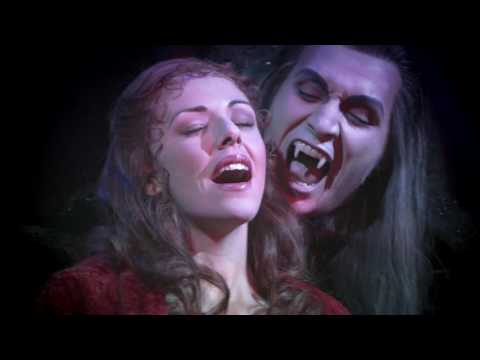
"Vampires in Love / Totale Finsternis / Total Eclipse of the Heart" (Sarah and the Count)
- The Scene:
- Sarah at the edge of a choice she cannot admit is a choice. The Count closes distance slowly. The lighting narrows, redder, softer, like the room is trying to hypnotize her for him.
- Lyrical Meaning:
- The song sells surrender as romance. Its images treat darkness as comfort and isolation as intimacy. That is exactly why it works, and why it is dangerous inside the story.
"Carpe Noctem" (Count von Krolock and Vampires)
- The Scene:
- A chorus that moves as one organism. The night becomes a crowd. If the show has a mass scene that feels like a takeover, it is here.
- Lyrical Meaning:
- The lyric reframes feeding as freedom. It is propaganda with a killer melody. By the time the chorus hits, you understand why the villagers lose.
"Eternity / Ewigkeit" (Count von Krolock)
- The Scene:
- Quiet grandeur. The Count alone, or nearly alone. A private confession in a room too large for honesty.
- Lyrical Meaning:
- This is the trap spelled out. Eternal life is not joy. It is appetite that never ends. The lyric makes immortality sound like a sentence.
"The Dance of the Vampires" (Finale) (Company)
- The Scene:
- The ballroom becomes fate. Mirrors, chandeliers, swirling bodies, and a final image that plays like a curse spreading past the footlights.
- Lyrical Meaning:
- The finale is not victory for the heroes. It is contagion. The lyric insists the dance continues because desire is easier than resistance.
Live Updates
2025-2026 status: The Broadway title is dormant, but the property is very much alive internationally under its VBW lineage. VBW reported the musical’s return to Japan in 2025, with a premiere on May 10, 2025 at Tokyo’s Brillia Hall and a planned 71-show run across Tokyo, Aichi (Nagoya), Osaka, and Fukuoka through late July. That announcement also frames the show as a long-running export with a deep multilingual footprint.
In Europe, the title remains a repertory engine for licensed and resident productions. A major example is the long-running St. Petersburg staging, where the theatre’s own repertoire page documents an opening night on September 3, 2011 and credits the international creative and design lineage, from Steve Margoshes’ orchestrations to Polanski’s originating direction. For audiences in 2026, that matters: the most “current” version of the musical is often not New York at all. It is the global network of productions that keep the score in circulation and keep the lyrics mutating across languages.
If you are tracking recordings, the story is similar. There are multiple official European and Japanese cast albums, but Broadway remains the missing trophy. A 2005 Broadway.com column literally names the lack of a Broadway cast album as a regret, and fan communities still talk about it because the 2002 English lyric approach is, for better or worse, its own artifact.
Notes & Trivia
- IBDB logs the Broadway run with a first preview on October 16, 2002, an opening on December 9, 2002, and a closing on January 25, 2003, after 61 previews and 56 performances.
- Playbill’s October 2002 reporting quotes Steinman saying he had only about six weeks to write the original Vienna score and pulled “Total Eclipse of the Heart” in as a ready-made vampire love duet concept.
- VBW’s creative-development page says Polanski initially thought adapting his film into a musical was crazy, then changed his mind once the theatrical approach clicked.
- Playbill covered multiple delays and ongoing changes during the Broadway preview period, including director John Rando’s descriptions of the opening graveyard imagery.
- IBDB’s song listing for Broadway includes a “Braver than We Are (Reprise)” credit noting lyrics by Don Black and Jim Steinman, a small clue that the English text had multiple hands.
- VBW’s 2025 Japan announcement cites over half a million attendees in Japan over nearly 350 performances across earlier visits, underlining how differently the show performs outside the U.S.
- The St. Petersburg theatre page notes the production’s age guidance as 18+, a reminder of how the show’s sexuality and menace are pitched differently by territory.
Reception
In the English-language critical record, two things are true at once. Reviewers could hear the score’s muscle. They also watched Broadway struggle to decide what it was selling. The result became a case study in tone management: you can have jokes, you can have erotic dread, you can have pop-rock grandeur. Mixing all three requires discipline, and the 2002 staging rarely sounded disciplined.
“This odd, expensive enterprise wants to be a light-hearted spoof … and at the same time a churning …”
“Dance of the Vampires, a lavish musical ridiculed by many critics, is to close … having failed to draw adequate audiences.”
“Dance of the Vampires … has a score that thunders and swoons, even when the story can’t decide whether it’s kidding.”
In later reassessments, the Broadway failure became part of the brand. Writers and fans tend to treat it as a fascinating wrong turn. Meanwhile, the European and Japanese versions keep winning by staying emotionally serious inside their comedy, and by letting the romance remain frightening.
Quick Facts
- Title: Dance of the Vampires (also known internationally as Tanz der Vampire)
- Year (your tag): 2002 Broadway production
- Type: Gothic rock musical; horror-comedy romance
- Based on: Roman Polanski’s 1967 film (The Fearless Vampire Killers)
- Music: Jim Steinman
- Original book and lyrics: Michael Kunze (German)
- Broadway book credits: Jim Steinman, Michael Kunze, David Ives
- Orchestrations associated with the original lineage: Steve Margoshes
- Broadway run facts: Minskoff Theatre; first preview Oct 16, 2002; opened Dec 9, 2002; closed Jan 25, 2003; 61 previews; 56 performances
- Selected notable placements (story spine): village inn (garlic numbers), castle invitation (ball build), seduction duet (“Total Eclipse” lineage), night-chorus manifesto (“Carpe Noctem”), ballroom finale (“Dance of the Vampires”)
- Recording reality: Official cast albums exist for major non-U.S. productions; Broadway did not receive a widely released commercial cast recording
- Current activity marker: Japan return announced and documented for May–July 2025, plus long-running licensed productions in Europe
Frequently Asked Questions
- Is “Dance of the Vampires” the same show as “Tanz der Vampire”?
- They share the same DNA, but they are not the same experience. The Broadway version was heavily rewritten and pushed harder into comedy, while VBW’s European lineage keeps more romantic dread and different song structures.
- Did Broadway really only run for a few weeks?
- Yes. IBDB records an opening on December 9, 2002 and a closing on January 25, 2003, following a long preview period.
- Why is “Total Eclipse of the Heart” in a vampire musical?
- Steinman told Playbill he had written it with vampire imagery in mind and repurposed it as a vampire love duet concept when he needed a major romantic number quickly for Vienna.
- Is there a Broadway cast recording?
- Not a widely released commercial one. Broadway.com has described the lack of a Broadway album as a notable omission, especially given how different the English lyric approach was in 2002.
- Where can I see the musical in 2025-2026?
- VBW documented a multi-city Japan run in 2025, and major licensed productions continue in Europe, including long-running repertory versions documented by producing theatres.
- Is a movie musical version happening?
- Plans have floated for years in various forms, but the most concrete “screen version” remains the original 1967 film that inspired the stage work.
Key Contributors
| Name | Role | Contribution |
|---|---|---|
| Jim Steinman | Composer; English lyrics contributor; Broadway co-book | Wrote the score’s gothic-pop engine and shaped the Broadway text direction. |
| Michael Kunze | Original book and lyrics (German); Broadway co-book | Created the story structure and character psychology that define the European lineage. |
| David Ives | Broadway co-book | Helped shape the Broadway comedy voice and structural revisions. |
| Roman Polanski | Director of the film; director of the original Vienna production | Set the originating tone and stage language for the 1997 world premiere. |
| Steve Margoshes | Orchestrations (key lineage credit) | Orchestral architecture that supports the rock weight without losing theatrical clarity. |
| John Rando | Broadway director | Helmed the 2002 Broadway staging through an extended preview rewrite period. |
| John Carrafa | Broadway choreographer | Built the movement language for village comedy, castle seduction, and ballroom mass scenes. |
| Vereinigte Bühnen Wien (VBW) | Originating producer | Developed the 1997 premiere and continues international licensing and brand stewardship. |
Sources: IBDB, Playbill, Variety, The Independent, TalkinBroadway, VBW (MusicalVienna + VBW International), St. Petersburg Musical Comedy Theatre (muzcomedy.ru), Broadway.com, JimSteinman.com, Wikipedia.