Connecticut Yankee, A Lyrics – All Songs from the Musical
Connecticut Yankee, A Lyrics: Song List
- Overture "A Connecticut Yankee"
- My Heart Stood Still
- Thou Swell
- On A Desert Island With Thee
- To Keep My Love Alive
- Can't You Do A Friend A Favor?
- I Feel At Home With You
- You Always Love The Same Girl
- Finale "A Connecticut Yankee"
- Bonus Tracs
- New Nothing But You by Shirley Ross
- Ev'ry Sunday Afternoon by Shirley Ross
- From Another World by Shirley Ross
- It Never Entered My Mind by Shirley Ross
-
Careless Rhapsody by Hildegarde
-
Jupiter Forbid by Hildegarde
- Ev'rything I've Got by Hildegarde
- Nobody's Heart by Hildegarde
About the "Connecticut Yankee, A" Stage Show
The original production was performed on Broadway in 1927 (originally published in 1889, and it was written by Mark Twain for 4 years, from 1885). His creation was repeatedly recognized as one of the best works of Mark. In addition to this musical, it has developed in a variety of options (books, movies, music, musicals, serial movies and cartoons) and it had set the notes of back-in-time storytelling throughout the following century. Its echoes can be seen even in the movies after 2000, for example, Hot Tub Time Machine 2 – the idea is not taken from the ceiling.Subsequently, many independent options were so parallel with this musical that even creators had to deny that some movie or some play was a remake of their original musical. No wonder – stories are very alike.
On Broadway, the musical lasted for 421 shows that for 1927 was a gorgeous result. It survived a series of resurrections. Herbert Fields wrote libretto, Richard Rodgers was the director, and Lorenz Hart wrote the lyrics. His producers were L. Fields & L. D. Andrews.
The most famous of its resurrection was in 1943 and after 135 stagings it was closed in the Al Hirschfeld Theatre. The director was John C. Wilson, a roles were performed by such actors: R. Chisholm, V. Segal, Vera-Ellen & D. Foran. In 1955, it screens out its adaptation, where played B. Karloff, E. Albert, G. Sherwood & J. Blair. New York took the play in 2001.
Release date: 1927
"A Connecticut Yankee" – The Musical Guide & Song Meanings
Review
Why does this show feel like a vaudeville prank with a romantic ache underneath it? Because “A Connecticut Yankee” is built on impact. A champagne bottle. A time warp. A modern brain dropped into Camelot like a loose wire. Herbert Fields’ book treats Twain’s satire as a mechanism for comic reversals, and Rodgers and Hart respond with songs that flirt, posture, and then surprise you with sincerity.
Hart’s lyric voice here is all surface intelligence. Characters talk as they sing. They tease themselves in real time. In “Thou Swell,” the love language is a list of delighted synonyms, a character practically improvising admiration because plain praise would feel too vulnerable. “My Heart Stood Still” goes the other direction. It makes a single physical reaction feel like fate, then lets Rodgers stretch the moment until it feels inevitable.
The score is also a snapshot of Rodgers and Hart before their later bitterness got memorialized as legend. These numbers are buoyant on purpose. The wit is precise, but the romance is not a punchline. Even the darker material added for the 1943 revision, especially “To Keep My Love Alive,” is funny because it is committed, almost formal in how it escalates. Hart turns morbidity into a controlled smile. That control is the point.
How It Was Made
Broadway first met this “Yankee” on November 3, 1927, at the Vanderbilt Theatre. The setup is simple and theatrical: Hartford, then Camelot. The original production stacked talent across disciplines, including dance work credited to Busby Berkeley, with orchestration credited to Roy Webb. The show was produced by Lew M. Fields and Lyle D. Andrews, and it ran long enough to turn its best tunes into standards.
Then the piece mutated. The 1943 Broadway revival shifted the contemporary framing to a wartime flavor and retooled the score, adding songs that now dominate the conversation about the title. “To Keep My Love Alive” was written for the revival’s star Vivienne Segal and became a late-career signature for Hart. Multiple reference sources tie it to his final stretch of work, with Hart dying within days of the revival’s opening week.
In 2001, New York City Center Encores! mounted the show in concert form, a reminder that the property’s survival has depended on curators, not long-running revivals. The underlying reason is practical: the book is a period artifact, while the songs stay current. Producers often want the second without the first. This musical keeps daring you to take both.
Key Tracks & Scenes
"My Heart Stood Still" (Martin and Alice / Alisande)
- The Scene:
- A modern room on the eve of a wedding. A familiar face arrives. The air changes. The lighting tightens, as if the space suddenly has fewer exits.
- Lyrical Meaning:
- Hart turns one involuntary reaction into a confession. The lyric is not flowery. It is startled. That surprise is the romantic credibility.
"Thou Swell" (Martin and Alisande)
- The Scene:
- Camelot as fantasy mirror. Two people recognize each other through disguise and dream logic. The staging often plays it as a private bubble inside a busy court.
- Lyrical Meaning:
- Compliments become choreography. The wordplay is the flirtation. Hart makes admiration sound improvised, which makes it feel honest.
"At the Round Table" (Company)
- The Scene:
- King Arthur’s court in full ceremony. Knights, ladies, banners, a crowd that can turn any gesture into a spectacle.
- Lyrical Meaning:
- The lyric treats tradition as pageantry and pressure. It is a musical diagram of Camelot’s social machinery, which is exactly what the Yankee plans to hack.
"On a Desert Island With Thee" (Evelyn, Galahad, Gawain, Ensemble)
- The Scene:
- A comic fantasy inside the fantasy. Characters flirt in a stylized “elsewhere,” often staged with bright, cheeky lighting and deliberately artificial tropical touches.
- Lyrical Meaning:
- It is escapism as courtship. The lyric sells longing through playful logistics, the way people joke when they mean it.
"To Keep My Love Alive" (Morgan Le Fay)
- The Scene:
- A femme fatale takes the room. She stands still while the story moves fast, a spotlight that feels like a confession booth with better jewelry.
- Lyrical Meaning:
- Love becomes a murder ballad played for laughs. The joke is repetition. Another husband. Another method. The lyric’s calm rhythm is what makes it chilling.
"Can’t You Do a Friend a Favor?" (Morgan Le Fay and Martin)
- The Scene:
- A negotiation disguised as banter. Morgan pushes. The Yankee parries. The blocking often reads like a chess match in polite clothing.
- Lyrical Meaning:
- The lyric is persuasion as flirtation. Hart writes “friendship” the way con artists do, as a word that means whatever the speaker needs.
"I Feel at Home With You" (Galahad, Evelyn, Gawain, Ensemble)
- The Scene:
- A warm pocket of camaraderie at court. Less plot, more atmosphere. The kind of number that invites soft edges and glowing stage pictures.
- Lyrical Meaning:
- It is the show’s argument for community. Even in a farce, belonging matters. Hart writes “home” as an emotional agreement, not a place.
"You Always Love the Same Girl" (Martin and Arthur)
- The Scene:
- The Yankee tries to explain desire across centuries. Arthur listens with the patience of a ruler who has seen every romantic mess in the kingdom.
- Lyrical Meaning:
- The lyric shrinks time travel down to a simple truth: we repeat our patterns. The joke lands because it sounds like wisdom.
Live Updates
As of January 23, 2026, “A Connecticut Yankee” is not a Broadway or major commercial touring title. Its active life is mostly licensing, concerts, and local repertory decisions. Concord Theatricals continues to license the musical, noting a restoration completed in 2001, which is a major reason the piece remains producible without becoming a museum exercise.
The most visible recent production signal came in July 2025, when The Shedd Institute in Eugene, Oregon staged the show (using the 1943 revival version) with ticket prices publicly listed in the low-to-mid range for regional summer programming. That kind of engagement is the modern footprint: smart, song-forward productions that trust the Rodgers and Hart material to sell the night.
Notes & Trivia
- The original Broadway run opened November 3, 1927 at the Vanderbilt Theatre and played 421 performances, closing October 27, 1928.
- The 1943 Broadway revival opened November 17, 1943 at the Martin Beck Theatre and ran 135 performances, closing March 11, 1944.
- Busby Berkeley is credited with dances in the 1927 Broadway production, an early-career data point that jumps out in the show’s history.
- The Rodgers & Hammerstein organization’s show pages present the song list as a combined view of the 1927 original and the 1943 revision.
- “To Keep My Love Alive” was written for the 1943 revision and is widely cited as one of Hart’s last major songs, linked to the final week of his life.
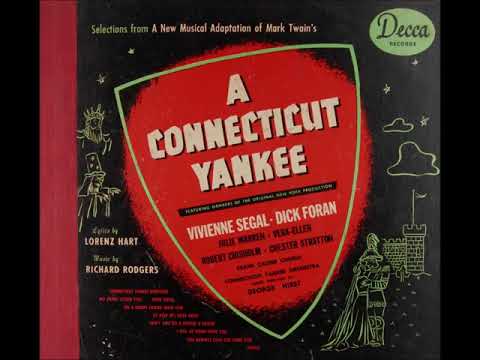
- A cast recording associated with the 1943 revival was released by Decca in 1944, preserving key numbers including “Thou Swell,” “On a Desert Island With Thee,” and “To Keep My Love Alive.”
- New York City Center Encores! brought the piece back in concert form in February 2001, positioning it as a rediscovery rather than a repertory staple.
Reception
This musical’s reputation splits cleanly in two. People who love it talk about the songs as if they escaped the book and built their own afterlife. People who resist it usually resist the book’s period comedy rhythms. That tension shows up in modern criticism, especially around concert presentations where the material has nowhere to hide.
“While Herbert Fields’ book for the show is, of course, ‘dated,’ ‘A Connecticut Yankee’ … can provide great enjoyment for modern audiences …”
“Time travel has not been an entirely happy experience for Richard Rodgers and Lorenz Hart’s ‘A Connecticut Yankee.’”
“ ‘Isn’t It Romantic?’ and ‘Thou Swell’ … another beaut from the same 1927 version of ‘A Connecticut Yankee’ …”
Quick Facts
- Title: A Connecticut Yankee
- Year: 1927 (Broadway original)
- Type: Musical comedy with fantasy time-travel framing
- Book: Herbert Fields
- Music: Richard Rodgers
- Lyrics: Lorenz Hart
- Based on: Mark Twain’s 1889 novel “A Connecticut Yankee in King Arthur’s Court”
- Original Broadway venue and run: Vanderbilt Theatre; Nov 3, 1927 to Oct 27, 1928 (421 performances)
- Major Broadway revision: 1943 revival at the Martin Beck Theatre; Nov 17, 1943 to Mar 11, 1944 (135 performances)
- Selected notable placements: “Thou Swell” as the central romantic wordplay duet; “At the Round Table” as court spectacle; “To Keep My Love Alive” as the revised-score showstopper
- Recording context: Decca release tied to the 1943 revival issued in 1944; Encores! 2001 concert had no commercial cast album release listed by major theatre recording indexes
- Licensing: Licensed through Concord Theatricals, which cites a 2001 restoration
Frequently Asked Questions
- Is “A Connecticut Yankee” the same as the Bing Crosby film?
- No. The 1949 film “A Connecticut Yankee in King Arthur’s Court” is a separate screen musical and is not the Rodgers and Hart stage score.
- Why do some song lists include “To Keep My Love Alive” and some don’t?
- That number was written for the 1943 Broadway revision, not the 1927 original. Modern productions often favor the revised version because the added songs are strong crowd-pleasers.
- What are the essential Rodgers and Hart standards that come from this show?
- “Thou Swell” is the signature duet. “My Heart Stood Still” and “On a Desert Island With Thee” also circulate widely beyond the show.
- Was there a Broadway cast recording?
- Yes, a recording associated with the 1943 revival was released by Decca in 1944, preserving several core numbers and the revised-score additions.
- What is the show actually about, in one sentence?
- A Hartford man gets knocked out, dreams himself into Camelot, modernizes the court, and realizes which woman he truly loves when the fantasy collapses.
- Is the musical being staged now?
- It is not on Broadway as of January 2026, but it remains active through licensing and periodic regional productions, including a publicly advertised July 2025 run at The Shedd Institute.
Key Contributors
| Name | Role | Contribution |
|---|---|---|
| Richard Rodgers | Composer | Writes melodies that sell romance and comedy with the same clean line. |
| Lorenz Hart | Lyricist | Supplies conversational wit, elastic rhyme, and the late-period bite of “To Keep My Love Alive.” |
| Herbert Fields | Book writer | Builds the Hartford-to-Camelot engine that lets the score pivot between worlds. |
| Lew M. Fields | Producer (1927) | Helped launch the original Broadway production and its year-long run. |
| Lyle D. Andrews | Producer (1927) | Co-produced the original Broadway production. |
| Busby Berkeley | Dances (1927 production credit) | Credited with dance work in the original production’s Broadway record. |
| Roy Webb | Orchestrations (1927 production credit) | Credited with orchestrating the original production’s music. |
| Vivienne Segal | Key performer (1943 revival) | Introduced “To Keep My Love Alive,” shaping the revision’s legacy and its recording footprint. |
Sources: IBDB; Rodgers & Hammerstein; Concord Theatricals; StageAgent; ovrtur; TheaterMania; Variety; Los Angeles Times; NYPL (Richard Rodgers guide); Lookout Eugene-Springfield; Discogs; library catalogs.