Come From Away Lyrics – All Songs from the Musical
Come From Away Lyrics: Song List
- Welcome to the Rock
- 38 Planes
- Blankets and Bedding
- 28 Hours/Wherever We Are
- Darkness and Trees
- On The Bus
- Darkness and Trees (Reprise)
- Lead Us Out Of the Night
- Phoning Home
- Costume Party
- I Am Here
- Prayer
-
On The Edge
-
In The Bar/Heave Away
- Screech In
- Me and the Sky
- The Dover Fault
- Stop the World
- New 38 Planes (Reprise)/Somewhere in the Middle of Nowhere
-
Something's Missing
-
Years Later
- Finale
-
Bonus: Screech Out
About the "Come From Away" Stage Show
Musical. Based on an inspiring true story. September 11, 2001 was an ordinary day in isolated Gander, Newfoundland—until it wasn’t. Thirty-eight planes were diverted to its doorstep on that fateful day, making this small town unexpected hosts to an international community. The camaraderie that followed reminds us all of the power that comes from opening up your heart and your home.Release date: 2017
"Come From Away" – The Musical Guide & Song Meanings
Review
How do you write about 9/11 without re-staging the images that already live in everyone’s head? "Come From Away" makes a braver choice. It keeps the catastrophe offstage and puts logistics, rumor, kindness, suspicion, and coffee at the center. The lyrics move fast because the day moved fast. Names, flight numbers, towns, and small requests become a kind of rhythmic documentary. That tactic can sound like plain reporting, until you realize the reporting is the point: language is how people hold each other together when nothing else makes sense.
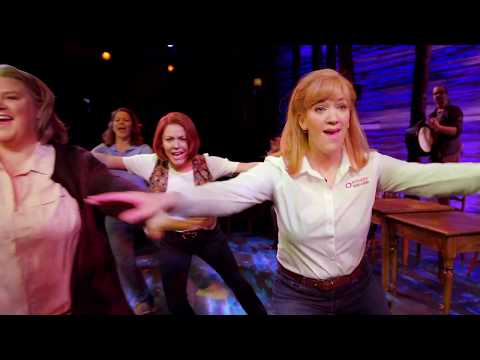
The score is folk-rock with Celtic lift and pub-band propulsion. It is built for momentum, not virtuoso posing. It also knows when to thin out. The show’s signature staging trick is that the chairs do most of the traveling, and the light does most of the emotional turning. One review describes how “slick chair choreography” and lighting changes create entirely new places with almost no scenery. That economy shapes how the lyrics land. A line like “somewhere in the middle of nowhere” hits harder when the stage is just bodies, chairs, and a sudden narrowing of space.
If you’re seeing it live, sit as centered as you can. This is a musical about angles: who is watching the television, who is looking for a phone, who is stuck behind a border agent, who is trying to keep a town calm. From the center, you can read those shifts instantly, which is where the writing is sharpest.
How It Was Made
Michael Rubinoff conceived the project and connected Irene Sankoff and David Hein to the story through Sheridan College’s Canadian Music Theatre Project. In 2011, Sankoff and Hein traveled to Gander for the tenth anniversary and spent weeks interviewing residents and stranded passengers, then shaped that material through workshops and school productions before the show reached major regional stages and, finally, Broadway in 2017.
The best origin details are oddly practical, which fits the musical. In a Playbill track-by-track, Hein says “Welcome to the Rock” was the first song they wrote, and Sankoff remembers stopping mid-walk to call him because she knew it was the opening. They cite Newfoundland pride songs and specific band influences as a spark for the number’s pulse. The same Playbill piece also captures how late-stage writing remained hands-on: “I Am Here” was the last song written, and Sankoff describes rewriting in the studio on Post-it notes that were handed to Q. Smith as she recorded. The method matches the material. The score is a collage of real voices, kept alive by constant revision.
Key Tracks & Scenes
"Welcome to the Rock" (Claude, Janice, Company)
- The Scene:
- Morning in Gander. The stage flips between a local routine and the first tremor of global news. Chairs become a diner, then a town map, then a gathering point. The energy is welcoming until the information changes, and the light cools with it.
- Lyrical Meaning:
- The lyric works as hospitality and a warning. It teaches you the cadence of Newfoundland speech and pride, then interrupts itself with geography and urgency. The show’s thesis is embedded here: community is a verb, and it starts before the crisis arrives.
"38 Planes" (Company)
- The Scene:
- Airspace closes. The town hall fills. Voices overlap like radio chatter. The staging often turns the ensemble into an air-traffic diagram, with bodies marking routes and arrivals.
- Lyrical Meaning:
- This is information as music. The lyric is spare because the event is too large for poetry. The number turns scale into shock: a town of roughly 9,000 suddenly facing thousands of strangers.
"Blankets and Bedding" (Beulah, Annette, Janice, Women of Gander)
- The Scene:
- Phones, favors, and a chain reaction of competence. The tempo is brisk, almost cheerful, because the job has to get done. The stage becomes a network: kitchens, closets, school gyms, and donation piles.
- Lyrical Meaning:
- The lyric is a rebuttal to helplessness. It does not romanticize. It enumerates. That’s what makes it moving. Care is shown through lists and repetition, the grammar of people who solve problems.
"28 Hours/Wherever We Are" (Bev, Passengers, Company)
- The Scene:
- Passengers wait for hours on the planes, then the first release into a strange holding pattern of buses, shelters, and uncertain sleep. The room can feel split: one side restless and claustrophobic, the other side trying to turn public spaces into bedrooms.
- Lyrical Meaning:
- The lyric toggles between endurance and coping. In Playbill’s track-by-track, the writers describe how the section was fused from two separate songs, which you can hear in the way it snaps between private phone calls and group survival tactics.
"Prayer" (Company)
- The Scene:
- Mid-show, the noise drops. Individual faith traditions surface side by side, not as debate but as parallel need. The staging often gathers the company into a shared stillness, with light isolating faces before it reunites them.
- Lyrical Meaning:
- The lyric’s power is its structure: different prayers coexisting in the same musical bar. Commentators often cite this sequence as an unusually clear theatrical picture of pluralism, without the scene asking for a single “correct” language of grief.
"Me and the Sky" (Beverley, Women of the Company)
- The Scene:
- A pilot’s life story compresses into one ride: childhood dream, workplace resistance, career breakthrough, then the instant when planes become weapons. The choreography is famously simple: chairs, tables, and a wave of clapping that reads like a rising engine.
- Lyrical Meaning:
- The lyric is ambition colliding with history. The song refuses to let “first female captain” be a trivia fact. It makes that achievement feel earned, then makes the grounding feel personal. Reporting on the real Beverley Bass notes that her interview directly fed lines that became the lyric.
"Stop the World" (Diane and Nick)
- The Scene:
- Two strangers find a small pocket of possibility in a week that keeps shrinking everyone else’s world. The scene is often staged with the least fuss: two people finally hearing each other, while the ensemble holds the environment like weather.
- Lyrical Meaning:
- In Playbill’s track-by-track, the writers frame it as gratitude for an unexpected moment. The lyric’s job is to justify romance without turning catastrophe into a meet-cute. It succeeds by staying modest.
"Something's Missing" (Company)
- The Scene:
- After the initial adrenaline, the emotional bill comes due. People search for certainty, for news, for missing family, for a single clean explanation. The stage can feel suddenly wider, which makes the characters look smaller inside it.
- Lyrical Meaning:
- The lyric names absence without trying to fill it. The title phrase becomes a shared diagnosis, spoken by people whose losses are different but simultaneous.
"Finale" (Company)
- The Scene:
- Departures and aftershocks. The show moves forward in time and asks what remains: friendships, changed politics, personal recalibration. The ensemble returns to chorus form, not as a crowd, but as a memory bank.
- Lyrical Meaning:
- The lyric insists the story is not a one-week miracle. It is a long relationship between “plane people” and Gander, and a reminder that empathy is measurable in action.
Live Updates
Information below is current as of January 23, 2026. The official "Come From Away" site states the North American tour played its last performance on May 9, 2025. A BroadwayWorld announcement previously outlined the 2024-2025 touring cast, which helps explain why the production still feels “current” in many markets even after the tour’s close.
The live footprint has shifted toward special engagements and destination runs. Neptune Theatre in Halifax lists "Come From Away" for spring 2026, extended through June 7, 2026. Confederation Centre of the Arts in Charlottetown has announced a summer 2026 festival run (June 30 through September 26, 2026), with a published running time of 1 hour 30 minutes and no intermission. These are not stopovers. They are anchor events, built to draw audiences for a season.
The strangest and most telling update is at sea. Cunard has announced an exclusive shipboard production of "Come From Away" debuting on Queen Elizabeth in October 2025, adapted to a one hour forty minute format and performed twice per voyage. It is a new phase of licensing for a show that was always about transit, border control, and what happens when travel collapses.
In the UK, the recent UK & Ireland tour ran through late 2024 and early 2025, and major ticketing pages now point to that completed run rather than listing a new route. If a new tour is announced, it will likely follow the same pattern: short, high-demand blocks rather than an endless road schedule.
Notes & Trivia
- The show was developed through Sheridan College’s Canadian Music Theatre Project, beginning with a 45-minute workshop in 2012 before expanding to a full production.
- In a Playbill track-by-track, the writers say “Welcome to the Rock” was the first song written for the musical.
- That same Playbill piece says “I Am Here” was the last song written, and the lyric continued changing during the cast album session via handwritten Post-it note revisions.
- MTI lists the show as a one-act piece with 12 roles, a structure that supports the rapid role-switching style of the chorus.
- The original Broadway cast album was released digitally on March 10, 2017, with a physical release later in March 2017, as reported by Playbill and TheaterMania.
- The official tour page notes the North American tour’s final date as May 9, 2025, which matches touring schedule listings.
- Cunard’s Queen Elizabeth adaptation is described as a specially crafted “stage at sea” version with a 12-performer ensemble and a one hour forty minute runtime.
Reception
Critics have tended to agree on two things even when they disagree on tone: the show is engineered with unusual efficiency, and it aims directly at the audience’s sense of decency. TIME called it a “warm-spirited” musical and praised its stripped-down ingenuity. The Washington Post noted that the score documents the Gander events “in song,” even as it recognizes the musical’s risk of leaning into goodness. The Guardian, reviewing an international production, admired how the chorus form becomes the storytelling engine and highlighted the production’s minimal means, especially what lighting and chairs can do.
“A warm-spirited, often stirring musical.”
“Sankoff and Hein set about documenting in song the events in and around the town of Gander.”
“Different realities are created through some very slick chair choreography.”
Quick Facts
- Title: Come From Away
- Year: 2017 (Broadway opening)
- Type: One-act musical
- Book, Music, Lyrics: Irene Sankoff, David Hein
- Director: Christopher Ashley
- Musical staging: Kelly Devine
- Music supervision & arrangements: Ian Eisendrath
- Orchestrations: August Eriksmoen
- Scenic design: Beowulf Boritt
- Lighting design: Howell Binkley
- Sound design: Gareth Owen
- Selected notable placements: “Welcome to the Rock” (morning in Gander); “38 Planes” (diversions announced); “Blankets and Bedding” (community mobilizes); “Prayer” (mid-show interfaith sequence); “Me and the Sky” (Beverley’s arc and the grounding); “Somewhere in the Middle of Nowhere” (passenger limbo); “Finale” (aftermath and long-term bonds)
- Original Broadway cast album: Digital release March 10, 2017; physical release later in March 2017
- Album notes: Spotify lists the album as 2017 with 23 tracks
- Current live status: North American tour ended May 9, 2025; notable 2026 Canadian regional runs announced in Halifax (Neptune Theatre) and Charlottetown (Confederation Centre of the Arts); Cunard shipboard production debuted October 2025
Frequently Asked Questions
- Who wrote the lyrics for "Come From Away"?
- Irene Sankoff and David Hein wrote the book, music, and lyrics.
- Is "Come From Away" based on a true story?
- Yes. It dramatizes what happened in Gander, Newfoundland after 9/11, when dozens of planes were diverted and thousands of passengers were hosted by local communities.
- Where does “Prayer” happen in the show?
- It appears about halfway through, when the characters and passengers reach for different faith traditions in the same moment of fear and uncertainty.
- What is “Me and the Sky” really about?
- It’s Beverley’s life as a pilot: ambition, resistance, breakthrough, then the shock of being grounded when aviation itself changes overnight.
- Is there a filmed version?
- Yes. A live stage recording was produced for Apple TV+ and premiered globally on September 10, 2021.
- Is the show touring in 2026?
- The official site states the North American tour ended May 9, 2025. In 2026, the most prominent listings are regional destination runs in Halifax and Charlottetown rather than a continuing U.S. tour route.
Key Contributors
| Name | Role | Contribution |
|---|---|---|
| Irene Sankoff | Book, Music, Lyrics | Co-authored the documentary-style lyric voice and the show’s choral structure. |
| David Hein | Book, Music, Lyrics | Co-authored the score’s folk-rock propulsion and rapid-fire narrative pacing. |
| Christopher Ashley | Director | Shaped the minimalist, fast-moving staging language that keeps the story fluid. |
| Kelly Devine | Musical staging | Built ensemble movement and chair choreography that constantly re-maps space. |
| Ian Eisendrath | Music supervisor, arrangements | Guided the score’s theatrical clarity and helped solve structural song transitions. |
| August Eriksmoen | Orchestrations | Translated the folk palette into a tight, stage-friendly orchestral engine. |
| Beowulf Boritt | Scenic designer | Created a flexible environment where small objects and chairs do the storytelling. |
| Howell Binkley | Lighting designer | Used lighting to shift locations and emotional temperature with minimal physical change. |
| Gareth Owen | Sound designer | Balanced band, voices, and rapid dialogue so the documentary lyric detail stays audible. |
| Michael Rubinoff | Conceiver / Development lead | Originated the project and incubated it through Sheridan’s Canadian Music Theatre Project pipeline. |
Sources: Official Come From Away Site, Playbill, Music Theatre International, The Guardian, The Washington Post, TIME, TheaterMania, Neptune Theatre, Confederation Centre of the Arts, Cunard, Cruise Critic, Apple TV+ Newsroom, Wikipedia, Spotify, BroadwayWorld.