Charlie and Algernon Lyrics – All Songs from the Musical
Charlie and Algernon Lyrics: Song List
- Have I the Right
- I Got a Friend
- Some Bright Morning
- Jelly Donuts and Chocolate Cake
- Hey Look at Me
- Reading
- No Surprises
- Midnight Riding
- Dream Safe with Me
- Not Another Day Like This
- Somebody New
- I Can't Tell You
- Now
- Charlie and Algernon
- The Maze
- Whatever Time There Is
- Everything Was Perfect
- Charlie
- I Really Loved You
- Whatever Time There Is (Reprise)
About the "Charlie and Algernon" Stage Show
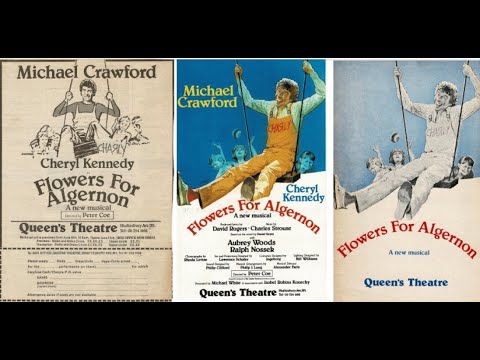
On Broadway, the show was running only for 29 plays, of which 17 were regular. It is unclear what caused such a small number of ones, because spectators perceived this musical generally positive. Michael Crawford, a guy who starred in The Phantom Of The Opera (having received his Tonies for this), was in the premiere of this one. Flowers for Algernon – this was the original name of this musical at the opening, during the pre-Broadway plays (in West End), and then the show was renamed to Charlie and Algernon, when it went to Broadway.Among notable developments in this musical, there was a kind of mini-show with trained white laboratory mouse, which crawled from one arm of Michael Crawford to another. He then repeated this trick in another show called The Woman in White, despite the fact that he was depicting a very different character.
Helen Hayes Theatre on Broadway hosted the musical as we have already mentioned, during only 29 shows in 1980, where the main role was played by P. J. Benjamin, who starred in the title role of Charlie and Sandy Faison played his governess/teacher/beloved. In 1981, the musical was nominated for Tony, but did not receive this award.
Release of musical recording on a CD was taken from its West End version, in 1980.
Release date: 1978
"Charlie and Algernon" – The Musical Guide & Song Meanings
Review and lyric themes
What do you sing when your leading man cannot yet hold a thought steady? “Charlie and Algernon” answers that by letting other people sing him into existence first. Alice’s opener frames Charlie as a person worth effort, not a case file. That choice matters because the entire story is built on gaze: who gets looked at, who gets studied, who gets loved, and who gets left behind when the novelty fades.
David Rogers’ lyrics keep returning to simple words that bruise over time: “friend,” “smart,” “try,” “now.” Early language is blunt on purpose, almost classroom-flat, because the character’s inner vocabulary is not available yet. As Charlie’s mind accelerates, the score’s rhetoric turns sharper and more self-aware, with patter-like density and performance-driven irony. The show does not simply “get bigger.” It gets more nervous. That anxiety is the point. The musical asks whether intelligence is a gift or a costume, and what it costs to wear it in public.
Charles Strouse writes in a deliberately shifting idiom. One moment is childlike, the next is brassy, the next is bare-bones and rhythmic, like a pulse refusing to settle. A science experiment onstage can read cold, but Strouse keeps tugging back toward melody, especially when Charlie and Alice try to speak like equals. When the story turns, the music is less interested in triumph than in time. It keeps glancing at the clock, as if it already knows the ending.
How it was made
The musical comes from a chain of adaptations, not a single lightning strike. Daniel Keyes’ “Flowers for Algernon” became a stage play by David Rogers in the late 1960s, and Rogers then adapted his own material into this musical with Strouse. The premiere arrived first in Canada in December 1978, before the West End run in 1979 and the Broadway run in 1980. That itinerary explains a lot about the piece. It was revised in motion, carrying its problems and its best ideas from city to city.
The show’s most famous bit of staging is also its most telling metaphor. In London, the production leaned into the theatrical dare of a live mouse, with a spotlight effect that turned Algernon into a tiny star and Charlie into the astonished stagehand who keeps the miracle moving. Reviewers and historians have described the mouse tracking a small light across the stage and scampering along Charlie’s body. It is an image that plays as charm, then unease. The “cute” device is also the show’s ethical thesis, delivered without a lecture: bodies become apparatus. Applause becomes data.
There is also craft evidence in the licensed script materials. The published excerpt bakes in practical guidance on costuming and visibility for the mouse sequence, treating the animal’s footing and contrast as production requirements, not garnish. That level of specificity is a quiet admission that, for this musical, story and stage engineering are tangled. You cannot separate the meaning from the method.
Key tracks and scenes
"Charlie Gordon" (Alice Kinnian)
- The Scene:
- Over the tail end of the overture, Alice reads a formal letter about the clinic. The space shifts toward the doctors’ office as the lights come up. She steps out of the everyday and into decision-making.
- Lyrical Meaning:
- A teacher’s advocacy becomes the show’s moral baseline. The lyric praises Charlie’s openness, but the subtext is guilt: she is naming him so the world stops treating him as invisible.
"I Got a Friend Today" (Children’s voices, underscoring Charlie)
- The Scene:
- As Alice and Charlie cross during the overture, children’s voices sing like a memory of belonging. The moment is staged as motion, not a stand-and-sing. It floats above him while he tries to keep up.
- Lyrical Meaning:
- The lyric is painfully plain. That is why it lands. “Friend” is not romance here. It is survival, and the show is already warning how temporary it can be.
"Hey, Look at Me!" (Charlie, with Alice)
- The Scene:
- Charlie tries to perform confidence before he fully understands what confidence is. The staging typically plays close, teacher and student in a shared pocket of light, because the world outside that pocket is ridicule.
- Lyrical Meaning:
- This is aspiration set to rhythm. The lyric is a plea for recognition that does not yet have the tools to argue its case. The song makes you hear how hunger can sound like cheer.
"Reading" (Charlie)
- The Scene:
- A musical “process scene” where effort is the action. Charlie pushes through drills, repetition, and frustration, while Alice calibrates between encouragement and impatience.
- Lyrical Meaning:
- Words become a staircase. The lyric’s power is not poetic flourish, it is insistence. The show treats literacy as both liberation and the first step toward loneliness.
"No Surprises" (Alice)
- The Scene:
- A private moment for the teacher after the clinical machinery has started turning. Alice stands between the role she chose and the outcome she cannot control.
- Lyrical Meaning:
- The title is almost a lie. The lyric is fear dressed as calm. Alice tries to set rules for her heart because the experiment has no mercy.
"Dream Safe with Me" (Charlie’s Mother)
- The Scene:
- A memory scene that arrives like a bruise. The stage can turn minimal here, with softer edges and a sense of a room that is more psychological than real.
- Lyrical Meaning:
- The lyric exposes how love can become control. It is lullaby language with threat inside it, the kind of sweetness that asks for obedience as payment.
"Now" (Charlie and Alice)
- The Scene:
- Charlie and Alice try to meet as adults, not teacher and student. The staging often tightens to two chairs, two bodies, and a silence that keeps interrupting them.
- Lyrical Meaning:
- “Now” is the show’s most fragile word. The lyric argues for present tense intimacy while both characters suspect the present tense will not last.
"Charlie and Algernon" (Charlie)
- The Scene:
- The show turns theatrical about its own experiment. This is where productions have historically leaned into stage business with the mouse and a focused spotlight effect that tracks Algernon’s movement.
- Lyrical Meaning:
- The lyric is showmanship with a crack in it. Charlie can finally narrate the spectacle, but that narration is also his trap: he is the headline, not the human.
"The Maze" (Charlie)
- The Scene:
- The maze is introduced early as a test, then returns as an obsession. The stage picture can echo fluorescent lab light, stark and exact, as Charlie realizes the pattern behind the miracle.
- Lyrical Meaning:
- This is the score thinking out loud. The lyric and rhythm tighten into diagnosis. Charlie is no longer asking to be loved. He is proving the cost of being improved.
Live updates 2025/2026
In 2025 and early 2026, “Charlie and Algernon” is not a commercial touring title in the way Strouse’s “Annie” is. Its life is more underground and more practical: licensing, readings, and collectors. Dramatic Publishing continues to license the musical worldwide, listing it as available for classroom study, readings, and performance, with a published minimum royalty rate and scripts currently in stock. The London cast recording remains actively sold through specialist retailers, and its track list is widely circulated among theatre fans.
The most consequential recent “update” is contextual: Strouse’s death in May 2025 triggered a wave of reassessment of the scores that sat outside his mega-hits. In that climate, “Charlie and Algernon” reads less like a footnote and more like a risky craft problem that Strouse tried to solve in public. If you are tracking this title for production, the practical takeaway is simple. The show is accessible to produce, but it asks for disciplined staging choices, especially around Algernon. Many companies solve the mouse problem with puppetry or prop-based metaphor. The licensed materials and the show’s performance history make clear that the “how” is part of the “what.”
Notes and trivia
- The musical premiered on December 21, 1978, at the Citadel Theatre in Edmonton before moving to London and New York.
- The West End production opened under the title “Flowers for Algernon,” starring Michael Crawford as Charlie.
- Broadway opened September 14, 1980, at the Helen Hayes Theatre and closed September 28, 1980, after 17 performances and 12 previews.
- The show earned a Tony nomination for Best Original Score (1981).
- A well-known staging feature used a trained white mouse and a mouse-sized spotlight effect; sources describe Algernon tracking the light and running along Charlie’s arm.
- Licensed script materials include specific guidance about dark costume colors and fabric texture so the mouse can be seen and can grip.
- The original London cast recording’s commonly listed track lineup runs 16 tracks, including “Whatever Time There Is” and “I Really Loved You.”
Reception then vs. now
At the time, critics often treated the material as a problem of tone. The story is tragic, but it has to move through comedy, romance, and clinical demonstration to get there, and that mix can read jagged. The Broadway run was brutally short, which flattened its chances to evolve through performance and word-of-mouth. Yet even the short-lived history left behind a durable afterimage: the show as a piece of theatrical engineering, where the audience’s delight becomes part of the plot’s moral discomfort.
“A show with a heart about our minds,”
“Good medicine for what ails the world of musical comedy ... a small, snappy and not entirely frivolous entertainment.”
A trained mouse “shows a flair for following a mouse-sized spotlight across the stage.”
Now, the conversation tends to be kinder to the score than to the book. Listeners who encounter the cast album hear Strouse attempting something structurally ambitious: a musical language that changes as a mind changes. That idea is hard to land in a theatre, but it is clear on a recording. In 2026, “Charlie and Algernon” is often appraised as a fascinating near-miss with several genuinely strong late-show sequences, rather than a simple flop.
Quick facts
- Title: Charlie and Algernon (also produced as Flowers for Algernon)
- World premiere: December 21, 1978 (Citadel Theatre, Edmonton)
- West End: Opened June 14, 1979 (Queen’s Theatre), starring Michael Crawford
- Broadway: September 14–28, 1980 (Helen Hayes Theatre), starring P. J. Benjamin and Sandy Faison
- Type: Musical (book and lyrics by David Rogers; music by Charles Strouse)
- Source material: Daniel Keyes’ novel “Flowers for Algernon”
- Notable staged set-piece: Algernon in a maze test; later theatrical sequences often emphasize a mouse-sized spotlight effect
- Album: Original London cast recording released on Original Cast Records (often sold via specialty retailers)
- Licensing: Available for worldwide amateur and educational performance through Dramatic Publishing
Frequently asked questions
- Is “Charlie and Algernon” the same show as “Flowers for Algernon”?
- Yes. The musical premiered as “Charlie and Algernon” in Canada, ran in London as “Flowers for Algernon,” and appeared on Broadway as “Charlie and Algernon.”
- Who wrote the lyrics?
- David Rogers wrote the book and lyrics, collaborating with composer Charles Strouse.
- Is there a cast album?
- Yes. A London cast recording was released and is still sold through specialty retailers; it includes songs such as “His Name Is Charlie Gordon,” “Now,” and “The Maze.”
- How do productions handle the mouse?
- Historically, some productions used a trained white mouse and a tiny spotlight effect. Many modern stagings choose puppetry or symbolic staging instead, especially for consistency and animal welfare.
- Why does the score’s style shift so much?
- The musical mirrors Charlie’s transformation. Early material leans simpler and more direct, then grows more complex as his intelligence rises, before tightening into darker, more analytical writing as the experiment collapses.
- Can schools and community theatres license it?
- Yes. Dramatic Publishing lists the title as licensable worldwide for readings, classroom use, and performance.
Key contributors
| Name | Role | Contribution |
|---|---|---|
| Charles Strouse | Composer | Music; a score designed to evolve alongside Charlie’s intellect |
| David Rogers | Book and lyricist | Adapted his own stage work into a musical form; wrote the lyric voice of the show |
| Daniel Keyes | Author | Wrote the source novel “Flowers for Algernon” |
| Michael Crawford | Original London cast | Originated Charlie in the West End production titled “Flowers for Algernon” |
| Cheryl Kennedy | Original London cast | Played Alice Kinnian in the London production and on the cast recording |
| P. J. Benjamin | Broadway cast | Played Charlie in the Broadway run and Kennedy Center-associated presentations |
| Sandy Faison | Broadway cast | Played Alice Kinnian on Broadway |
| Louis W. Scheeder | Director | Directed the Broadway production |
| Virginia Freeman | Choreographer | Choreography for the Broadway production |
| Alexander Faris | Conductor (recording) | Credited as conductor on library catalog entries for the London cast recording |
Sources: Dramatic Publishing (licensed script excerpt and title listing), Footlight Records, The Washington Post archive, IBDB, Playbill Vault, Wikipedia, SF Encyclopedia, Discogs, Billboard, The Guardian.