Note on “lyrics”: I can’t publish full lyric text. This guide focuses on meaning, story placement, and how the major recordings preserve the score’s punch.
Review
It’s a political comedy where the sharpest weapon is hospitality. Call Me Madam takes a real-world premise, a socialite turned ambassador, then lets Irving Berlin turn diplomacy into rhyme. The show’s central idea is almost rude in its simplicity: charisma is policy. That’s why the lyric writing moves like a campaign. It introduces Sally Adams as a public event before it introduces her as a person.
Berlin’s language here is breezy, but not empty. The best numbers operate like arguments with a grin. When Sally offers money, the lyric is a power flex disguised as generosity. When young love arrives, Berlin makes it sound like weather, casual and unstoppable. And when romance hits the grown-ups, he uses counterpoint to tell the truth nobody will say straight. Two melodies. Two denials. One confession hiding in plain sight.
Musically, it’s classic Broadway with a newsprint smell. Marches, patter, dance rhythms, then a sudden clean ballad line that makes the comedy feel, briefly, like stakes. It is also a star vehicle. The book sets up jokes. The score delivers authority. Sally’s voice does not just sing over a room. It runs the room.
How it was made
The show is rooted in Washington gossip that became national copy. President Harry S. Truman appointed Perle Mesta as Ambassador to Luxembourg in 1949, and the story was already theatrical. Howard Lindsay and Russel Crouse shaped it into a Broadway satire, then wrote it as a specific kind of machine: a part that could hold Ethel Merman’s sound and timing. The licensor’s history section also underlines the project’s heavy hitters: George Abbott directing and Jerome Robbins staging the dances and musical numbers. The goal was speed, not subtlety.
There’s a practical creation myth too: the score kept evolving under pressure. During the out-of-town period, Berlin wrote new material to strengthen Act II, and more than one source notes that “You’re Just in Love” arrived late, built as the kind of showstopper that changes the temperature of a night. A counterpoint duet is a structural brag. It says, “I can entertain you and outsmart you at the same time.”
Then came the recording saga, which is part of the show’s audio identity now. NBC and RCA Victor helped finance the production, so you would expect the definitive cast album to be straightforward. It wasn’t. Merman’s Decca contract blocked her from RCA’s original cast recording plan, so Decca cut its own album of her songs with guest vocal partners, while RCA recorded the score with Dinah Shore taking the lead on the “original cast album” release. It’s Broadway capitalism turned into discography, and it still shapes which “Sally Adams” you hear first on streaming.
Key tracks & scenes
These are the 8 lyric-first moments that carry the plot and define the score’s personality. Scene placement follows the licensor’s number order and the Masterworks Broadway synopsis.
"The Hostess With the Mostes" (Sally)
- The Scene:
- Washington, D.C. A party that feels like a committee meeting in gowns. Bright chandeliers. People laughing too loudly because influence is in the room.
- Lyrical Meaning:
- Sally introduces herself as an institution. The lyric turns social skill into civic power, and it makes her confidence sound like public service. It’s also a warning: she thinks hosting is governing.
"The Washington Square Dance" (Sally, Company)
- The Scene:
- A patriotic group number with a crowd-pleasing snap. Open stage, parade lighting, bodies moving in patterns that look like consensus.
- Lyrical Meaning:
- This is nationalism as choreography. Berlin uses communal rhythm to sell the joke that America can export its own vibe as foreign policy.
"Lichtenburg" (Company, Cosmo)
- The Scene:
- Sally lands in Europe and meets the place as a pageant. Formal uniforms. Courtly spacing. Cooler lighting than Washington, like the air is regulated.
- Lyrical Meaning:
- The lyric frames the duchy as quaint and strategic at once. It sets up the satire: a “tiny” country that will soon be treated like a bargaining chip.
"Can You Use Any Money Today?" (Sally, Cosmo)
- The Scene:
- A diplomatic conversation staged like a sales pitch. Sally leans forward. Cosmo keeps his posture. The humor is in the mismatch.
- Lyrical Meaning:
- The lyric makes aid sound casual, almost flirtatious. Underneath, it mocks how money becomes the blunt language of influence.
"Marrying for Love" (Duke, Duchess, Maria, Company)
- The Scene:
- Inside the palace, where tradition has the best seating. Warm, old-world light. A family plan disguised as romance advice.
- Lyrical Meaning:
- The lyric is a polite threat. It treats marriage as fiscal policy and makes “love” sound like a slogan that can be filed away.
"It’s a Lovely Day Today" (Kenneth, Maria)
- The Scene:
- A break from protocols. Outdoor air. Softer light. Two younger characters discovering that rules are loud until you step away from them.
- Lyrical Meaning:
- Berlin writes love as weather because it’s the one political force nobody can legislate. The lyric’s simplicity is the point. It refuses cynicism.
"The Best Thing for You" (Sally)
- The Scene:
- Sally campaigns for Cosmo with the confidence of a person who believes publicity equals truth. Big, brassy stage picture. Spotlight that loves a speech.
- Lyrical Meaning:
- This lyric fuses romance and endorsement. Sally sells Cosmo like a candidate and flirts like it’s part of the platform.
"You’re Just in Love" (Sally, Cosmo, Kenneth)
- The Scene:
- Late enough in the show that feelings have built up debt. The staging often clarifies two musical lanes at once, with characters moving in overlapping paths. The lighting tightens so the comedy feels precise.
- Lyrical Meaning:
- Counterpoint becomes psychology. Two perspectives deny what’s happening, and the very structure proves they’re trapped in the same truth. It’s Berlin using form as plot.
"They Like Ike" (Sally, Company)
- The Scene:
- Back in the United States with politics turned into chant. Rally energy. Banner-style lighting. The number can play as nostalgia or as a warning about how easily slogans replace thought.
- Lyrical Meaning:
- It’s campaign language at its most efficient. The lyric is purposely simple because it’s about repetition, not persuasion. Berlin captures how democracy can sound like advertising.
Live updates
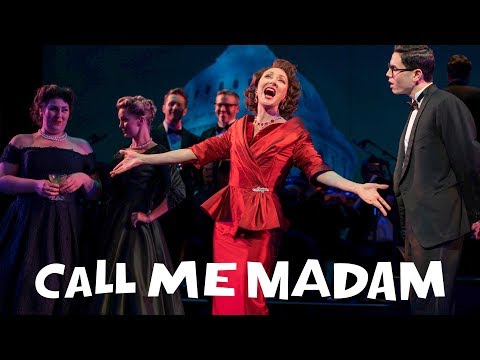
Call Me Madam is not currently running on Broadway, and there is no single “current cast” to track. Its modern visibility tends to come through limited-run concert revivals and regional productions, plus the licensing ecosystem that keeps older titles circulating. The most recent high-profile New York outing remains New York City Center’s Encores! staging in February 2019, promoted and reviewed as part of City Center’s anniversary season programming.
For 2025 and into 2026, the most concrete “status” signal is practical rather than glamorous: the show is actively licensed and promoted by Concord Theatricals, with detailed orchestration requirements and a full materials pipeline. It also appears on Educational Theatre Association “approved material” lists, which matters because school and youth performance culture is where many mid-century scores keep breathing.
If you’re updating an evergreen page, update it like this: (1) point readers to the licensor for production rights, (2) note the last major New York revival as a reference point, (3) guide listeners toward the recordings, because the album story is unusually central to how this show is remembered.
Notes & trivia
- The original Broadway production opened October 12, 1950 at the Imperial Theatre and ran 644 performances, closing May 3, 1952.
- Irving Berlin won the Tony Award for Original Musical Score in 1951 for Call Me Madam, according to the official Tony Awards winner list.
- The show also won a 1952 Tony for Stage Technician (master carpenter Peter Feller), as listed by both IBDB and the Tony Awards site.
- The licensor’s history notes Elaine Stritch leading a subsequent national tour, a reminder that the part can function without Merman, even if the legend says otherwise.
- Berlin reportedly wrote additional material during the tryout process to strengthen Act II, with multiple accounts highlighting the late arrival of the counterpoint hit “You’re Just in Love.”
- The “cast album” history is famously split: RCA Victor recorded an “original cast album” led by Dinah Shore, while Decca recorded Ethel Merman’s songs separately due to her exclusive contract.
- Masterworks Broadway frames the show as an “adrenalin shot” of circa-1950 zeitgeist and details how NBC and RCA Victor financed the production, linking the stage success to media business decisions.
Reception
Then, it played like a headline and a release valve. In tryouts, reviews were mixed, and the fix was classic Broadway engineering: write more songs, sharpen the second act, protect the laughs. On Broadway, it became a hit and a trophy magnet. Now, the reception is more complicated. Modern critics tend to admire Berlin’s craft while questioning the book’s fluff and the show’s gentle approach to politics. That split is the honest modern experience: you can love the score and still feel the period air in your lungs.
“This musical feature[s] a terrific score by Berlin ... and the show’s unqualified masterpiece of counterpoint, ‘You’re Just in Love.’”
“Call Me Madam exposes the central challenge of the Encores! series ... musicals that often feel dated and problematic by today’s standards.”
“The 1950 musical ... is frozen in its time, and its corny comedy style hasn’t aged well.”
Technical info
- Title: Call Me Madam
- Year: 1950 (Broadway premiere)
- Type: Full-length musical comedy; political satire
- Music: Irving Berlin
- Lyrics: Irving Berlin
- Book: Howard Lindsay and Russel Crouse
- Original Broadway venue: Imperial Theatre
- Original Broadway run: Oct 12, 1950 to May 3, 1952 (644 performances)
- Original production credits (high-level): Directed by George Abbott; dances and musical numbers staged by Jerome Robbins
- Selected notable placements: “The Hostess With the Mostes” introduces Sally’s Washington brand; “Can You Use Any Money Today?” turns aid into flirtation; “The Best Thing for You” is campaign-song romance; “You’re Just in Love” resolves adult feelings through counterpoint; “They Like Ike” turns politics into chant
- Album / recording status: Major 1950 recordings split across labels due to Ethel Merman’s Decca contract; Masterworks Broadway releases an authorized remaster of the RCA Victor album and documents the competing Decca releases
- Modern revival snapshot: New York City Center Encores! fully staged revival ran Feb 6–10, 2019 (limited engagement)
- Licensing: Available for production licensing and materials through Concord Theatricals
FAQ
- Who wrote the lyrics for “Call Me Madam”?
- Irving Berlin wrote both the music and the lyrics.
- What is the show about, in one sentence?
- A Washington party giver becomes ambassador to a tiny European duchy and accidentally turns charm into foreign policy.
- Where does “The Hostess With the Mostes” sit in the story?
- Early in Act I, at Sally’s Washington party, introducing her public persona before the plot ships her overseas.
- Why is “You’re Just in Love” such a big deal musically?
- It’s a counterpoint duet: separate melodies and viewpoints run at once, turning denial into confession through structure.
- Is there a definitive cast album?
- It depends on what you mean by “definitive.” The RCA Victor “original cast album” features Dinah Shore in the lead role, while Decca released recordings of Ethel Merman singing her numbers separately, due to contract restrictions.
Key contributors
| Name | Role | Contribution |
|---|---|---|
| Irving Berlin | Composer & Lyricist | Wrote the score’s political wit, the star-friendly belts, and the counterpoint construction that drives “You’re Just in Love.” |
| Howard Lindsay | Book | Shaped the Perle Mesta premise into a stage-ready farce with a romantic spine. |
| Russel Crouse | Book | Co-authored the satirical engine: Washington manners meeting European protocol. |
| George Abbott | Director (original Broadway) | Built the show’s pace and joke delivery, keeping the political material light on its feet. |
| Jerome Robbins | Choreography / staging of musical numbers (original Broadway) | Turned political comedy into stage motion, especially in public-facing ensemble sequences. |
| Ethel Merman | Original Sally Adams (Broadway) | Originated the role as a star vehicle and set the performance expectation that later revivals react to. |
| Dinah Shore | Lead vocalist on RCA Victor “original cast album” | Recorded the role for RCA Victor when Merman’s Decca contract blocked her participation, shaping the “cast album” memory for many listeners. |
| Masterworks Broadway | Catalog / reissue | Documents the recording rights conflict and distributes an authorized remaster of the RCA Victor album. |
| Concord Theatricals | Licensing | Licenses the show for productions and publishes the official number order, orchestration outline, and production details. |
Sources: IBDB; Concord Theatricals; Masterworks Broadway; Tony Awards (official site); Playbill; The Hollywood Reporter; Variety; amNY; New York Stage Review; Educational Theatre Association.