Review
What if the best writer in the room is the guy holding the gun? That’s the nasty joke “Bullets Over Broadway” keeps sharpening, then disguising with a grin. The lyric world is borrowed from 1920s and early-1930s standards, but the dramatic job is modern: every chorus has to push plot, expose status, or frame the show’s central bargain, art paid for by people who do not care about art. The result is a musical that uses old rhyme schemes like stage light: warm, flattering, and a little dishonest.
Because the score is largely pre-existing, the “meaning” lives in placement and intent. A speakeasy number is not wallpaper here; it is a social contract. A comic novelty tune is not just comic; it is a test of taste, and a warning sign that the production’s ethics are already sliding. The style is jazz-age pop with theatrical orchestration and new connective tissue where needed, which matters because the characters are always auditioning: the playwright auditions seriousness, the diva auditions immortality, the gangster auditions respectability. The songs become masks, and the lyrics, even when vintage, become a vocabulary for self-deception.
How It Was Made
On paper, “Bullets” looks like an adaptation machine: Woody Allen turns his 1994 film into a Broadway book; a director-choreographer with a reputation for kinetic comedy builds the evening around momentum; a music team threads period standards into a single narrative spine. The tricky part is not picking great songs. It’s making them behave like dialogue, and making the audience forget they already know the tunes.
There’s also a quiet historical tug-of-war behind the concept. Earlier attempts at a more traditional original-score approach were discussed years before the 2014 premiere, but the eventual solution was to lean into the era itself: period songs, shaped and contextualized, plus additional lyric work where transitions demanded it. You can feel the adaptation choice in the finished show: instead of “new songs that sound old,” it opts for “old songs that suddenly feel culpable,” because now they are attached to coercion, ego, and literal violence.
Key Tracks & Scenes
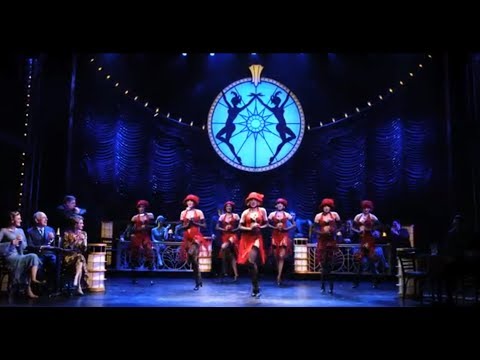
"Tiger Rag" (The Atta-Girls and Company)
- The Scene:
- Prohibition-era Manhattan. A club curtain takes fire from a machine gun, and the room snaps into life like a switchblade. The Atta-Girls flood the space in performance mode, bright smiles under hard light, while the threat stays visible at the edges.
- Lyrical Meaning:
- Even without new words, the “meaning” is architectural: jazz as camouflage. The number sells pleasure while the story sells danger, teaching you the show’s grammar in the first minutes.
"The Hot Dog Song" (Olive)
- The Scene:
- At Nick’s house, Olive “demonstrates” her talent. The atmosphere is part audition, part hostage negotiation. The staging leans into awkwardness: too much brightness, too little mercy.
- Lyrical Meaning:
- This is the show’s cruelty in miniature. A novelty lyric becomes a character diagnosis: Olive confuses noise for craft, and the men around her confuse power for taste. The song is funny, then it isn’t.
"I'm Sitting on Top of the World" (David and Company)
- The Scene:
- First day of rehearsal. David walks into the theatre with the private glow of somebody who thinks he has arrived. The ensemble energy lifts him, then undercuts him as reality sets in.
- Lyrical Meaning:
- The lyric is optimism with a trapdoor. David’s “top of the world” feeling is sincere, but the show uses the familiar phrasing to set up the fall: success is already compromised money.
"Let's Misbehave" (Warner and Olive)
- The Scene:
- Backstage heat. A leading man clocks the vulnerable target and makes it sound like romance. Lighting tightens, bodies get closer, and the comedy of flirtation sits beside the stink of exploitation.
- Lyrical Meaning:
- “Misbehave” reads as playful, but in context it is predatory permission. The song turns innuendo into leverage, revealing how quickly this world weaponizes charm.
"There's a Broken Heart for Every Light on Broadway" (Helen and David)
- The Scene:
- Helen Sinclair, the diva, takes David into her mythology. The stage picture often isolates her in a pool of glamour, the kind of light that flatters and lies, while David watches like a student who wants to be chosen.
- Lyrical Meaning:
- The lyric is a thesis statement: Broadway as a machine that runs on bruises. Helen sells tragedy as sophistication, and David starts buying it, because pain sounds like legitimacy.
"'Tain't Nobody's Biz-ness If I Do" (Cheech)
- The Scene:
- During rehearsal breaks and private conversations, Cheech offers “notes” that are actually rewrites. The staging frequently treats him as calm center while everyone else performs anxiety.
- Lyrical Meaning:
- The lyric is autonomy with a wink. Cheech claims privacy, but the subtext is authorship: he is taking the show, and he knows no one will stop him until it’s too late.
"The Panic Is On" (David)
- The Scene:
- Hours before opening, catastrophe lands: a body in the canal, a secret in the script, a conscience that finally wakes up. The rhythm turns clipped; the stage feels narrower, like the walls are moving.
- Lyrical Meaning:
- For once, the lyric is not nostalgia. It’s oxygen debt. The song exposes David’s central fear: not failure, but being revealed as a fraud who accepted the wrong kind of help.
"She's Funny That Way" / "Finale (Yes, We Have No Bananas)" (Company)
- The Scene:
- The hit has happened. The moral bill has not been paid, but the theatre is cheering anyway. A reconciliation lands on soft light, then the finale snaps back into vaudeville brightness, selling the “happy ending” like a product.
- Lyrical Meaning:
- These choices underline the show’s cynicism: the world forgives almost anything if the curtain call feels good. The finale’s buoyancy is the sting.
Live Updates
The Broadway run opened April 10, 2014 and closed August 24, 2014 at the St. James Theatre, after 156 performances and 33 previews. Since then, “Bullets Over Broadway” has lived primarily through licensing and the afterlife most period musicals rely on: regional productions, stock and amateur stagings, and nostalgia for a cast stacked with comic specialists. If you are tracking “what’s on now,” the most practical 2025-2026 reality is that it is not an active Broadway title, but it is positioned for revivals in the ecosystem that feeds on recognizable IP and dance-forward staging. For producers, the evergreen hook is simple: a gangster story where the jazz never stops smiling.
For soundtrack listeners, the cast recording remains the main entry point, and it is still marketed as a coherent album experience rather than a loose compilation: a curated trip through the era, arranged to feel like one night at Nick’s club with consequences.
Notes & Trivia
- The show’s scene writing leans on a meta premise: the “play within the musical” improves because a mob enforcer is secretly the best dramatist in the room.
- MTI’s full synopsis is unusually specific about musical placement, naming songs inside plot beats, which makes it a useful road map for listeners who want context without a libretto.
- The Broadway production was directed and choreographed by Susan Stroman, a pairing that affects how the score lands: dance frequently carries narrative weight when songs risk feeling imported.
- The Broadway run began previews March 11, 2014 and played the St. James Theatre for its full engagement.
- The cast album was released by Masterworks Broadway, positioning the recording as a formal “cast document,” not a novelty playlist.
- The plot’s key moral turn is tied to authorship: the show frames rewriting as theft, then complicates that by making the thief the only real artist.
Reception
Critics tended to agree on the same paradox: the staging can be thrilling even when the book-to-song chemistry fights back. Some writers praised the velocity and dance storytelling; others argued that a jukebox score, however expertly arranged, does not automatically deepen character.
“The tunes are jazz standards from the 1920s.”
“The songs are less successfully integrated and rarely deepen or enhance the narrative and emotional arcs.”
“Dumping music and comedy into the same pot does not in itself make musical comedy.”
Technical Info
- Title: Bullets Over Broadway
- Year: 2014 (Broadway premiere)
- Type: Jukebox musical comedy (period standards with adapted context)
- Book: Woody Allen
- Based on: Screenplay by Woody Allen and Douglas McGrath
- Direction and choreography: Susan Stroman
- Music adaptation / additional lyric work: Glen Kelly (as credited in production coverage and reference listings)
- Orchestrations (Broadway production): Doug Besterman (widely credited in production reference listings)
- Musical direction (Broadway production): Andy Einhorn
- Selected notable placements (story): “Tiger Rag” opens the club world; “The Hot Dog Song” spotlights Olive’s limits; “The Panic Is On” marks the opening-night crisis.
- Broadway run context: St. James Theatre; previews from March 11, 2014; opening April 10, 2014; closing August 24, 2014.
- Cast recording: Original Broadway Cast Recording on Masterworks Broadway (release documented by major classical/retail catalog listings).
- Availability: Streaming album listings remain active; stage rights and production materials are presented through major licensing infrastructure.
FAQ
- Is “Bullets Over Broadway” an original score?
- No. The show is built from jazz-era standards, arranged and placed to function as musical storytelling inside a new stage book.
- Who wrote the lyrics?
- Most lyrics are from the original songwriters of the period standards. The Broadway production also credits additional lyric work in its music adaptation process.
- Where does “Tiger Rag” happen in the story?
- It lands at Nick’s club early, establishing the speakeasy world and the show’s blend of glamour and menace.
- Is the musical still running in 2025-2026?
- It is not an ongoing Broadway engagement. Its current life is primarily through recordings and licensed productions rather than a single continuous commercial run.
- What’s the show really “about” under the jokes?
- Authorship and compromise. The plot keeps asking whether “great art” excuses terrible behavior, then twists the knife by making the artist a criminal.
Key Contributors
| Name | Role | Contribution |
|---|---|---|
| Woody Allen | Book | Adapted the film’s story into a stage musical book centered on artistic compromise. |
| Douglas McGrath | Co-screenwriter (source material) | Co-created the original story world and characters used as the musical’s foundation. |
| Susan Stroman | Director / Choreographer | Built plot momentum through dance-driven staging and comedic timing. |
| Glen Kelly | Music adaptation / additional lyric work | Shaped period songs into story beats; smoothed transitions where narrative demanded specificity. |
| Doug Besterman | Orchestrations | Expanded vintage material into Broadway-scale ensemble numbers. |
| Andy Einhorn | Musical direction | Maintained stylistic coherence across many composers and song eras. |
| Santo Loquasto | Scenic design | Created the Art Deco, theatre-within-the-theatre visual engine. |
| William Ivey Long | Costume design | Delivered period silhouettes that read instantly and support comedy at scale. |
| Donald Holder | Lighting design | Used club glow versus backstage starkness to separate fantasy from consequence. |
| Peter Hylenski | Sound design | Balanced dialogue-driven comedy with big-band energy in a large house. |
Sources: Music Theatre International; IBDB; Playbill Vault; Playbill (closing announcement); Masterworks Broadway; The New Yorker; The Guardian; Time Out New York; Vulture; YouTube (official/production clips).