Big River Lyrics – All Songs from the Musical
Big River Lyrics: Song List
- Act 1
- Overture/Do Ya Wanna Go to Heaven
- Boys
- Waitin' for the Light to Shine
- Guv'ment
- Hand for the Hog
- I, Huckleberry, Me
- Muddy Water
- Crossing
- River in the Rain
- When the Sun Goes Down in the South
- Act 2
- Royal Nonesuch
- Worlds Apart
- Arkansas
- How Blest We Are
- You Oughta Be Here With Me
- Leavin's Not the Only Way to Go
- Waitin' for the Light to Shine (Reprise)
- Free at Last
- Muddy Water (Reprise)
About the "Big River" Stage Show
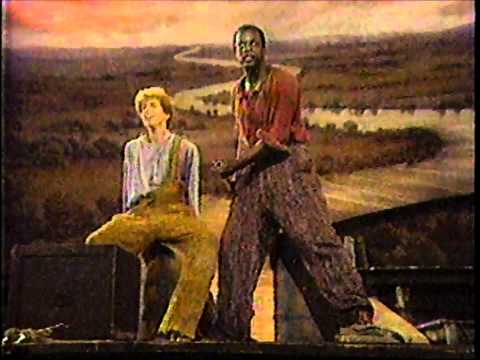
Cambridge, Massachusetts took the show in 1984 and in the same year, during one month the show played in San Diego, California.The Broadway hosted this play over 1005 shows from 1985 to 1987, in Eugene O'Neill Theatre. Director was Des McAnuff, Janet Watson was responsible for the choreography, and the actors were as follows: J. Short, R. Auberjonois, J. L. Warren, B. Gunton, P. Cohenour, J. Goodman, G. Connell, D. Jenkins, S. Browning & R. Richardson.
Her Majesty's Theatre took the show in 1989, in Melbourne.
In 2003, the resurrection of the musical took place and had as many as 28 previews. Jeff Calhoun was both the director and choreographer of this musical. American Airlines Theatre hosted it this time. Now the play has been much less successful than the previous one – only 67 shows. But it has just a completely different format. This version differed with following – it included the deaf actors in the cast (the role of Huck was no exception), who participated in a team on a par with those who can hear normally. And so all the people could touch the wonderful world of theater, staging was accompanied with sign language. Gestures, articulation, and everything else was done more expressive, but at the same time, organically fitted to the entire entourage.
The role of Mark Twain performed by the same actor who played Huckleberry on Broadway – Daniel H. Jenkins.
National tour took place in the period from June 2004 to May 2005 and was reformatted for such a display. Almost everyone who took part in the musical on Broadway, also participated in this traveling theater. Completion of it was in DC, where the musical ran two more months in Washington.
2008 – another year to return of the play, when it was going a little less than one season, in the autumn, under the guidance of Rob Ruggiero.
Release date: 1985
"Big River" – The Musical Guide & Song Meanings
Review: a river story where the jokes land, and the silence accuses
What if the funniest musical number in a show about slavery is also a warning flare? That’s the tightrope “Big River” walks. Roger Miller’s lyrics sound casual, even tossed off, and that’s the trick: the plain talk gives the story velocity, while the moral cost accumulates underneath. Huck’s lines favor everyday phrasing and half-swallowed grammar, the kind that keeps a boy believable and keeps a crowd leaning forward. Then Jim sings, and the language lengthens. The show’s lyric engine is contrast: boys’ games versus grown-up violence, a river that feels like escape versus a nation built to deny it. :contentReference[oaicite:0]{index=0}
Musically, it’s country, bluegrass, gospel, and folk, but it behaves like theatre. Refrains return the way memories do, not the way radio singles do. When Huck sings about light, it’s aspiration and self-justification at once. When the company sings about heaven, it’s community pressure dressed up as salvation. The score’s “Americana” isn’t decorative. It’s the setting’s power structure rendered as harmony: friendly on the surface, rigid underneath. :contentReference[oaicite:1]{index=1}
How it was made: an outsider’s Broadway score, built from Twain and Oklahoma dirt
The creation story matters here because “Big River” sounds like it was written by someone who didn’t grow up chasing Broadway approval. Producer Rocco Landesman pushed for Roger Miller, even though Miller had limited musical-theatre experience and hadn’t even read “Huckleberry Finn” at first. Once Miller finally read the material, he described ideas arriving page by page, and he tied Twain’s world back to his own childhood: cotton fields, rural hardship, and people he recognized as kin to Twain’s characters. That personal bridge is audible in the lyrics. They don’t polish the mud off the boots. They make the mud the point. :contentReference[oaicite:2]{index=2}
And there’s a second, quieter origin detail: both Miller and book writer William Hauptman were coming out of dry spells when they took the job. The show’s best songs carry that hunger. They feel like someone returning to craft, not demonstrating it. :contentReference[oaicite:3]{index=3}
Key tracks & scenes: the 8 moments where the lyrics do the heavy lifting
"Do You Wanna Go to Heaven?" (Company)
- The Scene:
- St. Petersburg, Missouri. Bright, public light. A town forms a moral circle around Huck, smiling while it tightens. (Act One, Scene 1.) :contentReference[oaicite:4]{index=4}
- Lyrical Meaning:
- The lyric is a sales pitch disguised as concern. Heaven becomes a tool of compliance: learn, behave, perform goodness. It’s “care” with a ledger behind it, and it sets up the show’s central fight, not against the river, but against the rules people pretend are mercy.
"Waitin’ for the Light to Shine" (Huck)
- The Scene:
- After the boys’ cave-world fades, Huck is back in the real one: homes, judges, lessons, expectation. The lighting wants to go dim, because this is a boy alone with a question he can’t name yet. (Act One, Scene 2.) :contentReference[oaicite:5]{index=5}
- Lyrical Meaning:
- “Light” is purpose, yes, but also permission. The song is Huck negotiating with himself: if he can’t be good in the way adults demand, can he be good in a way that still counts? It’s a moral coming-of-age song that refuses to sound lofty.
"Guv’ment" (Pap Finn)
- The Scene:
- Pap’s log cabin in the woods. Harsh, ugly light. The air is alcohol and grievance. His rage ricochets like a bottle thrown at the wall. (Act One, Scene 4.) :contentReference[oaicite:6]{index=6}
- Lyrical Meaning:
- This is comedy with rot in it. Pap’s language twists the idea of freedom into entitlement: he hates the world not because it’s unjust, but because it won’t let him keep power over his son. The lyric teaches you how American “liberty” can be weaponized by the worst person in the room.
"Muddy Water" (Jim and Huck)
- The Scene:
- Missouri shore, then onto the river. Movement replaces furniture. The raft is freedom and exposure at the same time, like stepping into an open road at night. (Act One, Scene 6.) :contentReference[oaicite:7]{index=7}
- Lyrical Meaning:
- The lyric makes the river a character: unpredictable, stained, alive. “Muddy” isn’t just weather. It’s the moral environment they’re traveling through. When they sing together, you hear an alliance forming, but the words already admit the cost: you don’t get clean choices in dirty systems.
"River in the Rain" (Huck and Jim)
- The Scene:
- On the river, south of St. Louis, heading toward Cairo. The stage feels like fog: soft edges, drifting time. The rain is a veil that makes their small world feel briefly safe. (Act One, Scene 7.) :contentReference[oaicite:8]{index=8}
- Lyrical Meaning:
- This is the show’s gentlest truth: intimacy without sentimentality. The lyric treats quiet as earned. It isn’t saying the world is fine. It’s saying that, for one song, the world can’t reach them. That relief becomes its own kind of heartbreak.
"Worlds Apart" (Jim and Huck)
- The Scene:
- After a cruel prank, the raft turns into a courtroom. The lighting narrows. Huck finally has to look at what he’s been treating as play. (Act Two, Scene 2.) :contentReference[oaicite:9]{index=9}
- Lyrical Meaning:
- The lyric puts a measuring tape between them: not affection, but circumstance. Critics have noted the song’s bluntness, and that bluntness is part of its function. It refuses poetry because the situation doesn’t deserve soft focus. :contentReference[oaicite:10]{index=10}
"You Oughta Be Here With Me" (Mary Jane Wilkes, Susan Wilkes, Joanna Wilkes)
- The Scene:
- A farm near Hillsboro, Arkansas. A funeral atmosphere even before the coffin enters. The light is warm but grieving, like late afternoon refusing to turn into night. (Act Two, Scene 4.) :contentReference[oaicite:11]{index=11}
- Lyrical Meaning:
- The lyric is yearning without manipulation. It’s also a trap door for Huck: the song offers him a version of belonging he has never had. The tragedy is that it’s sincere, and it arrives from people he can’t fully protect.
"Free at Last" (Jim and Slaves)
- The Scene:
- Interior of the Phelps home, then the shed at night. Gospel energy inside a cage. The body wants to rise; the plot won’t allow it yet. (Act Two, Scenes 8–9.) :contentReference[oaicite:12]{index=12}
- Lyrical Meaning:
- The lyric borrows the language of deliverance, but the staging reality keeps contradicting it. That friction is the point. Miller even described drawing inspiration for the number from words associated with Martin Luther King Jr., which adds historical echo to a scene that is still trapped in antebellum time. :contentReference[oaicite:13]{index=13}
Live updates 2025/2026: what’s happening with “Big River” right now
As of the latest listings available, “Big River” is not sitting inside a long-running commercial Broadway engagement or a major public tour pipeline. Ticket aggregators that track touring events often show no upcoming “Big River” dates, which usually means the title is living where it has always lived best: regional companies, repertory theatres, schools, and community stages. :contentReference[oaicite:14]{index=14}
That doesn’t mean it’s dormant. Licensing remains active through Concord Theatricals (including a Theatre for Young Audiences edition), and the show’s production history keeps renewing itself in smaller rooms where the story can feel uncomfortably close. :contentReference[oaicite:15]{index=15}
The bigger “industry” development is screen-facing: Playbill reported in 2025 that a feature film adaptation is in the works, with playwright Douglas Lyons attached to write the screenplay. If that project moves forward, expect the conversation around the lyrics to shift fast, because Miller’s plainspoken rhymes will be judged on camera, not from the back row. :contentReference[oaicite:16]{index=16}
Notes & trivia (the kind directors put in the rehearsal room packet)
- Concord Theatricals lists “Big River” as a full-length musical with music and lyrics by Roger Miller and a book by William Hauptman, adapted from Mark Twain. :contentReference[oaicite:17]{index=17}
- A South Bay Musical Theatre program preserves detailed “Scenes & Musical Numbers,” including location cues like “Indian Joe’s cave” for “The Boys” and a river sequence heading toward Cairo for “The Crossing” and “River in the Rain.” :contentReference[oaicite:18]{index=18}
- StageAgent notes “Hand for the Hog” was cut for at least one revival context, a reminder that this score has had to negotiate taste and pacing over time. :contentReference[oaicite:19]{index=19}
- The 2003 Broadway revival (Roundabout with Deaf West) became famous for integrating American Sign Language with sung/spoken performance, changing how audiences “read” lyrics in real time. :contentReference[oaicite:20]{index=20}
- Los Angeles Times reported Miller initially hadn’t read “Huckleberry Finn,” then found songs arriving as he read, connecting Twain’s characters to his own upbringing. :contentReference[oaicite:21]{index=21}
- Playbill’s 2025 anniversary piece frames “Big River” as an unusually successful American musical in an era dominated by British imports, and also notes a film version in development. :contentReference[oaicite:22]{index=22}
Reception: praised for its score, challenged for its second act, reinterpreted through ASL
The original Broadway run arrived with momentum and skepticism at once. Frank Rich’s early assessment caught the paradox: a show with real “high-water marks,” and moments where the imaginative flow slackens. That language has followed “Big River” ever since, because it describes the show’s structural risk: it wants to be a rowdy American musical and a moral reckoning, in the same breath. :contentReference[oaicite:23]{index=23}
By 2003, the Deaf West revival reframed the lyric experience itself. Critics wrote about moments where the orchestra drops out and the show communicates through signed rhythm and physical phrasing, turning “lyrics” into choreography and silence into emphasis. For many, that production didn’t just revive the musical. It revealed it. :contentReference[oaicite:24]{index=24}
“the first that audiences can attend without fear of suffering either profound embarrassment or terminal boredom.”
“The ensemble of deaf and hearing actors delivers a chorus of the song in utter silence.”
“Miller's lyrics for this song, ‘Worlds Apart,’ are on the blunt and sentimental side.”
Technical info
- Title: Big River: The Adventures of Huckleberry Finn :contentReference[oaicite:25]{index=25}
- Broadway opening year: 1985 :contentReference[oaicite:26]{index=26}
- Type: Full-length musical (adaptation of literature) :contentReference[oaicite:27]{index=27}
- Book: William Hauptman :contentReference[oaicite:28]{index=28}
- Music & lyrics: Roger Miller :contentReference[oaicite:29]{index=29}
- Selected notable placements (scenes & settings): “Do You Wanna Go To Heaven?” in St. Petersburg; “The Boys” in Indian Joe’s cave; “Guv’ment” in Pap’s cabin; “Muddy Water” on the Missouri shore; “The Royal Nonesuch” in Bricktown, Arkansas. :contentReference[oaicite:30]{index=30}
- Cast recording: Original Broadway Cast Recording (released in the mid-1980s; commonly listed with 20 tracks, including “Overture,” “Muddy Water,” and “Free At Last”). :contentReference[oaicite:31]{index=31}
- Label (cast album): Commonly listed as MCA Records for the original cast release. :contentReference[oaicite:32]{index=32}
- Availability: Streaming listings exist on major platforms (example: Spotify album page). :contentReference[oaicite:33]{index=33}
FAQ
- Who wrote the lyrics in “Big River”?
- Roger Miller wrote both the music and the lyrics, with William Hauptman writing the book. :contentReference[oaicite:34]{index=34}
- Is “Big River” the same as “The Adventures of Huckleberry Finn”?
- It’s an adaptation of Mark Twain’s novel, shaped into a Broadway musical that follows Huck and Jim down the Mississippi. :contentReference[oaicite:35]{index=35}
- What’s the most important song for Huck’s moral change?
- “Waitin’ for the Light to Shine” and its reprise frame his inner argument: whether doing the right thing can make him “bad” in the eyes of his world, and whether he’ll do it anyway. :contentReference[oaicite:36]{index=36}
- Was there a major revival that changed how the lyrics are performed?
- Yes. The Deaf West and Roundabout revival on Broadway integrated American Sign Language with sung/spoken performance, creating moments where “lyrics” are carried visually even when voices drop away. :contentReference[oaicite:37]{index=37}
- Is there a movie version coming?
- A feature film adaptation has been reported as in development, with Douglas Lyons attached to write the screenplay. :contentReference[oaicite:38]{index=38}
Key contributors
| Name | Role | Contribution |
|---|---|---|
| Roger Miller | Composer-Lyricist | Wrote the score and lyrics that blend country, gospel, and character-driven storytelling. :contentReference[oaicite:39]{index=39} |
| William Hauptman | Book writer | Adapted Twain’s narrative into a stage structure that supports Miller’s song forms. :contentReference[oaicite:40]{index=40} |
| Mark Twain | Source author | Wrote the original novel that supplies the characters, conflicts, and American argument at the center of the musical. :contentReference[oaicite:41]{index=41} |
| Rocco Landesman | Producer (origin driver) | Credited in later reporting and background notes as the catalyst who pursued Miller for the project. :contentReference[oaicite:42]{index=42} |
| Deaf West Theatre / Roundabout Theatre Company | Revival producers/collaborators | Popularized the ASL-integrated staging approach that reshaped audience attention to lyric delivery. :contentReference[oaicite:43]{index=43} |
Sources: Concord Theatricals; Playbill; Los Angeles Times; The Washington Post; Variety; South Bay Musical Theatre (program PDF); StageAgent; Discogs; Spotify.