Best Little Whorehouse in Texas, The Lyrics – All Songs from the Musical
Best Little Whorehouse in Texas, The Lyrics: Song List
- Act 1
- 20 Fans
- A Lil' Ole Bitty Pissant Country Place
- Girl, You're A Woman
- Watch Dog Theme
- Texas Has A Whorehouse In It
-
Twenty Four Hours Of Lovin'
-
Doatsy Mae
-
The Angelette March
-
The Aggie Song
- Act 2
- The Sidestep
-
No Lies
- Good Old Girl
- Hard Candy Christmas
-
The Bus From Amarillo
- Finale
About the "Best Little Whorehouse in Texas, The" Stage Show
We would suggest that the great success of this musical – 1584 shows – was due to the blatant appearances of actresses that played in it – because they all were dressed up as women of easy virtue – with all outwardly or barely hidden charms. This is probably one of the few – if not the only – musicals where husbands dragged their women to watch it, not vice versa.Its premiere took place on Broadway in 1978 in the 46th Street Theatre. The director was Peter Masterson together with Tommy Tune, and choreography held by Thommie Walsh, along with Tommy Tune. The actors were as follows: J. Garner, P. Blair, J. Ellis, C. Glynn, A. Morris, D. Hall, H. Forsythe & F. Flagg.
More than a year representations continued in different cities of America, and its completion was in LA, where the musical went for 7 more months. Overall, a very successful performance, both on Broadway standards, and on the standards of off-town.
Eugene O'Neill Theatre hosted the show in 1982, when it was performed as a resurrection, but maybe it has not been originally designed for a long play this time, or for some other reasons, however, it was closed after only 63 performances and 9 previews.
Of course, such a success would be incomplete without featuring on The West End’s Theatre Royal that hosted a musical in 1981, where it stayed for modest 204 performances. In 1994, Broadway saw a second resurrection, only this time its name has been added with “Goes Public” at the end.
The second national tour on the United States began in 2001, and 10 years later, in 2011, there was the third revival of the musical, this time in London – The Union Theatre settled it. It played there for one season, in the fall.
Finally, in 2015, it took fourth and so far last revival, on Broadway, where the director and choreographer was Rob Ashford.
Release date: 1978
"The Best Little Whorehouse in Texas" – The Musical Guide & Song Meanings
Review
Is it a “bawdy” musical that’s secretly polite, or a “wholesome” musical that’s secretly furious? “The Best Little Whorehouse in Texas” keeps both stories alive at the same time. Carol Hall’s lyrics smile, then sharpen. Everybody in town knows what the Chicken Ranch is. The problem is never sex. The problem is paperwork, television, and the kind of moral panic that needs a camera to feel real. :contentReference[oaicite:0]{index=0}
The score’s trick is its tone control. Hall writes like a songwriter who can switch hats mid-verse. One minute you’re in a rally chant, the next you’re in a private confession. That contrast is the musical’s ethics. Public men posture. Public women work. When the women finally sing their fear out loud, the show stops teasing and starts telling the truth. :contentReference[oaicite:1]{index=1}
Musically, it lives in a Broadway-country handshake, with pop hooks and Texas twang as dramatic tools rather than genre cosplay. “The Sidestep” satirizes politics with dance. “Texas Has a Whorehouse in It” satirizes media with repetition and volume. “Hard Candy Christmas” drops the satire and lets the bill come due. The lyric isn’t about a holiday. It’s about survival when the only “benefit package” you had is gone. :contentReference[oaicite:2]{index=2}
How it was made
Before it became a Broadway title, it was Texas legend under hot lights: the real Chicken Ranch near La Grange, a brothel that operated for decades and became an open secret until a televised investigation helped force its closure in 1973. The musical’s DNA is journalism, not fantasy. Larry L. King wrote about the story and later adapted it for the stage with Peter Masterson, while Hall supplied music and lyrics that kept the women from turning into a joke. :contentReference[oaicite:3]{index=3}
The Broadway transfer story is unusually clean: it opened off-Broadway in spring 1978, moved to Broadway that summer, and then simply kept going. It opened at the 46th Street Theatre on June 19, 1978 and ran until March 27, 1982, reaching 1,584 performances. That’s not a cult run. That’s a civic run. :contentReference[oaicite:4]{index=4}
Hall’s later reflections add another layer: she resisted the lazy framing that the show “must” be anti-woman because it’s about a brothel. She argued, repeatedly, that the musical is about hypocrisy and power, and that the women are the sanest people in the room. You can hear that in the writing. The lyrics don’t wink at the girls. They listen to them. :contentReference[oaicite:5]{index=5}
Key tracks & scenes
"A Lil' Ole Bitty Pissant Country Place" (Miss Mona, the Girls)
- The Scene:
- The Chicken Ranch in full daylight. Warm practical lighting, like a workplace that refuses to feel illicit. Mona lays down rules, the girls echo them, and the choreography treats order like a service. :contentReference[oaicite:6]{index=6}
- Lyrical Meaning:
- The lyric is Mona’s mission statement: work, boundaries, discretion, and community reputation. It’s a business hymn that doubles as character defense.
"Texas Has a Whorehouse in It" (Melvin P. Thorpe, Watch Dogs, Company)
- The Scene:
- A TV studio. Bright, harsh, flat light. The kind that makes everyone look guilty. Thorpe turns a known fact into a “reveal” by repeating it like an alarm. :contentReference[oaicite:7]{index=7}
- Lyrical Meaning:
- This lyric isn’t information, it’s branding. It shows how outrage works: a simple line, said loudly, until it becomes policy.
"Twenty Fans" (the Girls)
- The Scene:
- A communal bedroom moment, comic timing over close harmonies. The lighting softens because the audience is invited “inside,” not as voyeurs, but as witnesses. :contentReference[oaicite:8]{index=8}
- Lyrical Meaning:
- It’s a joke about demand, but it’s also labor math. The women quantify attention because their world forces them to.
"The Sidestep" (The Governor, Reporters, Company)
- The Scene:
- A press conference that becomes a dance. White-hot spotlight on the Governor when the questions land. Each dodge becomes choreography, and the whole stage turns into a legislative hallway. :contentReference[oaicite:9]{index=9}
- Lyrical Meaning:
- The lyric makes a political point without preaching: leadership that moves, but never answers. Rhythm replaces responsibility.
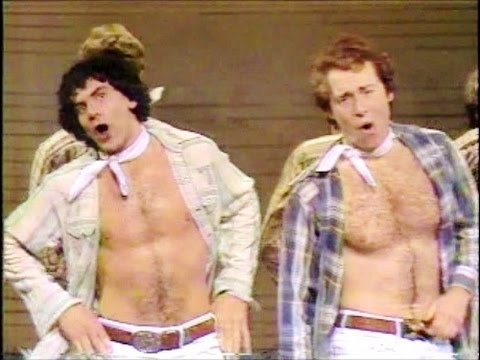
"The Aggie Song" (The Aggies)
- The Scene:
- All-male chorus, locker-room energy, then a performance that’s half march, half ritual. It’s often staged with stadium lighting and relentless forward motion. :contentReference[oaicite:10]{index=10}
- Lyrical Meaning:
- The show lets the boys be funny, then shows the entitlement underneath. The lyric is a victory lap that treats women like a prize.
"Good Old Girl" (Sheriff Ed Earl Dodd, the Aggies)
- The Scene:
- A rowdy male number that drags the Sheriff into the boys’ mythology. The staging usually turns him into a reluctant mascot, surrounded. :contentReference[oaicite:11]{index=11}
- Lyrical Meaning:
- This is how the show sketches Ed Earl’s contradiction: he’s law, but he’s also local. He wants to protect Mona, but he also wants to belong.
"The Bus from Amarillo" (Miss Mona)
- The Scene:
- A quiet storytelling pocket. Mona remembers arrival, fate, and the way a life can “start” by accident. A single pool of light. Minimal movement. :contentReference[oaicite:12]{index=12}
- Lyrical Meaning:
- The lyric is origin without apology. It insists Mona’s past is a biography, not a punchline.
"Hard Candy Christmas" (the Girls)
- The Scene:
- Near the end, as the women prepare to leave after the Ranch is forced to close. The staging often breaks them into individual fragments, then reunites them on the chorus. Lights dim like a last call. :contentReference[oaicite:13]{index=13}
- Lyrical Meaning:
- Hall writes a group lament that refuses self-pity. The lyric says: we will be broke, we will be lonely, and we will still walk out on our own feet.
Scene-and-song anchoring above draws from contemporary critical description of signature numbers and published song lists that preserve Act II’s political and closing sequences. :contentReference[oaicite:14]{index=14}
Live updates
In 2025, the show keeps doing what it’s done for decades: thriving in the regional lane, where big ensembles and big laughs are an asset. Annapolis Summer Garden Theatre mounted a production running June 26 through July 19, 2025, with ticketing publicly listed at $30 and a review noting a two-and-a-half-hour running time including a short intermission. :contentReference[oaicite:15]{index=15}
That kind of scheduling is the modern “tour” for this title: not one national company, but many localized runs that can sell the brand, the dance numbers, and the familiar songs. Concord Theatricals continues to license the musical, which is the clearest sign it’s still in active circulation for 2025 and 2026 seasons. :contentReference[oaicite:16]{index=16}
As for Broadway, there have been public reports and speculation about potential revivals across the 2010s, but no confirmed Broadway engagement has materialized from those announcements. The show’s present tense is the road, the parks, and the summer venues. It’s still Texas politics, just staged under different skies. :contentReference[oaicite:17]{index=17}
Notes & trivia
- The original Broadway production opened June 19, 1978 and closed March 27, 1982, reaching 1,584 performances. :contentReference[oaicite:18]{index=18}
- Concord’s history listing credits the original Broadway run at the 46th Street Theatre, directed by Peter Masterson and Tommy Tune. :contentReference[oaicite:19]{index=19}
- The real Chicken Ranch operated near La Grange and was shut down in 1973 after public pressure and official action; it later inspired the musical and film. :contentReference[oaicite:20]{index=20}
- The New Yorker singled out “The Sidestep” press-conference dance as a comic peak, praising the show’s “clever, tuneful songs” and Tommy Tune’s choreography. :contentReference[oaicite:21]{index=21}
- “Hard Candy Christmas” is written by Carol Hall and, in the stage show, is structured with different women taking lines before joining on the refrains. :contentReference[oaicite:22]{index=22}
- At the 1979 Tony Awards, the show was represented in the broadcast year’s nominee lists, including a nomination for Tommy Tune’s choreography and nominations for Carlin Glynn and Joan Ellis. :contentReference[oaicite:23]{index=23}
- Carol Hall is repeatedly cited as one of the few women of her era to write both music and lyrics for a Broadway musical, and “Whorehouse” became her signature credit. :contentReference[oaicite:24]{index=24}
Reception
Critics in 1978 did not all agree on the show’s bite level. Some heard it as a romp with soft teeth. Others heard a political musical hiding in a party musical. What’s not debatable is the gap between reviews and audience appetite. The run length tells you that the show found its public, and kept it, even as the moral weather changed. :contentReference[oaicite:25]{index=25}
“It received lukewarm reviews, but audiences loved it.”
“a foolish, engaging romp about Texas politics and Texas mores”
“has all the satiric bite of a playful puppy”
Technical info
- Title: The Best Little Whorehouse in Texas
- Year: 1978 (Broadway opening) :contentReference[oaicite:26]{index=26}
- Type: Musical comedy
- Book: Larry L. King and Peter Masterson :contentReference[oaicite:27]{index=27}
- Music & lyrics: Carol Hall :contentReference[oaicite:28]{index=28}
- Based on: A story by Larry L. King inspired by the real Chicken Ranch near La Grange, Texas :contentReference[oaicite:29]{index=29}
- Original Broadway run: June 19, 1978 to March 27, 1982; 1,584 performances :contentReference[oaicite:30]{index=30}
- Selected notable placements: workplace rule-setting (“A Lil’ Ole Bitty Pissant Country Place”); TV exposé (“Texas Has a Whorehouse in It”); governor press conference dodge (“The Sidestep”); football-team ritual (“The Aggie Song”); forced closure farewell (“Hard Candy Christmas”) :contentReference[oaicite:31]{index=31}
- Licensing: Concord Theatricals :contentReference[oaicite:32]{index=32}
- 2025 example production: Annapolis Summer Garden Theatre (June 26 to July 19, 2025) :contentReference[oaicite:33]{index=33}
- Awards snapshot: Listed among 1979 Tony Awards nominee pages for performance categories and choreography, reflecting its Broadway-season footprint :contentReference[oaicite:34]{index=34}
FAQ
- Who wrote the lyrics to “The Best Little Whorehouse in Texas”?
- Carol Hall wrote both the music and lyrics. The book is by Larry L. King and Peter Masterson. :contentReference[oaicite:35]{index=35}
- Is the Chicken Ranch real, or just a plot device?
- It’s real history. The Chicken Ranch near La Grange operated for decades and was shut down in 1973, later inspiring the musical’s story. :contentReference[oaicite:36]{index=36}
- Where in the show does “Hard Candy Christmas” happen?
- Near the end, as the women prepare to leave after the Ranch is forced to close, with different girls often taking lines before joining together. :contentReference[oaicite:37]{index=37}
- Why is “The Sidestep” such a fan favorite?
- Because it stages political cowardice as choreography: the Governor answers pressure by dancing away from it, turning evasion into entertainment. :contentReference[oaicite:38]{index=38}
- Is the show touring in 2025 or 2026?
- It’s active mainly through regional productions and licensing. One documented 2025 run played in Annapolis, and Concord continues to license the title. :contentReference[oaicite:39]{index=39}
Key contributors
| Name | Role | Contribution |
|---|---|---|
| Carol Hall | Composer / Lyricist | Wrote the show’s Texas-pop-Broadway score, including “Hard Candy Christmas,” and shaped the lyric point of view around the women’s interior lives. :contentReference[oaicite:40]{index=40} |
| Larry L. King | Book / Source story | Turned Texas reportage and legend into stage narrative, then co-wrote the book adaptation. :contentReference[oaicite:41]{index=41} |
| Peter Masterson | Book; Original director | Co-wrote the book and directed the original Broadway staging with Tommy Tune. :contentReference[oaicite:42]{index=42} |
| Tommy Tune | Original director / Choreographer | Made the show’s political comedy physical, with “The Sidestep” cited as a signature choreographic gag. :contentReference[oaicite:43]{index=43} |
| Concord Theatricals | Licensing | Current licensing home, keeping the show in ongoing production circulation worldwide. :contentReference[oaicite:44]{index=44} |
| Annapolis Summer Garden Theatre | Recent producer (example) | Mounted a documented 2025 run (June 26 to July 19), illustrating the show’s current regional-production life. :contentReference[oaicite:45]{index=45} |
Sources: IBDB, Playbill Vault, Concord Theatricals, The New Yorker, The Washington Post, Houston Chronicle, Annapolis Summer Garden Theatre, DC Theater Arts, Wikipedia (show and Chicken Ranch), Dramatists Guild, PopMatters, Tony Awards (official site).