Barnum Lyrics – All Songs from the Musical
Barnum Lyrics: Song List
- Act 1
- Overture Chase
- There Is A Sucker Born Ev'ry Minute
- Humble Beginnings Chase
- Thank God I'm Old
- The Colors Of My Life (Part 1)
- The Colors Of My Life (Part 2)
- One Brick At A Time
- Museum Song
- Female Of The Species Chase
- I Like Your Style
- Bigger Isn't Better
- Love Makes Such Fools Of Us All
- Midway Chase
- Out There
- Act 2
- Come Follow The Band
- Black And White
- The Colors Of My Life (reprise)
- The Prince Of Humbug
- Join The Circus
- Finale Chase
- The Final Event: There Is A Sucker Born Ev'ry Minute (Reprise)
About the "Barnum" Stage Show
Broadway saw this musical in 1980 and it played successful 854 performances, before it was closed in May of 1982. Joe Layton – director and choreographer, David Mitchell served as stage designer, Theoni V. Aldredge was responsible for the costumes and Craig Miller carried out to be purposeful for the light. Actors were following: T. Mann, J. Dale, T. White, M. Tatum & G. Close. Last one – Glenn Close – is a successful actress (and even a producer) in Hollywood (her most famous roles – in films about spotted dogs, Dalmatians, respectively, 101 & 102 Dalmatians, she played Cruella there). Back in 1980th, she has been 35 years younger – and so, she was 33.West End hosted the opening of the show in 1981 – and lasted for 655 performances that is in this place is a very successful quantity. S. Payne, M. Crawford & D. Grant played in this production. In the United Kingdom, the show went on for 3 years, from 1984 to 1986, in Victoria Palace Theatre, as the first place, which hosted this, and Manchester Opera House was the second. Music from the show in 1986 was recorder on DVD & VHS.
In 2013, 14 and 15 years was the renewal of the musical – first in the Chichester Festival Theatre, then on Cameron Mackintosh. Some production was in Australia in 1982, in Florida in 2008 and in 1984 in Madrid. Production in 2013 was initially planned in another theater, but it was closed for renovation. Timothy Sheader was the director here, and L. Steel & A. Wright were choreographers and assistants of director.
Release date: 1980
"Barnum" – The Musical Guide & Song Meanings
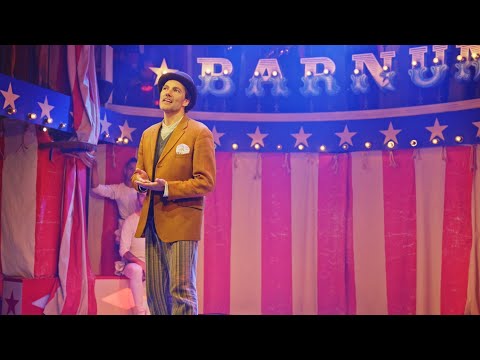
Review
Barnum is a musical about the mechanics of attention. Not fame. Attention. The show treats the audience like a town square and P.T. Barnum like its loudest vendor. The lyrics are built to be heard over noise: brass-band consonants, slogans that bounce, rhymes that grin. Then, in the middle of all that ballyhoo, it drops a line that sounds like a private confession. That push-pull is the whole point. Barnum’s life is public performance, Charity’s life is the bill.
Michael Stewart’s lyric voice loves a hook, but it also loves a pivot. “There Is a Sucker Born Ev’ry Minute” lands as a boast, then curdles into a philosophy. “Black and White” is a domestic ultimatum that makes the show’s color metaphor suddenly literal. The musical style is classic Cy Coleman: melodies that can march, strut, waltz, and still feel like one score. It works because Barnum’s mind moves like a parade. Even when he’s still, the show wants motion.
Mark Bramble’s book has always been the soft spot. Productions either lean into the thin biography and play it as a circus revue, or they try to interrogate Barnum the man and run into the show’s basic design: it was built to entertain first. That doesn’t make it shallow. It makes it strategic. The musical knows Barnum’s superpower was distraction, and it bakes that into the form.
How It Was Made
Barnum opened on Broadway at the St. James Theatre on April 30, 1980, with music by Cy Coleman, lyrics by Michael Stewart, and a book by Mark Bramble. The stage language was the selling point: director-stager Joe Layton turned the theatre into a one-ring circus, with performers functioning as clowns, acrobats, and narrators. Masterworks Broadway’s production notes make a blunt claim that still frames the show’s history: the concept was strong, but the piece leveled up when Jim Dale signed on and proved he could sing, clown, and do the danger tricks that the role quietly demands.
One of the best bits of craft trivia is structural. Accounts tied to Masterworks Broadway describe Bramble’s early conception as a tighter, one-act idea that evolved into a two-act Broadway machine. That change matters because the score’s most famous parade, “Come Follow the Band,” is often treated like an Act II ignition switch. It’s not just a hit tune. It’s a pacing solution, a way to restart the audience’s appetite for spectacle after intermission.
The show’s strongest lyric strategy is simple: Barnum speaks in sales language, and the musical lets you enjoy it. Charity speaks in consequences, and the musical makes you sit with it. That is why the best numbers are not always the loudest ones. They are the ones that reveal who is paying for the noise.
Key Tracks & Scenes
"There Is a Sucker Born Ev'ry Minute" (Barnum)
- The Scene:
- Center ring. Barnum addresses the crowd like they’re both customers and co-conspirators. Bright front light. Drum hits that feel like a wink you can hear.
- Lyrical Meaning:
- The lyric is marketing as worldview. It’s catchy, almost friendly, and that’s the trap. The number sets up Barnum’s charm as a skill, not a moral position, and the show keeps testing whether charm can stand in for truth.
"Thank God I'm Old" (Joice Heth)
- The Scene:
- A sideshow act presented as history. The staging often frames Joice like an artifact, with movement around her doing the “selling.” The laugh is uneasy.
- Lyrical Meaning:
- The lyric is a survival mask. It turns exploitation into punchlines so the audience can keep watching. In good productions, the comedy never quite erases the discomfort, and that discomfort is the point.
"The Colors of My Life (Part 1)" (Barnum)
- The Scene:
- Before the empire. Barnum paints his future in big strokes. The ring feels empty enough to imagine it filling. A dream sold as autobiography.
- Lyrical Meaning:
- Color becomes appetite. Barnum’s lyric argument is that wanting more is a virtue. It’s also a warning sign: he can only feel alive when the world is louder than his own doubts.
"The Colors of My Life (Part 2)" (Charity)
- The Scene:
- A quieter counterpoint. Charity’s space is domestic, grounded, practical. Warmer lighting, fewer tricks. The room stops spinning.
- Lyrical Meaning:
- Same metaphor, different cost. Charity’s “colors” are not ambition. They are stability, family, and patience. The duet structure across Parts 1 and 2 is the show admitting the marriage is two competing definitions of a good life.
"Bigger Isn't Better" (Tom Thumb)
- The Scene:
- Tom Thumb makes his case in a world that treats him like novelty. The staging can be playful, but it’s also a trial: who gets to be seen as “enough”?
- Lyrical Meaning:
- The lyric flips the Barnum doctrine. If Barnum worships scale, Tom Thumb worships specificity. It’s a key moral hinge: the show asks whether spectacle is liberation or a cage.
"Love Makes Such Fools of Us All" (Jenny Lind)
- The Scene:
- Jenny arrives with celebrity aura, often staged as a concert within the circus frame. Spotlight focus. Cleaner musical line. The noise hushes for her.
- Lyrical Meaning:
- It’s romance and warning in the same breath. The lyric tells you love is irrational, then shows you how that irrationality becomes leverage. Barnum thinks he can brand her. The song hints she will not stay a product.
"Come Follow the Band" (Ensemble)
- The Scene:
- Act II opener energy. A marching-band blast that turns the theatre into a street parade. In recent praised stagings, the “circus” can even spill outdoors before pulling you back in.
- Lyrical Meaning:
- This is Barnum’s philosophy set to a beat. Follow the noise, follow the promise, follow the next shiny thing. The lyric sells motion as meaning, and the show dares you to admit you like being sold to.
"Black and White" (Charity, Barnum, Choir/Blues Singer, Citizens)
- The Scene:
- A marriage negotiation staged like a civic argument. Barnum is asked to drain the color from his life and take a “respectable” job. The palette metaphor becomes costume and lighting logic.
- Lyrical Meaning:
- Charity’s lyric is not about killing joy. It’s about stopping the bleeding. The number is the show’s most direct critique of Barnum: when your life is a pitch, your marriage becomes a contract.
"Join the Circus" (Bailey, Circus Performers, Barnum)
- The Scene:
- The partnership offer lands like fate. The ring fills with possibility and danger at the same time. It’s the moment the brand becomes an institution.
- Lyrical Meaning:
- The lyric is recruitment propaganda, and it knows it. It’s also the show admitting its own nature: musicals are circuses too, built on bodies doing hard things so strangers can feel wonder for two hours.
Live Updates
2026 is a real touring year for Barnum in the UK. Bill Kenwright Ltd has announced a UK and Ireland tour opening at Theatre Royal Windsor on 30 January 2026, with Lee Mead starring as P.T. Barnum. The production is billed as a circus-forward revival directed by Jonathan O’Boyle and choreographed by Oti Mabuse, with an ensemble of actor-musicians plus circus and aerial work. Kenwright’s production page also lists principal casting including Monique Young (Charity) and Penny Ashmore (Jenny Lind), and names George Dyer as arranger/orchestrator and musical supervisor.
The show’s modern life has also been boosted by high-quality regional revivals that treat it less like a museum piece and more like a playable event. The Watermill Theatre’s 2024 staging drew major press attention for leaning into physical circus skills and band-driven momentum, while still acknowledging the book’s thin portrait of Barnum. That split is now part of the conversation around the title: audiences still want the tunes, but they also want productions to be honest about who Barnum was and what “humbug” hides.
Notes & Trivia
- Barnum opened on Broadway April 30, 1980 at the St. James Theatre and ran for 854 performances (plus 26 previews).
- Jim Dale won the 1980 Tony Award for Best Actor in a Musical for playing Barnum, a role built around showmanship and physical risk.
- The original Broadway production also won Tony Awards for Scenic Design (David Mitchell) and Costume Design (Theoni V. Aldredge).
- Masterworks Broadway notes the “one-ring circus” framing as the show’s signature staging concept, with Joe Layton credited for staging that turned the theatre into a circus space.
- “Come Follow the Band” is treated in many histories as the Act II kick-start number, designed to restart the show’s adrenaline after intermission.
- Masterworks Broadway’s plot notes explicitly frame “Black and White” as Charity’s condition for resuming the marriage: Barnum must banish color from his life and take a clock-factory job.
- The 2026 tour’s creative team publicly lists a “Circus Director” role, reflecting how contemporary productions increasingly treat the circus discipline as its own department, not just choreography.
Reception
Critical response has always been a balancing act: admiration for the craft of the entertainment, frustration at the biography’s soft edges. That debate has only gotten sharper in the 2020s, as productions grapple with Barnum’s myth-making versus Barnum’s reality. What has stayed consistent is the praise for the score’s propulsion and the star vehicle challenge of the title role.
“This man can create magic, the magic of infectious charm.”
“Splashy and flashy, it is; tense and exciting, it ain't.”
“The circus begins outside with fire-eating, juggling and a coconut shy in the Watermill's gardens.”
Technical Info
- Title: Barnum
- Year: 1980
- Type: Biographical musical with circus staging elements
- Music: Cy Coleman
- Lyrics: Michael Stewart
- Book: Mark Bramble
- Broadway opening: April 30, 1980 (St. James Theatre, New York City)
- Original Broadway leads: Jim Dale (P.T. Barnum), Glenn Close (Charity)
- Notable song-to-story placements: “There Is a Sucker Born Ev’ry Minute” (Barnum’s early pitch); “The Colors of My Life” (Barnum/Charity worldview split); “Come Follow the Band” (Act II parade ignition); “Black and White” (Charity’s conditions); “Join the Circus” (Barnum and Bailey partnership)
- Cast album: Original Broadway Cast Recording released in 1980 (Columbia Records; later reissued/streaming metadata varies by platform)
- Orchestrations (notable credit referenced in contemporary write-ups): Hershy Kay is cited in a major retrospective for “raising the rafters” with the orchestration
- 2026 UK tour (key staff): Director Jonathan O’Boyle; choreographer Oti Mabuse; arranger/orchestrator & musical supervisor George Dyer; circus director Amy Panter
FAQ
- What is Barnum actually about?
- It dramatizes P.T. Barnum’s rise from hustler to showman, framing key episodes (museum promotion, Jenny Lind, Tom Thumb, and the circus partnership) inside a theatrical circus format.
- Is “Come Follow the Band” an opening number?
- In the standard stage structure, it opens Act II and functions as a post-intermission parade that snaps the audience back into the show’s rhythm.
- Who wrote the lyrics?
- Michael Stewart wrote the lyrics, with music by Cy Coleman and a book by Mark Bramble.
- What’s the main lyrical theme?
- Color versus control. Barnum equates “color” with ambition and scale, while Charity’s lyric perspective treats color like something you protect at home, not something you spend to impress strangers.
- Is Barnum touring now?
- In the UK and Ireland, a major tour is scheduled to open January 30, 2026 in Windsor with Lee Mead starring, backed by a circus-forward creative approach.
Key Contributors
| Name | Role | Contribution |
|---|---|---|
| Cy Coleman | Composer | Wrote a score that moves like a parade: marches, ballads, and show-strut numbers engineered for momentum. |
| Michael Stewart | Lyricist | Built lyrics from sales language, slogans, and emotional pivots that expose the cost beneath the pitch. |
| Mark Bramble | Book writer | Structured a bio narrative designed to support circus set-pieces and a star-driven title role. |
| Joe Layton | Director / Musical staging (original Broadway) | Turned the theatre into a circus frame, making the form part of the story’s argument. |
| Jim Dale | Original Broadway Barnum | Defined the role as an athletic charm machine; won the Tony for Best Actor in a Musical. |
| Glenn Close | Original Broadway Charity | Anchored the show’s moral center, giving the domestic numbers real consequence. |
| Hershy Kay | Orchestrator (credited in major retrospective) | Orchestration frequently cited as a key reason the score lands with “raise the rafters” force. |
| David Mitchell | Scenic designer (original Broadway) | Designed the circus-ready environment; won the Tony for Scenic Design. |
| Theoni V. Aldredge | Costume designer (original Broadway) | Created the period-meets-ringmaster look; won the Tony for Costume Design. |
| Jonathan O’Boyle | Director (2026 UK tour) | Leads the current tour version that foregrounds circus disciplines and actor-musicianship. |
| Oti Mabuse | Choreographer (2026 UK tour) | Shapes the movement language that merges dance with circus physicality. |
| Lee Mead | Star (2026 UK tour) | Plays Barnum on tour, stepping into the role’s tightrope tradition. |
| George Dyer | Arranger/Orchestrator & Musical Supervisor (2026 UK tour) | Supervises the musical architecture for a modern ensemble-plus-circus touring format. |
Sources: Playbill, Masterworks Broadway, Bill Kenwright Ltd, The Guardian, Variety, StageAgent, Wikipedia, Apple Music.