
Pipe Dream Lyrics: Song List
- Act 1
- Overture
- All Kinds Of People
-
The Tide Pool

-
Everybody's Got A Home But Me
-
On a Lopsided Bus
-
The Bum's Opera
-
The Man I Used To Be
-
Sweet Thursday
- Suzy Is A Good Thing
-
All At Once You Love Her
- Act 2
- The Happiest House On The Block
-
The Party That We're Gonna Have Tomorrow Night
- Will You Marry Me?
-
Thinkin'
- All at Once You Love Her (Reprise)
- How Long?
-
The Next Time It Happens
- Finale
About the "Pipe Dream" Stage Show
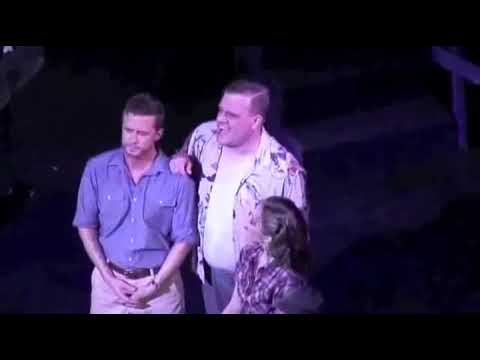
Musical was created by writer O. Hammerstein II & composer R. Rodgers. Broadway premiere took place in late November 1955 in the Shubert Theatre. The show has ended in June 1956 after 246 performances. Staging was by director H. Clurman and choreographer B. Runanin. The performance had such cast: W. Johnson, J. Tyler, H. Traubel, G. D. Wallace, K. Harvey, J. Heller, M. Kellin, R. Smith, N. Andrews & R. Kobart. In 1981, the musical has been featured in the LA’s Conejo Players Theatre. In July 1995, production took place in 42nd Street Moon – in San Francisco’s New Conservatory Theatre. The director of the play was F. Coppola. The cast was: P. Christenson, B. Wilmurt, J. Friedman, J. Mark, T. Michaels, S. Plaskett & S. Sharp. From May to June 2002, 42nd Street Moon hosted a re-run of the theatrical. Production also took place in the Eureka Theatre. The main roles in the play were performed by M. Mackay, M. Henderson & J. Davis.
From March to April 2012, the musical was in Encores! in NY. Production was performed by director M. Bruni and choreographer K. Barclay. The show involved cast: W. Chase, L. Osnes, L. Uggams, T. Wopat, J. Clow, J. Moye, S. Routman & S. Wallem. In September 2012, an album was released with the recording of this concert. From July to August 2013, the histrionics was in London's Union Theatre, directed by S. Regan & choreographed by L. Gee. The performance had cast: K. Brown, C. Scott, D. Haydn, N. Martland, J. Hicks, S. Landers & V. Gilchrist. The musical has received 9 nominations for Tony and won it in one category.
Release date of the musical: 1955
"Pipe Dream" – The Musical Guide & Song Meanings
Review
What do you do when you are Rodgers & Hammerstein, and your next story is about drifters, a not-quite-brothel, and a romance that refuses to behave? You write some of your warmest, bluntest lyrics, then watch your book keep slipping out the side door. “Pipe Dream” wants to humanize a neighborhood full of “losers” without turning them into punchlines. It mostly succeeds musically. Dramatically, it sometimes feels like the town itself is the protagonist, and the love story has to fight for its own screen time.
Hammerstein’s lyric voice here leans less courtly than in “The King and I” and less pastoral than “Oklahoma!” He goes conversational. He builds character with plain words, short turns, and a lot of self-exposure. The show’s best songs are not “I want” anthems. They are “I am embarrassed to admit this” confessions. That’s why the score still plays well on recordings: the emotional data is in the syllables, even when the plot is busy taking a scenic route along Cannery Row.
Musically, Rodgers toggles between lush, long-lined melody and quick pop-smart numbers, as if he is testing how far a Steinbeck world can be coaxed into Broadway form. The result is a fascinating mismatch: big-hearted musical-theatre architecture trying to live inside an atmosphere piece. When it clicks, it is tender and strangely modern. When it doesn’t, you can hear the show politely clearing its throat and changing the subject.
Information current as of January 31, 2026.
How it was made
The adaptation’s DNA is unusually tangled for a Rodgers & Hammerstein title. The musical grows out of John Steinbeck’s Cannery Row universe, but the key turning point is that Steinbeck wrote “Sweet Thursday” with a clear love plot, the thing a musical absolutely needs. That shift let Hammerstein shape a workable libretto, even if the finished show keeps some of Steinbeck’s digressive, hangout energy.
There is also a “friendship hazard” baked into the origin story. Rodgers, Hammerstein, and the Steinbecks were socially close, which sounds cozy until rehearsal rooms start producing criticism, rewrites, and bruised egos. “Pipe Dream” carries that tension: you can feel the creative team trying to be faithful to a writerly, paradoxical world while also trying to land scenes with Broadway finality.
One unusually revealing footnote: Rodgers & Hammerstein’s own historical material notes that the “Sweet Thursday” adaptation process overlapped with their first encounter with a young Julie Andrews during auditions. She did not join the show, but it’s a reminder that “Pipe Dream” sits right on the hinge between their imperial 1940s and their transitional 1950s.
Key tracks & scenes
"All Kinds of People" (Doc)
- The Scene:
- Doc’s marine biology lab. Glass tanks, specimen jars, that watery light that makes every human decision look faintly ridiculous. He’s trying to explain his worldview to Hazel and, really, to himself.
- Lyrical Meaning:
- This is the show’s moral thesis, sung with the relaxed authority of someone who believes empathy is a science. Hammerstein’s language is deceptively plain: each example is a tiny act of mercy. The lyric argues that the neighborhood’s mess is not a bug. It’s the ecosystem.
"Ev'rybody's Got a Home but Me" (Suzy)
- The Scene:
- Doc tends Suzy’s injured hand after she breaks a window trying to steal food. The room is quiet enough to hear embarrassment. Suzy cracks tough jokes until the loneliness leaks out.
- Lyrical Meaning:
- Hammerstein writes Suzy’s homelessness as identity, not plot device. The lyric keeps landing on the word “home” like a bruise you can’t stop touching. It’s the show’s most efficient character sketch: guarded, self-mocking, and terrified of being wanted.
"The Man I Used to Be" (Doc)
- The Scene:
- After Suzy hits him where it hurts, Doc is alone. The stage dims. The lab becomes less workplace than confessional booth. He looks at his research like it might answer personal questions. It doesn’t.
- Lyrical Meaning:
- Doc’s problem is not romance, it’s inertia. The lyric is a self-audit: what happened to ambition, nerve, appetite? Hammerstein frames masculinity as something that can quietly erode, not explode. Rodgers matches that with a melody that keeps reaching, then settling back down.
"Sweet Thursday" (Fauna)
- The Scene:
- Fauna spots an opening in her matchmaking plan. The Bear Flag Café glows with late-night warmth. The town’s schemers are suddenly sentimental, which is how you know they’re dangerous.
- Lyrical Meaning:
- Fauna sings the show’s philosophy from the other side: community as gentle manipulation. The lyric is practical optimism. She’s selling hope as a public utility, with a wink. It’s a character number that doubles as social infrastructure.
"All at Once You Love Her" (Doc & Suzy)
- The Scene:
- Dinner with Doc. Two people who don’t trust language trying it anyway. The lighting softens, the room feels temporarily safer, and sincerity becomes the most surprising special effect onstage.
- Lyrical Meaning:
- This lyric is almost aggressively simple: cigarettes, eyes, good nights. That’s the point. Hammerstein strips away cleverness until only recognition remains. The repetition is the technique. Love arrives as a glitch in the routine, then rewrites the routine.
"How Long?" (Ensemble)
- The Scene:
- The whole neighborhood decides Doc is taking too long to act. The flop house crowd, Fauna’s women, everybody piling in. Bright stage, quick tempo, a communal shove disguised as support.
- Lyrical Meaning:
- It’s a pressure-cooker chorus: desire framed as impatience. The lyric turns romantic fear into something the community can mock, coach, and chant away. In other words, “Pipe Dream” admits it’s a town where everyone has an opinion about your life and they will sing it at you.
"The Next Time It Happens" (Doc & Suzy)
- The Scene:
- On the beach, Suzy has retreated into an empty boiler pipe like a defensive animal. Doc arrives. They circle each other with pride, each pretending they are fine. The ocean is there, doing its indifferent percussion.
- Lyrical Meaning:
- A breakup duet that refuses to say “breakup.” The lyric is denial as choreography: polite phrases, careful exits, promises aimed at an imaginary future self. Rodgers gives them a melody that suggests they are lying, even when the words insist they are learning.
"Will You Marry Me?" (Suzy)
- The Scene:
- Fauna stages a pageant during Mac’s raffle, aiming Suzy like an arrow at Doc. Suzy is dressed up, performing a script that isn’t hers. The plan collapses in public, which is exactly how shame likes to travel.
- Lyrical Meaning:
- Here the lyric matters because it exposes the show’s central risk: turning intimacy into spectacle. Suzy cannot survive it. The moment clarifies what kind of heroine she is: sincerity works, performance destroys.
Listener tip: if you are sampling the score before seeing a production, start with “Ev'rybody's Got a Home but Me,” “The Man I Used to Be,” and “The Next Time It Happens.” Those three tracks explain the emotional plot even when the book is busy.
Live updates
“Pipe Dream” is not a touring staple, and there is no ongoing Broadway or West End run to track. What it has instead is periodic, high-quality rediscovery: concert treatments, regional revivals, and the slow accumulation of defenders who argue the score is better than the show’s reputation.
The most widely circulated modern performance document remains the 2012 New York City Center Encores! concert adaptation, recorded live and released later that year. The official Rodgers & Hammerstein production notes credit David Ives for the concert adaptation and identify the featured cast, with the release dated September 18, 2012.
In summer 2024, Berkshire Theatre Group mounted the piece at its Unicorn Theatre in Stockbridge, Massachusetts, with publicly listed ticket prices and a full creative team announcement. That kind of regional investment is the most reliable “status” marker for this title: not a commercial machine, but a work directors return to when they want to test how far kindness can stretch in a messy town.
If you are considering producing it, the current licensing pathway runs through Concord’s theatrical channels. In practical terms: you are more likely to encounter “Pipe Dream” as a deliberate repertory choice than as a market trend.
Notes & trivia
- The show is based on the Cannery Row world, with “Sweet Thursday” providing the love-plot engine that makes a musical viable.
- Rodgers & Hammerstein’s own archival “facts” material notes the team first met Julie Andrews during the audition process for “Pipe Dream.” She did not join the cast.
- The Broadway debut opened November 30, 1955 at the Shubert Theatre and ran roughly 245–246 performances, depending on the source you consult.
- It earned nine Tony nominations and won for Best Costume Design (Alvin Colt).
- It reportedly set a then-record advance sale figure of $1.2 million.
- The 2012 City Center concert adaptation was recorded live and released as a cast album in September 2012.
- Outside the theatre, “All at Once You Love Her” had an early pop afterlife: Perry Como recorded the song in 1955.
Reception
The original production arrived with huge expectations and got greeted with a shrug that was, by mid-century Broadway standards, practically a felony. The central critique was that the material resisted the clean moral machinery of a Rodgers & Hammerstein musical: too many digressions, too much atmosphere, too little propulsion. Later reassessments tend to separate the book from the score, defending the songs as unusually tender, even when the evening itself feels structurally loose.
“I did not regard it as a bore, but I did regard it as a disappointment.”
“While the work is often puzzlingly experimental… director Marc Bruni has given the piece a colorful, detail-filled staging.”
“Rarely have great artists produced a work that so consistently eludes engagement.”
Quick facts
- Title: Pipe Dream
- Broadway year: 1955 (opened November 30)
- Type: Book musical (mid-century musical theatre), adapted from literary fiction
- Music: Richard Rodgers
- Book & lyrics: Oscar Hammerstein II
- Source material: John Steinbeck’s Cannery Row world, especially Sweet Thursday
- Selected notable song placements in-story: “All Kinds of People” (lab philosophy), “Ev'rybody's Got a Home but Me” (Suzy’s confession), “The Next Time It Happens” (beach confrontation)
- Original Broadway venue: Shubert Theatre
- Original cast album context: Masterworks notes a first LP release date of June 1, 1965 for the original cast recording listing
- Modern recording: 2012 New York City Center Encores! live cast album released September 18, 2012 (Ghostlight Records licensing noted on digital platforms)
- Availability: Both major recordings are broadly available on streaming services and digital stores (varies by region)
Frequently asked questions
- Is “Pipe Dream” based on a book?
- Yes. It adapts the Cannery Row world, with “Sweet Thursday” providing the central romance, and the show also draws on “Cannery Row” characters and setting.
- Who wrote the lyrics?
- Oscar Hammerstein II wrote the book and lyrics, with music by Richard Rodgers.
- Why is the show rarely produced compared to other Rodgers & Hammerstein titles?
- Even sympathetic critics note structural looseness: the setting and community color can overpower the central plot. The score, however, is frequently praised and often heard as stronger than the book.
- Is there a movie version?
- No major feature film adaptation exists for the stage musical. The most accessible modern performance document is the 2012 City Center Encores! concert production and its live cast recording.
- Which recording should I start with?
- If you want the fullest musical picture, the 2012 live cast album includes additional music not on the original cast recording, alongside restored orchestration details.
Key contributors
| Name | Role | Contribution |
|---|---|---|
| Richard Rodgers | Composer | Score balancing lush ballad writing with pop-leaning mid-1950s numbers. |
| Oscar Hammerstein II | Book & lyricist | Adapted “Sweet Thursday” into a stage libretto; wrote character-forward, plainspoken lyrics. |
| John Steinbeck | Source author | Created the Cannery Row world and wrote “Sweet Thursday,” the romance-forward source. |
| Robert Russell Bennett | Orchestrator | Original orchestration language, later preserved in revival recording notes. |
| Harold Clurman | Director (1955) | Staged the original Broadway production at the Shubert Theatre. |
| Jo Mielziner | Scenic designer (1955) | Nominated for Tony Award; helped define the Cannery Row stage environment. |
| Alvin Colt | Costume designer (1955) | Won Tony Award for Costume Design. |
| David Ives | Concert adaptation (2012) | Adapted the work for City Center Encores!, credited in official production notes. |
| Rob Berman | Music director (2012) | Led the Encores! orchestra; credited in official revival recording notes. |
| Ghostlight Records | Label (2012 live cast) | Released the 2012 City Center live cast recording on major digital platforms. |
Sources: Rodgers & Hammerstein (official site), Masterworks Broadway, Playbill, TheaterMania, OUPblog, Berkshire Theatre Group (press PDF), WAMC, Variety, Apple Music (album listing), SecondHandSongs.