
High School Lyrics: Song List
About the "High School" Stage Show
Release date of the musical: 2006
"High School Musical" (2006) – The Musical Guide & Song Meanings
Review: why these lyrics still move
What happens when a teen romance is written like a marketing memo, then sung like a secret? “High School Musical” answers with lyrics that keep pulling the camera back to the same fight: who gets to be multiple things at once. The words are plain. That is the point. They are meant to be yelled in a hallway, not decoded in a seminar. Yet the soundtrack keeps returning to the same vocabulary of permission: try, choose, join, belong, breathe.
The writing treats cliques like genres. Jocks get percussive couplets. Theater kids get internal rhyme and theatrical stress. The brains get crisp, measured phrasing that snaps under pressure. Even the love songs are built as debates: two people trading lines until the chorus becomes a shared thesis. The music leans pop with borrowed theater timing, so the lyrics can switch from diary voice to crowd voice without sounding like homework. It is also why the album plays cleanly outside the film. Each track is engineered to work as a radio-ready scene summary.
How it was made
The soundtrack is a relay. Different writing teams handle different emotional jobs, which is why the lyric texture changes song to song without losing the film’s central argument. The best trick is structural: the characters do not “announce” growth. The songs force them into it. A duet becomes a dare. A pep rally becomes a referendum. A cafeteria number becomes a group confession with a built-in backlash.
Director Kenny Ortega has described approaching casting and rehearsal with a theater mindset, pushing long, chemistry-driven audition sessions that functioned like a compressed workshop. That energy shows up in the lyrics. They behave like dialogue that learned to dance. Behind the vocals, the album also carries a famously complicated detail: Drew Seeley’s voice is used for much of Troy’s lead singing on the first film’s soundtrack era, a production decision that has become part of the project’s mythology.
Key tracks & scenes
"Start of Something New" (Troy, Gabriella)
- The Scene:
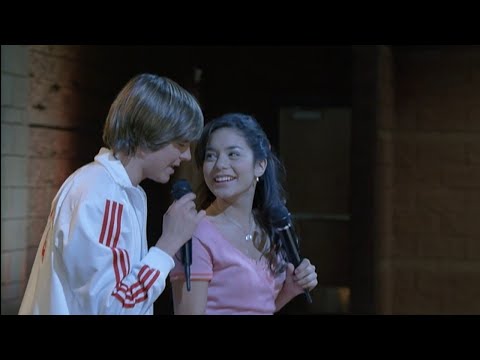
- New Year’s Eve at a ski lodge party. Stage lights and karaoke bulbs do the flirting first. They are pushed into the spotlight, then find a shared rhythm they did not know they had.
- Lyrical Meaning:
- The lyric is built from caution turning into consent. It avoids grand romance language. It focuses on the shock of possibility. The song is the inciting incident, but it is also the thesis: you can step into a new version of yourself in public.
"Get’cha Head in the Game" (Troy)
- The Scene:
- The gym becomes an echo chamber. Bright overhead lighting. Sneakers and bouncing balls act like percussion. Troy splits into two tempos: the athlete and the singer arguing inside the same body.
- Lyrical Meaning:
- It is a distraction song that admits it is a distraction song. The hook is self-command, almost military. The subtext is panic: he is trying to think his way out of feeling.
"Stick to the Status Quo" (Ensemble)
- The Scene:
- Cafeteria daylight. Tables become territories. Confessions land like trays dropping. Each revelation is answered by a louder demand for order.
- Lyrical Meaning:
- This is the show’s sharpest lyric idea: the chorus argues against the verses. Individuals admit hidden loves. The crowd replies with rules. The song dramatizes how a community polices identity, then makes that policing sound catchy enough to spread.
"What I’ve Been Looking For" (Sharpay, Ryan)
- The Scene:
- Drama room glow. Rehearsal piano. A performance that is also a trap, delivered with smiles that never stop measuring the room.
- Lyrical Meaning:
- The lyric is parody-adjacent. It uses romance clichés as strategy. The point is not the love story. The point is ownership of the stage and who gets to define “talent.”
"When There Was Me and You" (Gabriella)
- The Scene:
- Quiet interior spaces. Softer lighting. The camera lingers. This is the moment the film lets a teen ballad behave like an adult one.
- Lyrical Meaning:
- The lyric frames loneliness as a math problem: before and after, plus and minus. It is less about Troy than about control. She wants her inner life back.
"Bop to the Top" (Sharpay, Ryan)
- The Scene:
- Rehearsal fantasy turned production number. Hard, theatrical light. Jazz hands with an edge. The siblings move like a single machine built for applause.
- Lyrical Meaning:
- This is ambition written as a chant. The lyric is all verbs. It makes fame sound like cardio, which is exactly the point: winning is work, and they enjoy it.
"Breaking Free" (Troy, Gabriella)
- The Scene:
- The callback audition. The room is a pressure cooker with stage lights that feel like judgment. Time compresses. They arrive late, then sing like the doors were always open.
- Lyrical Meaning:
- The lyric is liberation by repetition. It keeps insisting until it becomes true. The strongest detail is how it shifts from private choice to public declaration. The song is a relationship duet, but it plays as a mutual career decision.
"We’re All in This Together" (Company)
- The Scene:
- Finale in the gym. Bright celebration lighting. The choreography turns the whole building into a single chorus line. It feels like a pep rally that learned empathy.
- Lyrical Meaning:
- The lyric is a brand promise delivered with sincerity. It simplifies the social conflict into one communal statement, then sells it as joy. The reason it lasts is that it gives audiences a sentence they can borrow.
Live updates (2025/2026)
As of January 27, 2026, the franchise is being treated as a 20-year legacy property, with fresh press around Kenny Ortega’s original production constraints and the way the film became a repeatable Disney music engine. Anniversary coverage has leaned into behind-the-scenes craft: casting methods, character adjustments, and the finale as the moment the team felt the project “clicked.”
On the stage side, the title remains a durable licensing staple for schools and community theaters through the official theatrical licensing pipeline, because the songs are modular and the story is simple to mount. That matters for the lyrics. They are designed to be sung by groups of teenagers in real rooms, not just by characters on camera.
For listeners, the 2026 angle is not a new cast album. It is renewed circulation. Streaming promos, anniversary event coverage, and constant social clips keep the soundtrack behaving like a living catalog item rather than a frozen 2006 artifact.
Notes & trivia
- The soundtrack was recorded quickly, a production detail often cited as part of its pop efficiency.
- Multiple songwriting teams split the album, with different writers credited across the track list.
- “Stick to the Status Quo” is credited to David Lawrence and Faye Greenberg, and its structure lets the chorus argue against the solos.
- Contemporary reporting noted the soundtrack’s leap to No. 1 on the Billboard 200 soon after the film’s breakout.
- The soundtrack is widely cited as the best-selling album of 2006 in the U.S., an unusual feat for a TV movie project.
- Drew Seeley’s vocals are part of the first film’s Troy singing footprint, a detail later discussed openly in retrospective interviews.
- Ortega has said he adjusted character dynamics during development, including sharpening the Sharpay–Ryan sibling concept based on chemistry.
Reception, then vs. now
In 2006, the story was scale. A Disney Channel movie soundtrack behaving like a mainstream pop release. In 2026, the story is mechanics: how the lyrics and hooks were engineered to travel. Criticism has also matured. Early coverage often treated the writing as bubblegum novelty. Later takes read the album as a clean, teachable model of how to write “identity conflict” for young performers without making it feel like a lecture.
The soundtrack “hits the charts this week as No. 1 on The Billboard 200.”
“We made every dollar stretch and every minute mean something.”
“There hadn’t really been a live-action musical that resonated with the public since ‘Grease.’”
Quick facts
- Title: High School Musical (Original Soundtrack)
- Year: 2006
- Type: Soundtrack album (Disney Channel Original Movie)
- Primary songwriters (selected): Matthew Gerrard; Robbie Nevil; David Lawrence; Faye Greenberg; Jamie Houston; Adam Watts; Andy Dodd; Ray Cham; Greg Cham; Randy Petersen; Kevin Quinn
- Label: Walt Disney Records
- Recording window (reported): Summer 2005; fast-turn production schedule
- Signature placements: Ski-lodge karaoke opener; cafeteria ensemble confrontation; audition duet; gym finale
- Chart context: Major Billboard 200 peak; widely reported as the top-selling album of 2006 in the U.S.
- Stage life: Officially licensed stage versions continue to circulate widely in school/community theater ecosystems
Frequently asked questions
- Is this a Broadway musical?
- No. It began as a 2006 Disney Channel Original Movie, then expanded into licensed stage versions and concert/tour formats.
- Who wrote the lyrics?
- There is no single lyricist. The album credits multiple songwriting teams across the track list, including Matthew Gerrard and Robbie Nevil, David Lawrence and Faye Greenberg, and others.
- Why do the songs feel so different from each other?
- Because they solve different story problems. Some songs are internal conflict, some are social conflict, and some are pure celebration. Different writers and styles help those moods land fast.
- Did Zac Efron sing everything on the first soundtrack?
- Not entirely. Retrospective credits and reporting discuss Drew Seeley’s vocal involvement for Troy’s singing in the first film era, with Efron handling more of his own singing later in the franchise.
- What is the main lyrical theme?
- Permission to be more than one thing. The lyrics keep returning to choice, identity, and belonging, then reward characters when they act in public on what they feel in private.
- Is the soundtrack still popular today?
- Yes, especially around major anniversaries and on social platforms where the choruses function like shared language.
Key contributors
| Name | Role | Contribution |
|---|---|---|
| Kenny Ortega | Director / Producer (album producer credits listed on major discographies) | Staging concept, performance direction, pop-theater hybrid tone |
| Matthew Gerrard | Songwriter | Co-wrote key franchise hooks (including major ensemble material) |
| Robbie Nevil | Songwriter | Co-wrote several principal pop numbers |
| David Lawrence | Composer / Songwriter | Co-wrote “Stick to the Status Quo” |
| Faye Greenberg | Lyricist / Songwriter | Co-wrote “Stick to the Status Quo” |
| Jamie Houston | Songwriter | Wrote “Breaking Free” and “When There Was Me and You” |
| Drew Seeley | Performer / Songwriter | Vocal presence on early Troy tracks; credited on key songs |
Sources: Wikipedia (soundtrack track listing and credits), Playbill, Business Insider, Axios, People, Music Theatre International (show synopsis/licensing info), IMDb (soundtrack credits), Cornell Sun (David Lawrence interview), MOTU (David Lawrence interview), YouTube (official trailer upload).