Take Me Along Lyrics – All Songs from the Musical
Take Me Along Lyrics: Song List
- Act 1
- Overture - The Orchestra
- The Parade
- Oh, Please
-
I Would Die
- Sid, Ol' Kid
- Staying Young
-
I Get Embarrassed
- We're Home
- Take Me Along
- For Sweet Charity
- Volunteer Firemen Picnic
- Pleasant Beach House
- That's How It Starts
- Act 2
- The Beardsley Ballet
- Oh, Please (Reprise)
-
Promise Me a Rose
- Staying Young (Reprise)
- Little Green Snake
- Nine O'Clock
- But Yours
- Finale
About the "Take Me Along" Stage Show
Librettists were R. Russell & J. Stein. The songs composed by B. Merrill. The first show was held in September 1959 in New Haven’s Shubert Theatre. In late September, the play moved to Boston’s Shubert Theatre. In early October, production was exhibited in Philadelphia’s Shubert Theatre. Broadway’s premiere took place in October 1959 in the Sam S. Shubert Theatre. It finished in December 1960 after 448 regular appearances. Production carried out director P. Glenville & choreographer O. Whit. The musical involved W. Pidgeon, Z. North, J. Gleason, L. Halpin, U. Merkel, E. Herlie, R. Morse & S. Luckey in the cast. In June 1961, the show was hosted by Springfield Storrowton Music Fair. Then, the theatrical was held in Valley Forge Music Fair & in Painters Mill Music Fair. This performance ended at the Westbury Music Fair in July 1961. This production was directed by B. Penn and choreographed by P. Conlow. The actors list was: B. McKay, P. Bauersmith, J. Roberts & P. Hartman.In 1984, renewed Pre-Broadway regional production began, which lasted 7 months. In April 1985, in Martin Beck Theatre was the second Broadway production. Unfortunately, it was only 8 preliminaries and 1 regular performance. Production was carried out by director T. Gruenewald and choreographer D. Siretta. The show had cast: K. Knudson, B. Fowler, R. Nichols, B. Johnson, G. L. Wright, T. Grimes & A. Kirk. In October 2006, the Theatre at St. Peter's Church hosted an off-Broadway version. Staging has been developed by filmmaker M. Montel. The cast involved: D. Schramm, S. Bigelow, N. Wyman, K. Cavett, M. Crowle, R. Driscoll, J. A. Jones, J. Levy & L. Lisitza. In 1960, the show has gained one victory in 10 categories at the Tony Award.
Release date: 1959
"Take Me Along" – The Musical Guide & Song Meanings
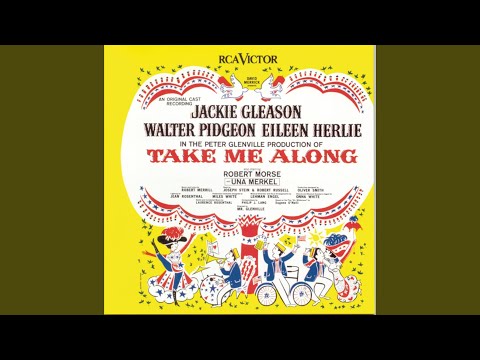
Review: what the lyrics are really doing
How do you turn a cozy holiday comedy by Eugene O’Neill into a Broadway musical without turning it into a souvenir spoon? “Take Me Along” answers with a practical strategy: make the songs act like private diaries, then let the book handle the porch swings and ice-cream sodas. Bob Merrill’s lyrics keep dragging the characters out of politeness and into confession. The best numbers do not “decorate” the scenes. They call somebody’s bluff.
Merrill writes in a pop-forward Broadway language that likes clean rhymes, punchy internal turns, and titles that arrive fast. That matters because “Take Me Along” is full of people performing versions of themselves: the father who insists he is fine with age, the teenage boy who thinks literature makes him experienced, and the town’s lovable problem uncle who treats charm as a renewable resource. The score is often labeled sunny, and it is, but it is also a little sharp. “Staying Young” is not a pep talk. It is an argument with time. “Promise Me a Rose” is not a valentine. It is a contract drafted by someone who has waited long enough to hate hope.
If you only know the title song as a jingle, the show’s writing can surprise you. The lyric engine here is not sarcasm or spectacle. It is self-justification. People sing to convince themselves they are still the hero of their own small-town story. The moments land because Merrill keeps the metaphors domestic: youth as a habit, romance as proof, belonging as a door you can finally close at night.
How it was made: O’Neill goes musical
The producer was David Merrick, and the underlying dare was simple: musicalize “Ah, Wilderness!” and keep its warmth while replacing long stretches of talk with song. The development history is messy in the very Merrick way, including an earlier attempt that stalled after the death of writer John La Touche. When the project re-formed, Joseph Stein and Robert Russell wrote the book, and Merrill supplied music and lyrics. The result was built as a star vehicle, and it did not pretend otherwise: Jackie Gleason’s Sid is engineered to arrive with a bang, shake the town, and steal oxygen until the plot forces him to sober up or shut up.
The most useful way to understand Merrill’s lyric approach is to compare productions. The 1959 Broadway staging leaned into personality and size: big laughs, a “parade” opener, and a comic leading man the audience already thought they knew. The 2008 Irish Repertory Theatre revival went in the opposite direction, with a tighter physical footprint and more attention on the show’s sentiment and structure. Both approaches change the meaning of the same lines. In a large house with a star, Sid’s jokes can feel like camouflage. In a smaller room, the same jokes read like somebody working very hard to avoid a mirror.
One more bit of accidental afterlife: the title song escaped the theatre. In 1967, the melody was adapted for a major United Airlines campaign, with promotional films directed by a young Michael Cimino. That reuse is flattering, and it is also slightly ironic. The show’s core is about home. The most famous reuse sold leaving.
Key tracks & scenes: 8 lyrical pressure points
"The Parade" (Nat and Townspeople)
- The Scene:
- Early morning on the Fourth of July. The town organizes itself in public, the way small places do: flags, smiles, and an assumption that everybody belongs in the picture.
- Lyrical Meaning:
- As an opener, it is community as choreography. The lyric function is to establish the “rules of normal” so the later songs can break them. You cannot feel rebellion until you can hear what it rebels against.
"I Would Die" (Muriel and Richard)
- The Scene:
- Same morning, in the Macomber home. Two teenagers, overdressed in feelings, try to treat first love like an epic poem. The air is still, the stakes are not, and everything feels permanent because they have not been proven wrong yet.
- Lyrical Meaning:
- This is young romantic language pushed to a comic edge. Merrill lets the couple borrow tragic vocabulary to describe a situation that is, in reality, tender and temporary. The point is not to mock them. It is to show how sincerely adolescents inflate emotion into identity.
"Sid, Ol' Kid" (Sid and Townspeople)
- The Scene:
- Later that morning at the car barn. Sid’s entrance is staged as a public event. The town watches him the way it watches weather, partly thrilled and partly bracing for damage.
- Lyrical Meaning:
- A self-introduction disguised as a celebration. The lyric sells a persona: lovable rogue, charming disaster, everybody’s “uncle” even when he is nobody’s responsibility. The number is a mission statement for a character who survives by being welcomed back.
"Staying Young" (Nat)
- The Scene:
- A little later at the Miller home. Nat steps away from the bustle and talks himself through a quiet panic: age is arriving, and he can feel it in the room even when nobody says it aloud.
- Lyrical Meaning:
- One of Merrill’s smartest tricks is making optimism sound like a policy you must renew. The lyric keeps insisting on youth as a choice, which hints at the fear underneath: if youth is a choice, then “old” can feel like a failure.
"I Get Embarrassed" (Sid and Lily)
- The Scene:
- Still at the Miller home. Sid flirts, Lily parries. The mood is comic, but the temperature spikes whenever Lily reminds him that charm is not the same thing as trust.
- Lyrical Meaning:
- Embarrassment here is not shyness. It is self-awareness breaking through a practiced routine. The lyric frames romance as a surprise, because for Sid, sincerity is the risky behavior.
"Take Me Along" (Sid and Nat)
- The Scene:
- On the street, later in Act I. Two men sing about motion: being included, being chosen, being pulled into somebody else’s plan. The energy is breezy; the subtext is need.
- Lyrical Meaning:
- The title lyric is a bid for belonging, not travel. The charm is that it sounds casual. The bite is that it is not. In context, the phrase is a pressure tactic: do not leave me behind with my consequences.
"Promise Me a Rose" (Lily and Sid)
- The Scene:
- Later that night at the Miller home. The party noise has thinned. Lily asks for proof, and the room feels smaller because the question is specific.
- Lyrical Meaning:
- One of the show’s best “adult” lyrics. Lily is not asking for flowers. She is asking for follow-through, for a daily act that proves a man can change. The metaphor is simple because she is done negotiating in riddles.
"But Yours" (Sid and Lily)
- The Scene:
- The following evening, back at the Miller home. The flirtation returns, but it is more measured. Sid tries a new tactic: drop the act, keep the affection.
- Lyrical Meaning:
- This is the lyric of a man bargaining for an ordinary life. The phrase “but yours” is small, even grammatical, and that is the point. Sid finally frames commitment as belonging to someone else’s reality, not just inviting them into his.
Live updates: 2025-2026 reality check
“Take Me Along” is not a touring brand in 2025-2026. Its footprint is quieter: licensing, revivals in the right-sized rooms, and a cast recording that keeps circulating under modern labels. If you are looking for the show now, your best “live” path is usually regional, community, or academic production, and the rights are actively handled by Concord Theatricals. The most visible modern New York staging remains the Irish Repertory Theatre revival, which reframed the material in an intimate style that made the lyric writing read more honestly.
Listening tip for first-timers: start with “Staying Young,” then jump to “Promise Me a Rose,” then return to the Act I material. That sequence gives you the show’s two engines (fear of time, fear of trust) before you meet the crowd scenes and comic bustle. You will track the plot faster because you will already know what the adults are protecting.
Information current as of February 2026.
Notes & trivia
- It opened on Broadway on October 22, 1959, and ran 448 performances.
- The show was nominated for the 1960 Tony Award for Best Musical, and Jackie Gleason won for Leading Actor in a Musical.
- Several sources date the story to July 4, 1906; some printed programs for stock productions list 1910. The Fourth-of-July frame is the constant.
- In 1967, United Airlines adapted the title song for a major advertising campaign, with promotional films directed by Michael Cimino.
- A popular myth claims the airline promotion “exposed” cheating spouses via free companion fares; contemporary write-ups note companions were discounted, not free.
- Bob Merrill reportedly could not read or write musical notation and was known for working out melodies in unusually informal ways.
- The 1985 Broadway revival transferred after successful regional runs and then closed almost immediately in New York, a reminder that affection and market timing are different skills.
Reception: then, later, and the awkward middle
On its face, “Take Me Along” looks like mid-century comfort food: a small-town holiday, a teenager in love, a boozy uncle, and a family that survives its own emotions. Critics have often responded to the craft more than the premise. The lyric writing is where the show earns its longevity, because Merrill does not let the characters stay cute for long.
“To slice through this cocoon of cliche to the lyrical freshness that lies beneath is a difficult operation, but in ‘Take Me Along’ it is performed…”
“Charlotte Moore’s stripped-down staging… reveals layers of heartfelt sentiment not normally evident…”
“…last week’s ingratiating revival of a 1959 hit, Take Me Along, folded the day after it opened.”
Put those together and you get the show’s reputation in miniature. When it is staged big, it can lean on star power and jokes. When it is staged lean, the lyric sentiment shows through. When it is revived without a clear reason, it can look like nostalgia with a clock ticking.
Quick facts: album and production data
- Title: Take Me Along
- Year: 1959
- Type: Musical comedy (adapted from “Ah, Wilderness!”)
- Book: Joseph Stein and Robert Russell
- Music & Lyrics: Bob Merrill
- Original Broadway theatre: Shubert Theatre
- Original producer: David Merrick
- Director (original Broadway): Peter Glenville
- Choreography (original Broadway): Onna White
- Musical direction / vocal arrangements: Lehman Engel
- Original cast recording label: RCA Victor (later reissues via Masterworks Broadway and others)
- Selected notable placements: “Take Me Along” adapted for United Airlines advertising campaign (1967)
Frequently asked questions
- Is “Take Me Along” based on a play?
- Yes. It is based on Eugene O’Neill’s “Ah, Wilderness!” and keeps the Fourth-of-July coming-of-age frame while shifting key emotional beats into songs.
- Who wrote the lyrics?
- Bob Merrill wrote both music and lyrics. His writing style here favors direct language that lets characters confess without sounding like they are giving speeches.
- Why do people single out “Staying Young”?
- Because it turns a pleasant idea into a personal stake. Nat is not merely cheering up; he is trying to out-argue the evidence of time.
- Is the United Airlines “Take Me Along” jingle the same song?
- It is an adaptation of the title song. The melody and hook traveled well, even if the show’s meaning is more about belonging than travel.
- Is there a movie version of the musical?
- No major feature film adaptation exists in the way some other Golden Age titles have been filmed. The easiest access point remains the cast recording.
- Where can I legally get the music?
- The original Broadway cast recording has been reissued and is widely available via major streaming platforms and digital stores, with official uploads appearing under Masterworks Broadway branding.
Key contributors
| Name | Role | Contribution |
|---|---|---|
| Bob Merrill | Composer-lyricist | Wrote the score’s music and lyrics, including “Staying Young” and “Promise Me a Rose.” |
| Joseph Stein | Book | Co-wrote the libretto shaping the O’Neill adaptation for musical structure. |
| Robert Russell | Book | Co-wrote the libretto, balancing comedy beats with family drama. |
| David Merrick | Producer | Developed and produced the original Broadway staging as a star-led commercial property. |
| Peter Glenville | Director | Staged the original production; praised for clarity that let the lyric sentiment land. |
| Onna White | Choreographer | Created dance and staging for major musical sequences. |
| Lehman Engel | Musical director | Led musical direction and vocal arrangements for the Broadway production and recording. |
| Jackie Gleason | Original cast | Created Sid Davis on Broadway and anchored the show’s star-comedy identity. |
| Walter Pidgeon | Original cast | Played Nat Miller and carried “Staying Young” as the show’s moral center. |
| Eileen Herlie | Original cast | Played Lily Miller and delivered key romantic material including “Promise Me a Rose.” |
| Robert Morse | Original cast | Played Richard Miller and gave the teen perspective its nervous literary sparkle. |
Sources: IBDB; Tony Awards; Concord Theatricals; Masterworks Broadway; The New Yorker; Variety; TIME; Irish Repertory Theatre archive; Discogs; castalbums.org; archived production programs (EIU Booth Library PDF).