How to Succeed in Business Without Really Trying Lyrics – All Songs from the Musical
How to Succeed in Business Without Really Trying Lyrics: Song List
- Act 1
- Overture
- Dear Reader
- How To Succeed
- Happy To Keep His Dinner Warm
- Coffee Break
- You Have Alertly Seized Your Opportunities
- The Company Way
- The Company Way (Reprise)
- The Entrance Of Hedy LeRue
- A Secretary Is Not A Toy
- Been A Long Day
- Been a Long Day (Reprise)
- Saturday Morning Ballet
- Grand Old Ivy
- Paris Original
- Rosemary
- Finaletto Act One
- Act 2
- Entr'acte
-
How To Succeed (Reprise)
- So You Are Now A Vice-President
- Cinderella, Darling
- Happy To Keep His Dinner Warm (Reprise)
- Love From A Heart Of Gold
- I Believe In You
- The Pirate Dance
- How To Handle A Disaster
- I Believe in You (Reprise)
- By This Time, You Are A Seasoned Executive
- Brotherhood Of Man
- Finale
About the "How to Succeed in Business Without Really Trying" Stage Show
The decision to create the musical was made after the increased popularity of the book, written by Shepherd Mead. The first screenwriters were working on the version for five years. In 1950, the adaptation, which made great success, was created. The second version was shown in 1961. It included a new love line and more humor. The author of the music was F. Loesser.In 1995, the performance was created on Broadway. 548 performances were staged, and the leading roles were played by M. Broderick and M. Mullali. The second revival of the musical under the leadership of the director R. Ashford falls on 2011. The leading roles are played by D. Radcliff and J. Larokket. The debut also took place in 2011.
In January, 2012 Radcliff was replaced by D. Chris for three weeks, and from February 24 to May 20 — by Nick Jonas. In May 2012, the show was closed after 473 performances. 50 years after the first display of the musical, the Australian directors thought about the creation of their own show. They were afraid that the Australian audience cannot understand the idea of the American musical. However, the show received huge popularity. Performance in Sydney lasted for two months.
There is also a TV adaptation, which was shown in 1975 on the ABC channel, and the film adaptation created in 1967 by D. Swift. A couple of original songs were left in these versions.
Release date: 1961
"How to Succeed in Business Without Really Trying" – The Musical Guide & Song Meanings
Review: When a musical weaponizes office language
Does any classic Broadway score sound more like it has a clipboard? Frank Loesser’s lyrics in "How to Succeed in Business Without Really Trying" treat corporate etiquette as a dialect: slogans, pep-talk rhythms, and the kind of polite menace that hides behind “teamwork.” The trick is that the show sells ambition as a product, and the songs are the sales pitch. That matters because Finch does not grow through introspection; he advances through technique, and the lyric-writing behaves like technique.
The score’s big achievement is how it turns workplace ritual into musical ritual. “Coffee Break” is basically a consumer frenzy given choreography and syllables. “The Company Way” makes bland loyalty feel like a hymn. “I Believe in You” weaponizes affirmation into a mirror, with Finch coaching himself the way a corporation coaches its employees: upbeat, relentless, and slightly empty. Even the romance songs have a transactional tint, because the office is the ecosystem. Rosemary’s suburban fantasy is a lyricized job title.
Musically, the show leans jazz-tinged musical comedy with brisk patter and choral punch, and that style is the point. Jazz here reads as motion: quick pivots, quick promotions, quick rationalizations. The lyric motifs return like policy memos. Every reprise feels like a “per my last email” you can tap-dance to.
Copyright note: I can’t publish full lyrics here. What follows focuses on where songs land in the story and what their language is accomplishing.
How it was made
The DNA starts as satire, not romance: Shepherd Mead’s best-selling business spoof became the raw material, then Abe Burrows and team shaped it for stage. MTI’s synopsis keeps the mechanics visible: Finch literally begins with the book in hand, and the “Book Voice” frames his rise as instruction, not destiny. That framing is why the lyric-writing stays so sharp; it is always pointing at the method.
Behind the scenes, the production history has its own office politics. The original Broadway crediting around choreography is famously thorny: Hugh Lambert received the choreographer credit while Bob Fosse took a “musical staging” credit after stepping in, an arrangement later discussed in connection with Burrows’ account of the rehearsal-room crisis and Fosse’s reluctance to publicly displace Lambert. It is the show’s theme playing out in real time: the org chart matters as much as the work.
For an “alive” listening tip before you hit a cast album: start with “The Company Way,” then “I Believe in You,” then “Brotherhood of Man.” That trio is the show’s argument, its self-deception, and its group-think victory lap. You will hear how Loesser makes corporate language sing without softening the bite.
Key tracks & scenes
"How to Succeed in Business without Really Trying" (Finch)
- The Scene:
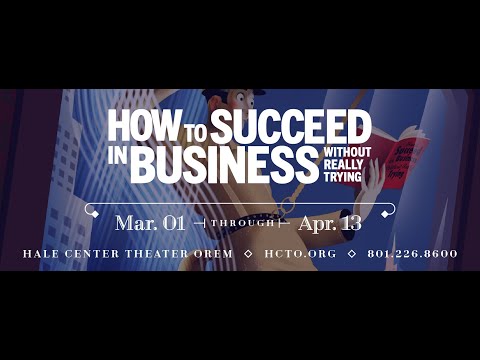
- Finch is on a window-washing scaffold outside the World Wide Wicket Company, book in hand. As the scaffold descends, he sings chapter headings and steps into an “office tableau,” already dressed for the job he does not yet have.
- Lyrical Meaning:
- The lyric treats ambition as a checklist. The humor comes from the confidence of instruction: the words promise certainty in a world built on bluffing.
"Coffee Break" (Ensemble)
- The Scene:
- A coffee break is called and the machine is empty. The office, hooked on caffeine, collapses into frantic movement that reads like a workplace riot with a smile.
- Lyrical Meaning:
- Loesser turns a minor inconvenience into mass hysteria. The lyric is a snapshot of dependency and conformity: one missing commodity, and the whole machine stutters.
"The Company Way" (Twimble, Finch)
- The Scene:
- In the mailroom, Twimble explains how he survived 25 years: low ambition, fear of being fired, total faith in the company’s wisdom. The number plays like a mentorship session delivered as doctrine.
- Lyrical Meaning:
- The song is corporate loyalty as self-preservation. The lyric laughs at obedience while admitting its practical genius, which is why it feels uncomfortably catchy.
"A Secretary Is Not a Toy" (Bratt, Ensemble)
- The Scene:
- Hedy La Rue arrives, men swarm, and Bratt lays down policy on flirting. The office becomes a classroom with rules that everyone intends to break.
- Lyrical Meaning:
- The lyric is management trying to control desire with bullet points. It lands because it is both a warning and an admission that the workplace runs on this exact hypocrisy.
"Grand Old Ivy" (Finch, Biggley)
- The Scene:
- Saturday morning: Finch arrives early, makes a mess to look like an all-nighter, and “absent-mindedly” hums Biggley’s college fight song. Biggley hears kinship and promotes on the spot.
- Lyrical Meaning:
- Alumni identity becomes a secret handshake. The lyric is about code-switching: Finch sings the password, and the door opens.
"Paris Original" (Rosemary, Ensemble)
- The Scene:
- At a reception, Rosemary arrives in a new dress, only to find every woman wearing the same thing. The party’s glamour turns into synchronized disappointment.
- Lyrical Meaning:
- The lyric punctures consumer aspiration. Individuality is mass-produced, and the joke hurts because it is true even when the music is sparkling.
"I Believe in You" (Finch)
- The Scene:
- In the executive washroom, Finch gives himself a pep talk while washing his hands before the big meeting. The private ritual is staged like a confession booth for careerists.
- Lyrical Meaning:
- Self-belief is performed, not felt. The lyric’s insistence reads as insecurity in a good suit, which is why the number stays memorable beyond the joke.
"Brotherhood of Man" (Finch, Ensemble)
- The Scene:
- After the treasure-hunt disaster wrecks the office, the executives wait for Finch’s resignation. Finch flips the room with a moral appeal to family and unity, and the company “spares” itself by firing Bud.
- Lyrical Meaning:
- The lyric sells ethics as strategy. “Brotherhood” becomes a corporate shield: community language deployed to protect the hierarchy.
Live updates 2025–2026
Information current as of January 27, 2026. This title is not sitting on a single commercial Broadway pipeline right now, but it is thriving as a high-visibility revival pick for regional companies, conservatories, and limited-run presenting houses.
In the U.S., San Diego Musical Theatre has the show on sale for February 6 to March 1, 2026, with a published cast list and venue details, making it one of the most concrete near-term professional-ish postings currently visible. Northwestern’s Wirtz Center listings also show a scheduled February 2026 engagement in Evanston.
Internationally, Australia has multiple signals: the Elder Conservatorium production ran in October 2025, and Hayes Theatre Co lists a major run window for August 28 to September 27, 2026, framed as a presenting/producing association engagement. The pattern is clear: the show’s satire keeps getting re-bid for new office cultures, with stagings that can lean “Mad Men” sleek or cartoon-bright, depending on who is holding the stapler.
Notes & trivia
- The original Broadway production opened on October 14, 1961 and ran for 1,417 performances, according to IBDB.
- The show won the 1962 Pulitzer Prize for Drama (Loesser and Burrows are the credited winners).
- MTI’s synopsis makes the structure explicit: Finch’s “Book Voice” is a narrative engine, not just a framing device.
- A well-known backstage story concerns original choreography crediting: Hugh Lambert was credited as choreographer while Bob Fosse received “musical staging,” after Fosse’s larger choreographic contribution in rehearsal.
- There is a 1967 film adaptation, which helped lock several numbers into the broader pop-culture memory of “corporate satire you can hum.”
- The 2011 Broadway revival became a celebrity-lit visibility wave, headlined by Daniel Radcliffe, and it generated a contemporary critical argument about whether the book’s gender politics and sketch-like structure still land cleanly.
- Even in 2025–2026, the title’s calendar is alive across conservatories and regional houses, suggesting its “office ecosystem” remains broadly legible.
Reception, then vs. now
Early reception treated the show as a craft knockout: satire that could still sell tickets, plus Loesser’s rare ability to make cynicism bounce. Later revivals tend to split the vote: the songs keep their snap, while the book’s period assumptions become the friction point audiences either forgive or resent.
“How to Succeed In Business Without Really Trying” ... deserves to go down in history for definitively disproving George S. Kaufman’s theorem that “Satire is what closes on Saturday night.”
You don’t need a self-help book to figure out how to revive ... All you really need is Daniel Radcliffe ...
Accept the lead role in a musical and there's nowhere to hide ... But somehow semi-competence is perfect here
My read: modern productions win when they stage the office as a system rather than a nostalgia postcard. When directors treat “policy” as choreography and “motivation” as a corporate ritual, Loesser’s lyric machine still feels nasty-funny in the best way.
Quick facts
- Title: How to Succeed in Business Without Really Trying
- Year: 1961 (Broadway opening Oct 14, 1961)
- Type: Musical comedy, corporate satire
- Music & Lyrics: Frank Loesser
- Book: Abe Burrows, Jack Weinstock, Willie Gilbert
- Based on: Shepherd Mead’s satirical business book
- Notable song-story placements: “Coffee Break” as a caffeine panic; “I Believe in You” as a washroom pep talk; “Brotherhood of Man” as the reputational escape hatch
- Awards: 1962 Pulitzer Prize for Drama; Tony Award wins are widely recorded for the original production
- Cast album status: 1961 Original Broadway Cast Recording (widely reissued and available digitally); 2011 revival cast album released by Decca Broadway and widely available on streaming platforms
Frequently asked questions
- Can you give me the full lyrics?
- I can’t publish full lyrics. I can help with song-by-song meanings, clean summaries, and where each number sits in the plot.
- What order do the key songs happen in?
- Act I begins with Finch literally singing the book’s headings, builds through “Coffee Break,” “The Company Way,” and the party sequence, and ends with Finch’s promotion. Act II pivots on the big meeting (“I Believe in You”) and the disaster fallout that leads into “Brotherhood of Man.”
- Is there a cast recording I should start with?
- If you want the source feel, start with the 1961 Original Broadway Cast Recording. If you want a modern studio sheen and a complete revival document, the 2011 cast album is the clean on-ramp.
- Is the show touring in 2026?
- There is no single official “national tour” footprint visible in the sources I reviewed, but there are multiple scheduled 2025–2026 productions at regional and presenting venues, including a February–March 2026 run in San Diego and a listed 2026 engagement at Northwestern’s Wirtz Center.
- What is the show actually saying about success?
- It treats success as performance. Finch “wins” by reading the room, speaking the language, and mastering optics. The score keeps winking at you: the advice works, which is the darkest punchline.
- What’s one misconception about the show?
- That it is only a period joke about gray-flannel suits. The satire keeps resurfacing because it is really about systems: who gets coached, who gets promoted, and how organizations reward confidence over competence.
Key contributors
| Name | Role | Contribution |
|---|---|---|
| Frank Loesser | Composer-Lyricist | Wrote the score’s corporate patter, romantic counter-melodies, and satirical ensemble language. |
| Abe Burrows | Book / Director (original production) | Shaped the stage engine that turns self-help instruction into plot. |
| Jack Weinstock | Book | Co-wrote the book adaptation from the original dramatic treatment lineage. |
| Willie Gilbert | Book | Co-wrote the book adaptation; helped push satire into theatrical scenes. |
| Bob Fosse | Musical staging (credited) | Key dance language associated with the original staging history and its crediting story. |
| Robert Ginzler | Orchestrator | Orchestration credited by MTI for licensed materials, supporting the score’s jazz-bright momentum. |
Sources: Music Theatre International (MTI), IBDB, Pulitzer Prize, Los Angeles Times, Entertainment Weekly, The Guardian, San Diego Musical Theatre, Hayes Theatre Co, University of Adelaide events calendar, Spotify, Masterworks Broadway, Wikipedia (for cross-referenced production history).